
A Journey to the End of the Universe
A Journey to the End of the Universe
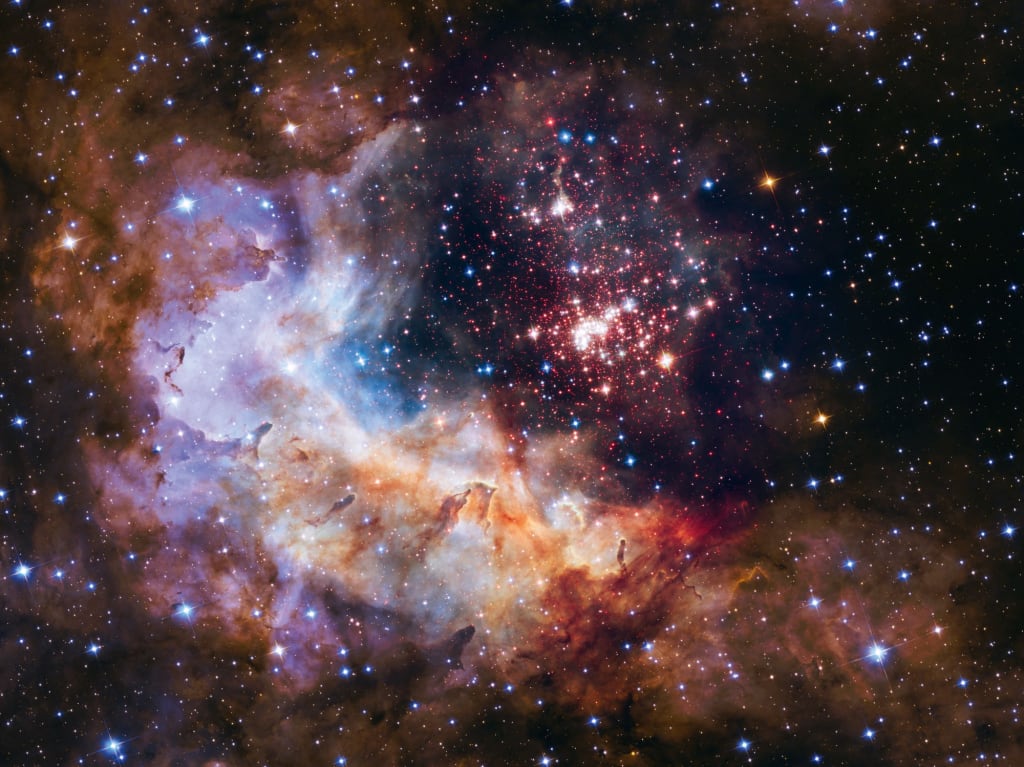
Our Universe is of an immense and inconceivable scale, marked by at least 70 sextillion stars, creating islands of light within the vast darkness. There are more stars in our Universe than there are grains of sand on every beach on Earth, a number so absurd it defies human understanding. Yet, in this universe filled with cosmic landmarks, there's an irony in the fact that concentrated matter is sparse and scattered.
If we were to shrink each star to the size of a grain of sand, the typical distance between them would be approximately six miles. To put this in perspective, it's akin to the distance from here at Columbia to downtown Manhattan in Greenwich Village, about four light years when converted to physical units. This enormous distance presents a considerable challenge for our modern spacecraft. For instance, Voyager 2, our most distant spacecraft, would take another 80,000 years to cover such a distance. And this is just to reach the nearest star; the nearest galaxy is half a million times farther away.
In the face of such vast distances and timescales, it appears that human astronauts exploring the depths of space is a dream the Universe may never allow. It's as if the Universe is teasing us with the allure of exploration, forever just out of reach.
During moments like these, we might be tempted to ponder exotic physics solutions like warp drives or wormholes. However, as far as our current knowledge goes, these concepts are theoretically implausible. But what if we used real, proven physics? In a recent video, we explored the "halo drive" as a potential means for interstellar travel, yet it's still not fast enough for reaching other galaxies. Surprisingly, there's a method using established physics that could allow a person to travel between distant galaxies within their lifetime. However, it comes at a steep price, a natural consequence of Einstein's special theory of relativity.
Let's imagine a spacecraft that can constantly accelerate at 1g for as long as we desire. In this scenario, its velocity increases by 10 meters per second for every second that passes. After just 10 seconds, it would be traveling at 100 meters per second, covering half a kilometer. For the purpose of this discussion, we'll temporarily set aside the practicalities of achieving this constant acceleration and assume it's possible, allowing us to stay focused.
With this constant acceleration, life on board would resemble life on Earth, creating artificial gravity that pushes the crew toward the rear of the ship, like how Earth's gravity keeps us grounded. The ship would start slowing but steadily gain momentum as it continues its voyage, akin to how compound interest accumulates over time. After just two and a half hours, it would have surpassed the Moon, and in one and a half days, it would reach Mars. After three weeks, it would have left the Solar System behind, traveling at around 6% the speed of light, far faster than any previous human-made spacecraft.
As it departs the Solar System and approaches Alpha Centauri, the nearby star system gradually brightens, while our own Sun becomes a mere speck of light in the rearview mirror. The journey would be uneventful for about a year, with regular updates from Earth reaching the crew after many months due to the time it takes for radio waves to travel. After 15 months, the crew celebrates crossing the first light-year, which means they've covered a quarter of the distance to Alpha Centauri but over a third of the time for the outbound journey. This discrepancy is due to the ship's constant acceleration, which affects the perception of time.
Another significant milestone arrives when the Lorentz factor, a measure of time dilation, passes a factor of two. This means that Earthbound observers would perceive the crew as moving in slow motion aboard the ship. As the ship continues to accelerate, time dilation and other relativistic effects intensify. Once the ship reaches 87% of the speed of light, Einstein's theory of special relativity plays a more pronounced role in the crew's experience. At this point, the ship is departing Earth at a significant fraction of the speed of light.
However, the crew's perception of acceleration changes. While they still feel a 1g acceleration, Earthbound observers would see the ship's acceleration as diminishing due to relativistic effects. From the crew's perspective, time runs normally, but outside the ship, unusual phenomena occur. The Sun appears to dim rapidly and emit mostly infrared light, while Alpha Centauri becomes brighter and emits high-energy ultraviolet light. Constellations ahead of the ship seem distorted.
The crew decides to decelerate the ship halfway to Alpha Centauri and, after completing the round trip, realizes that they have aged less than they expected. The ship's Lorentz factor has reached a level where the effects of time dilation are evident.
If the crew chooses to travel beyond the local cluster of galaxies, the Virgo cluster, they must rely on life extension technologies to survive the journey. As they travel farther and approach the edge of the Laniakea supercluster, which spans hundreds of millions of light-years, the Universe's expansion becomes a significant factor in their journey. By the time they return to Earth, after a 100,000 light-year round trip, the crew will have aged only seven years, while thousands of years will have passed on Earth.
However, their journey cannot extend beyond a certain point. The expansion of the Universe itself begins to interfere with their ability to travel to the edges of the observable Universe. The accelerating expansion of the Universe, driven by dark energy, sets limits on how far they can go. In essence, there are horizons that constrain their interactions with the Universe, such as the "particle horizon" and the "event horizon."
As the crew crosses the event horizon, they enter a point of no return. It becomes impossible to return home as the expansion of the Universe outpaces their ability to travel. They're isolated in the void, separated from everything they've ever known. Eventually, the Universe expands so much that they are the only particles remaining, with no other matter in sight.
The concept of time dilation loses its meaning beyond this point. The crew's journey ends in complete isolation and a void of nothingness. They become a monument to a bygone Universe, a reminder of a time when stars sparkled, and life flourished.
The Universe is in its prime, and we live in a time of abundance, but it will eventually come to an end. Let us make the most of the time we have and use it wisely, for it is a unique and precious moment in the Universe's history.
About the Creator
Enjoyed the story? Support the Creator.
Subscribe for free to receive all their stories in your feed.
Comments
There are no comments for this story
Be the first to respond and start the conversation.