Climate
What If We Dumped Our Trash into Volcanoes?
Volcanoes, despite their formidable nature, have garnered interest as potential solutions for waste disposal due to their intense heat and destructive power. However, the feasibility of utilizing volcanoes for this purpose is riddled with challenges and potential risks.
By Muhammad Faraz Butt3 years ago in Earth
What will happen if Earth were Sucked Into a Black Hole?
Once upon a time, a question hung in the minds of entities, biding their time with acurious souls: Could a sinister black hole one day engulf our world? There, in the vast expanse of the universe, lay millions of these enigmaticn eerie patience. The mere contemplation of accidentally creating one sent shivers down spines; if such a mishap were to occur, it was as if the world itself would need to buckle up, preparing for a tumultuous ride into the unknown.
By Mehdi Lamh3 years ago in Earth
The Mysteries
In the heart of a secluded valley shrouded in mist, a forgotten village named Eldridge stood frozen in time. Its cobblestone streets were lined with quaint cottages, their timeworn facades bearing witness to centuries of history. Yet, it was not the village itself that held the allure of mystery, but rather the legend of the Whispering Grove that loomed on its outskirts.
By Jet The goat3 years ago in Earth
The Plastic Paradox
The sun was setting over the city skyline, casting a warm orange glow across the bustling streets below. I stood on my apartment balcony, a cup of steaming coffee in hand, taking in the familiar sights and sounds of urban life. The convenience of this world has always been a comfort to me—everything at my fingertips, just a click away. But little did I know, behind the façade of this modern paradise, a troubling reality was lurking.
By Akbar Ergashev3 years ago in Earth
OUT OF MANKIND (part 2)
As the years went by, the unity that Elara had helped to inspire continued to strengthen across the interstellar colonies. The lessons learned from the stories she had collected became integral to the education systems, cultural exchanges, and diplomatic negotiations between worlds. People began to see themselves not only as citizens of their individual colonies, but as part of a greater interstellar community.
By emmanuel charles3 years ago in Earth
Out of Mankind
In the distant future, a time when the Earth had long been abandoned, humanity's legacy remained embedded in the cosmos. After centuries of technological advancements, mankind had achieved the ultimate dream of space colonization. New worlds were discovered, and colonies thrived on distant planets and moons. The accomplishments of human civilization were awe-inspiring, but the journey was not without challenges.
By emmanuel charles3 years ago in Earth
Rising Beyond: Embracing the Depths of Loss and the Pinnacles of Triumph in the Global Crisis
In the annals of history, 2020 mark a stark reminder of the indomitable human spirit and the unforgiving forces of nature. As the world grappled with an unprecedented crisis, the silent enemy known as COVID-19 emerged, leaving aftermath a trail of death, despair, and devastation. However, amidst the gloom, stories of resilience, unity, and triumph also became apparent, painting a portrait of humanity's unyielding will to overcome even the darkest of adversities.
By Josiah Oluwole3 years ago in Earth
What happens if oxygen disappears from earth surface for six seconds?
Can you take a moment to consider what would happen if we just woke up one day and the earth's supply of oxygen ran out . Okay, that sounds a bit harsh. How about we say it disappears for around just 6 seconds? You probably respond, "We could just hold our breath until it passes." Well maybe the longest we can hold our breath is 30 seconds, so perhaps you can)
By Maryam Baura3 years ago in Earth
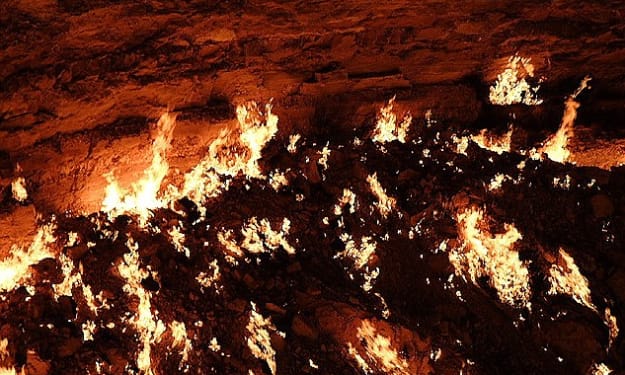
The Real “DOOR TO HELL”: GIANT Hole in Desert Has Been on Fire For Over 40 YEARS
Greetings, my name is Austine Ochieng and I am pleased to inform you that it is nearly the month of October, which happens to be my favorite month of the year. This is due to the fact that fall is my preferred season, as it is neither too hot nor too cold. Additionally, this time of year marks the beginning of the holiday season, starting with one of my favorite holidays, Halloween. During this time, I am working on a few videos for my channel, and while doing so, I stumbled upon a fascinating location that resembles the gates of hell. Before delving into this topic, I would like to take a moment to acknowledge our sponsor for today's video, Audible. More information on this will be provided at the end of the video. Now, let us return to the matter at hand. What if hell existed on earth, and what if it was our fault? This may seem like a dramatic statement, but there is a real place that many believe is worthy of the devil himself. This place is known as the Darwaza gas crater, a nightmarish inferno inadvertently created by human interference. It is located in the Karakum desert in Central Asia and has earned the nickname of the Gateway to Hell. If you are a Star Wars fan, you may compare it to the notorious Sarlacc pit, albeit without the hot breath. Furthermore, you need not worry about being slowly digested, as you would likely burn up in a matter of seconds. However, the crucial question is why this place exists in the first place, and how did the crater come to be? Well, it was all the fault of geologists who arrived from the Soviet Union in 1971. They were attempting to drill for oil but instead caused a massive fire. They realized something was wrong when the ground beneath them began to cave in, but it was too late. They had set up operations in an unstable area containing an underground pocket of natural gas, such as methane. The ground was unable to support the weight of the equipment, and after a terrifying experience, the Darwaza crater was born. It measures 230 feet wide and 65 feet deep, although some claim it is closer to 100 feet. The flames reach a scorching temperature of a thousand degrees Celsius. With so much gas escaping, there was no way to keep going. The geologists had an idea to set fire to the methane, which, as risky as it sounds, is the most effective method of ensuring natural gas does not escape into the air. Shockingly, it only takes five percent of methane to be present in the air before a reaction occurs, resulting in an explosion. There are further dangers in the effect that the gas has on oxygen. Natural gas pushes oxygen away, and as a result of the geologists' mistake, local wildlife was being killed off. The crater was set on fire, and spiders, lots of spiders, were attracted by the flame. They showed up from all directions and started to jump into the pit of fire. While this is probably a natural phenomenon, it is still quite unsettling. The Soviet team hoped that by lighting the crater, the problem would be solved, and it certainly took care of the gas. However, there was one serious problem: there was so much gas that the crater is still on fire today, 50 years later. It is challenging to know what to do with this unusual location. A recommendation was made to fill it in a few years back, but so far, this has not come to fruition. In the meantime, tourists show up to the crater to check it out, although it is not without its dangers. Back in 2015, a scientist named George RunAs was lowered into the depths of the crater to collect soil samples. He was attached to a robot and wore a protective suit. While this may seem insane, there was a serious purpose behind the descent. By studying soil in these extreme situations, scientists hope to gain insight into whether life can exist under flesh-meltingly hot conditions. In conclusion, while the Darwaza gas crater may be a fascinating location, it is also a reminder of the dangers of human interference. It is a place that I would never want to visit, but it is still a natural wonder, albeit one that was accidentally created by us. .
By Austine Ochieng 3 years ago in Earth
Could Chat GPT Talk to Whales?
This is the resonance emanating from the largest-toothed apex predator existing on our planet, a melodic broadcast emerging from the unfathomable depths of the sea – a call that diverges from harmonious melodies characterizing other whales' vocalizations, manifesting more akin to digital data transmissions. This auditory phenomenon has reverberated through the annals of nautical history, echoing through the centuries, ensnaring sailors' imaginations with its eerie wails, erroneously believed to be the lamentations of drowned mariners' spirits. Astonishingly, it wasn't until 1957 that the scientific community realized these sounds originated from cetaceans, and it took until the 1970s to comprehend the complex nature of these undulating clicks and bellowing utterances as a form of communication.
By Nida Rafiq3 years ago in Earth