
What will happen if Earth were Sucked Into a Black Hole?
The Unrealistic Power of a Black Hole
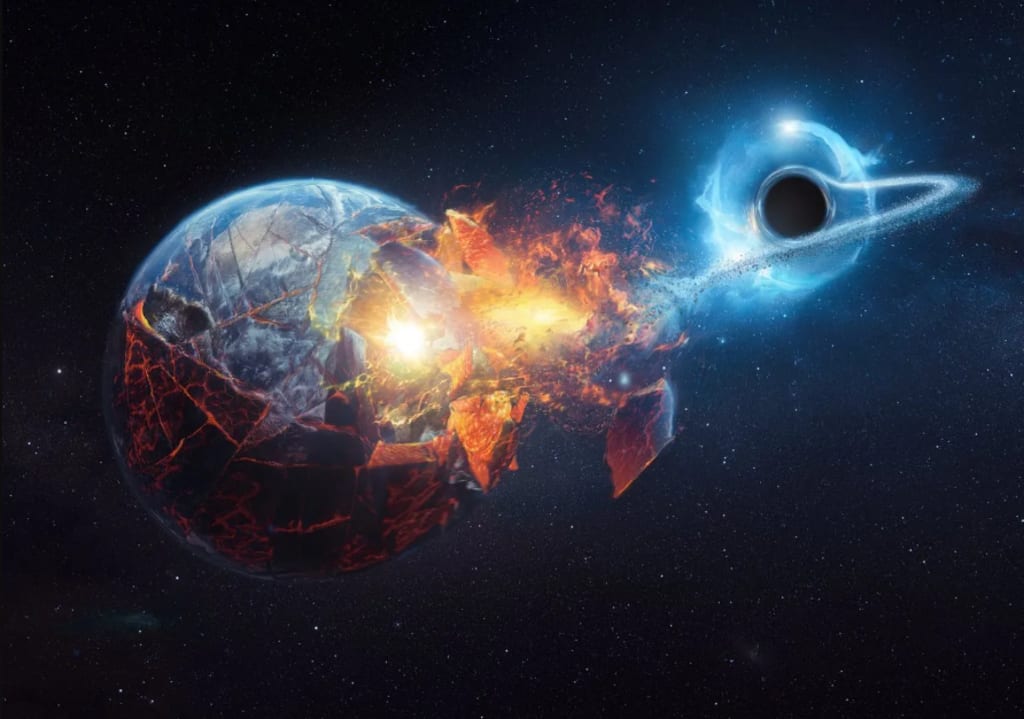
Once upon a time, a question hung in the minds of entities, biding their time with acurious souls: Could a sinister black hole one day engulf our world? There, in the vast expanse of the universe, lay millions of these enigmaticn eerie patience. The mere contemplation of accidentally creating one sent shivers down spines; if such a mishap were to occur, it was as if the world itself would need to buckle up, preparing for a tumultuous ride into the unknown.
Imaginations ran wild with inquiries. What if we found ourselves ensnared by the gravitational clutches of a black hole? Could our dear Earth, the anchor of our existence, twirl in orbit around both the sun and a voracious cosmic chasm? The concept was enthralling, even if the outcome seemed dire. Could we endure the bizarre process of "spaghettification," an evocative term that evoked images of noodles and cheese but, in reality, described a nightmarish stretching of matter?
Amid these contemplations, the stage was set for a tale woven from the fabric of speculative science. The scene shifted to the proximity of Earth, where, at a distance of 3,000 light years, a black hole made its haunting presence known. Visible to the naked eye, it served as a distant reminder of cosmic wonders and dangers. Yet, relief washed over humanity, knowing that this stellar abyss was sufficiently remote to spare us its clutches. Countless others, remnants of supernovae, speckled the galactic canvas, each harboring its own ominous aura.
Among them, stellar black holes held a certain familiarity, measuring a mere 16 kilometers in diameter. But in the cosmic hierarchy, they paled in comparison to their grandiose counterparts: supermassive black holes. These cosmic behemoths boasted diameters comparable to our solar system and masses that dwarfed a million suns combined. Sagittarius A, one such leviathan, reigned in the galactic heart, a sentinel of the unseen.
Yet, the central question persisted: How close must a black hole be to jeopardize our existence? The answer lay within the smallest of scales—a black hole no larger than a millimeter's pinprick could spell our demise if it dared to venture too near. The unfathomable density and relentless gravitational force of such a minuscule yet monstrous entity could spell catastrophe. Survival hinged upon our dance with the event horizon, that boundary beyond which even light trembled at the thought of escape.
Should Earth inch perilously close to a black hole's abyssal grasp, a tragic ballet would commence. The side facing this cosmic maw would stretch toward it, while the atmosphere, like an ephemeral wisp, would succumb to its inexorable pull. Earth would buckle under this cosmic assault, and great swathes of its land would tear asunder, mirroring the chaos within.
As the relentless gravitational tide carried Earth into the deadly waltz, tidal forces would heat the planet's core to catastrophic levels. The very foundation beneath our feet would quake, volcanoes would erupt in apocalyptic fervor, and tsunamis would roar with an unforgiving fury—an unholy trinity of devastation.
And then, the climax of this cosmic drama: Earth's gradual, agonizing stretch. Spaghettification, a term at once whimsical and horrifying, would distort the planet beyond recognition. In an alternate universe, perhaps a hero would arise to confront this abyss, but their valiant stand would be in vain. Arms and feet would be cruelly disjointed by the black hole's relentless grasp, a tormenting spectacle of compression and elongation.
For smaller black holes, the dreaded fate of spaghettification might manifest hundreds of kilometers from the event horizon. Yet, in the realm of supermassive monstrosities, physicists foretold a more sinister tale. Here, this grotesque transformation would unfold within the heart of the event horizon, the point of no return. Across the cosmic tapestry, all matter—people, planets, stars—would succumb to this unraveling into individual atoms.
Desperation reigned as humanity confronted its doom. The delicate equilibrium binding our solar system would fracture, sending celestial bodies crashing together. An asteroid belt, once a silent sentinel of the cosmos, would surge towards us, its impact an exclamation mark upon our inevitable demise. Among these celestial assassins were colossal asteroids, each capable of delivering a death blow.
As a grim finale, all matter from our solar system would spiral into the insatiable maw of the black hole. Radiation, born of this cosmic consumption, would bathe the surrounding void in its deadly glow. Even if we weathered the assault of asteroids, this radiation would seal our fate.
Curiously, in the far reaches of astronomy's domain, circumbinary planets danced around twin stars. Could Earth and a black hole share such a cosmic ballet? Alas, these titanic forces would render our home uninhabitable, expelling us from orbit or sending us to fiery deaths within the sun's embrace.
Yet, amid despair, a glimmer of hope—perhaps the most fragile of possibilities—dwelled within fortified space shuttles. Could these vessels safeguard us from the black hole's grasp? If, against all odds, we hurdled the event horizon, the fabric of reality might warp, rewriting laws of physics, gravity, and atomic behavior.
Despite the maelstrom of conjecture, one fact remained immutable: black holes yielded no answers. They were cosmic enigmas, stubbornly guarding their secrets, casting doubt upon our perceptions and comprehension. Were they gateways to other dimensions, harboring parallel universes? Could we be trapped within a black hole, our reality an illusion woven by its gravitational grip? As speculation soared, the story of black holes remained a puzzle for another time.
About the Creator
Enjoyed the story? Support the Creator.
Subscribe for free to receive all their stories in your feed.
Comments
There are no comments for this story
Be the first to respond and start the conversation.