
The Scam Script Hasn't Changed. The Money Route Has.
Why “never transfer money to a stranger” is no longer enough, and the three checks that still stop the loss.
The scripts used in telecom and online fraud have barely changed. At its June press conference, the Ministry of Public Security said ten scam types account for 85% of cases: brushing-for-rebate, fake shopping and services, fake investment and wealth management, fake e-commerce and logistics customer service, loan and credit-reporting, fake game trading, romance and dating, impersonating police, prosecutors, and courts, impersonating superiors and acquaintances, and flight refund and change scams. Most “new scam” warnings on your phone break down into one of these ten.
The money route changed. Operation Card-Breaking restricted suspicious transfers, cracked down on buying, selling, and renting bank cards, and let police stop payments and freeze accounts mid-route. Scammers found link-and-transfer too narrow, so they now push victims to withdraw cash, buy gold, buy large gift cards, and buy luxury watches.
Cash and goods leave the bank account, the electronic trail, and the reach of an emergency freeze.
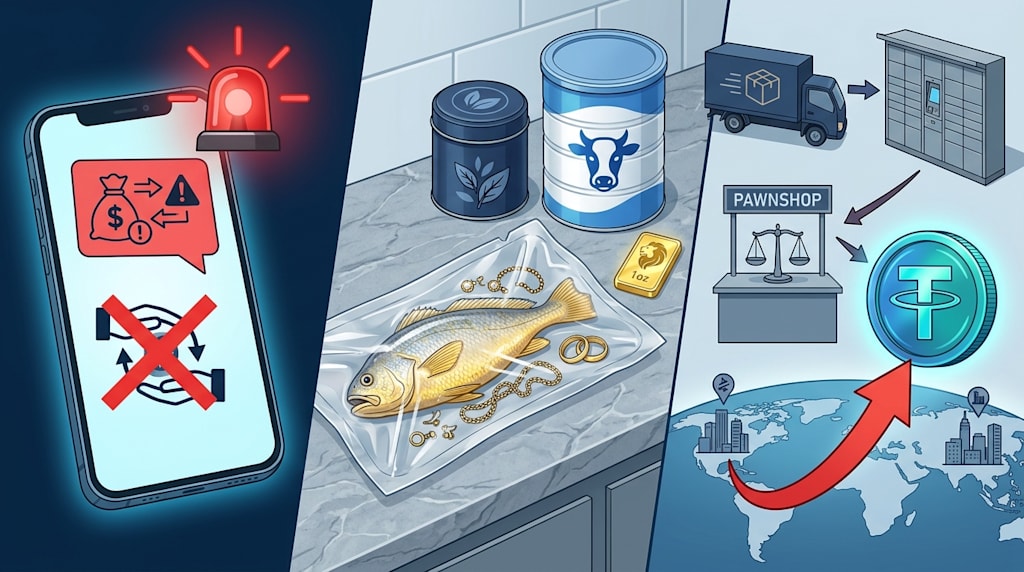
In August, Shanghai police stopped a victim who had hidden gold jewelry inside a vacuum-packed yellow croaker and was about to mail it. From outside, it looked like seafood. If it had reached a delivery truck, recovery would have become much harder.
Typical route: fraud money → gold and other goods → goods sold cheap → cash → virtual currency → overseas funds. Sometimes the goods are carried across the border and cashed out at an overseas gold shop or pawnshop, skipping virtual currency entirely. The money leaves with no records, and tracing stops.
Scammers give everyday reasons for cash, gold, and watches: “cash avoids tax,” “physical verification is safer,” “gift card top-ups come with discounts.” Victims hide cash in tea tins, milk powder cans, and clothing linings. They stuff gold bars into snack boxes and mail them to addresses. Online, the gang sends orders through overseas chat apps and hires runners to pick up goods, or has victims mail items to parcel lockers in other cities. Runners never meet victims. Buyers never meet runners. The gang never meets runners. An arrest cuts one segment; the chain does not connect.
Secondhand watch shops, consignment shops, pawnshops, and luxury buyback centers buy low, resell, and cash out. The cash goes to “water rooms” for layered transfers, converts to USDT at the live rate, lands in a wallet in minutes, and is withdrawn overseas. Cash and goods leave no electronic record. Secondhand luxury goods are hard to trace. Virtual currency moves fast and anonymously. Encrypted voice chats can burn after reading. Every link avoids a paper trail.
Recovery is hard because each link does one small job and stops. The runner does not know the upstream handler. The buyer does not know where the goods came from. The water room moves money and does not ask. Investigators cannot pull chat logs, check logistics real names, or trace secondhand sales. By the time they find a wallet address, the money is overseas.
So prevention beats pursuit.
You do not need to understand virtual currency or money laundering to spot the scam. Remember three checks.
Any investment, wealth-management, or online part-time brushing job that promises “inside information” or “high returns” is a scam. The first two small rebates may be real. The gold bars you are told to buy after that are gone.
Any stranger who asks you to mail gold or cash, or pushes you to buy gift cards or luxury goods to move money, is running a scam. “Tax avoidance,” “asset verification,” “safe account,” “physical top-up,” “courier inspection”: if the final step is handing over or mailing cash, gold, or gift cards, stop. The gold in that yellow croaker was the “verification funds” the victim almost mailed.
Before a large cash withdrawal or a precious-item purchase, talk to family or call 110. A teller asking “What is this cash for?” a courier asking “What is in this box?” a family member asking “Why gold bars?” can break the scam. Many victims later say they felt something was off, but the caller kept rushing them: withdraw, buy, mail. They had no time to think.
The scam scripts did not change. The money route did. “Do not transfer money to strangers” no longer covers the play. A stranger who tells you to withdraw cash, buy gold, buy gift cards, or mail valuables is also stealing from you.
Prevention is cheaper and more effective than recovery. Once the gold is inside the fish and on the truck, stopping it gets much harder.
About the Creator
Jin
Writer of reamstories
https://reamstories.com/jin
Enjoyed the story? Support the Creator.
Subscribe for free to receive all their stories in your feed. You could also become a paid subscriber, letting them know you appreciate their work.
Comments
There are no comments for this story
Be the first to respond and start the conversation.