
The Confession Booth Some Secrets Are Too Dangerous to Keep — And Too Deadly to Share
The priest hadn't slept in six days. Every morning, Father Daniel Marsh unlocked the heavy oak doors of St. Augustine's Cathedral, lit the candles, and waited.
M Mehran
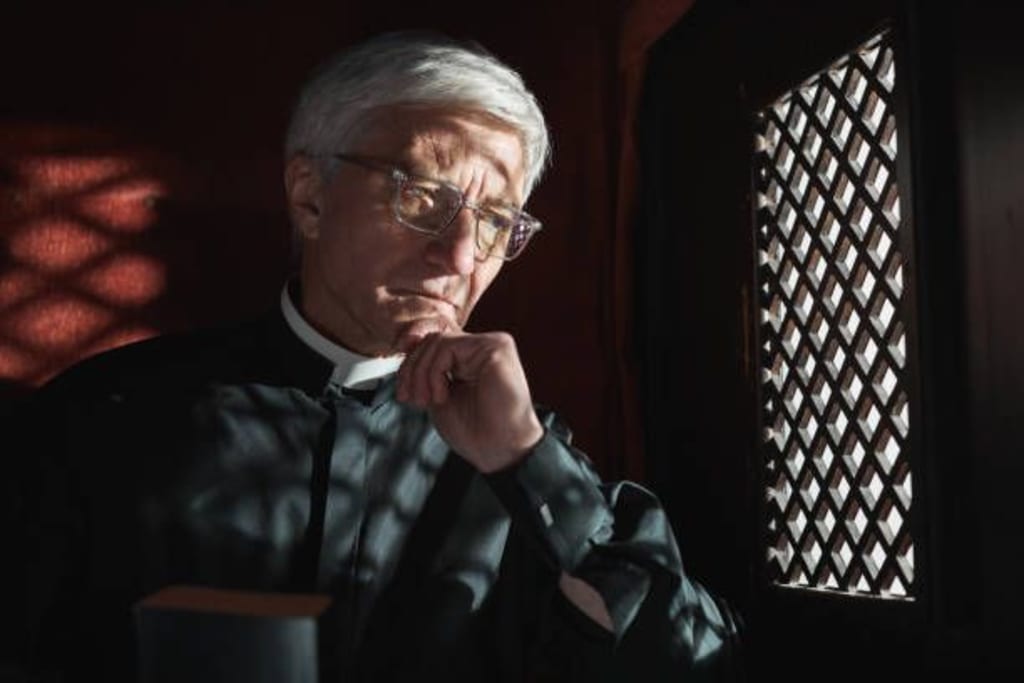
The priest hadn't slept in six days. Every morning, Father Daniel Marsh unlocked the heavy oak doors of St. Augustine's Cathedral, lit the candles, and waited. Every evening, he locked those same doors, blew out the flames, and carried a weight that was slowly crushing him from the inside. Six days ago, someone had walked into his confession booth. And destroyed his entire world in four minutes. The Voice Behind the Screen It was a Tuesday afternoon when it happened. The cathedral was empty except for an elderly woman praying quietly in the third pew. Rain tapped gently against the stained glass windows, painting the marble floor in broken colors of red and gold. Father Daniel was half-asleep in the booth when the door clicked open on the other side of the partition. He straightened. Composed himself. This was sacred work. "Bless me, Father," the voice whispered. "For I have sinned." The voice was low, measured, almost mechanical — like someone who had rehearsed these words a thousand times but felt nothing saying them. "How long since your last confession?" Daniel asked. "Never," the voice replied. "I don't believe in God. But I believe in consequences. And I need someone who legally cannot repeat what I'm about to say." Daniel's hands tightened in his lap. The seal of confession. Absolute. Unconditional. Legally and spiritually unbreakable. Whatever this stranger said next, Daniel would be forced to carry it alone forever. "Then speak," Daniel whispered. "This is a safe place." The worst mistake he ever made. What the Criminal Confessed Over the next four minutes, the voice described three murders. Not with remorse. Not with guilt. With the calm, precise detail of someone filing a report. Names. Locations. Methods. Dates. Daniel recognized two of the names immediately — they had been all over the news. A businessman found in the river. A judge discovered in her locked office with no sign of forced entry. Both ruled accidents. Both, according to the voice behind the screen, were anything but. "Why are you telling me this?" Daniel finally managed. "Because the fourth person on my list," the voice said slowly, "is you." The elderly woman in the third pew shifted in her seat. Somewhere outside, a car horn sounded, distant and ordinary — a reminder that the normal world still existed just beyond these walls. Daniel couldn't feel it anymore. "Me," he repeated. "Why me?" "Because ten years ago, Father, you testified in a court case. Your testimony sent an innocent man to prison. That man was my brother. He died there, three years into his sentence, in circumstances the prison called a suicide." Silence swallowed the booth whole. "I've been working my way toward you," the voice continued. "The businessman funded the prosecution. The judge oversaw the trial. You provided the moral credibility that convinced the jury. You were all responsible." "I told the truth," Daniel whispered desperately. "I told exactly what I witnessed—" "You told your truth. And my brother paid with his life for the gap between your truth and the actual truth." Another pause. Then: "I came here to tell you that you have one week. Use it however you choose. Make peace with your God. Put your affairs in order. Or—" the voice shifted almost imperceptibly — "find a way to make this right." The booth door clicked open. Then closed. And Father Daniel Marsh sat completely still for forty-five minutes, unable to move, unable to breathe, unable to pray. The Impossible Prison He couldn't call the police. That was the diabolical genius of it — and Daniel recognized immediately that it was genius, calculated and cruel. The seal of confession was absolute. Canon law. Centuries of sacred tradition. A priest who violated it faced automatic excommunication. Beyond the spiritual consequences, Daniel personally believed in the seal with his entire soul. It existed to protect the vulnerable, to create a space where truth could exist without weaponization. But the criminal had weaponized the protection itself. He had turned the most sacred privacy in Daniel's world into a cage. Daniel began researching the case privately. Pulled old newspaper archives on his phone at 2 AM in the empty cathedral. Found the trial — State versus Marcus Webb, convicted of financial fraud and manslaughter, 2016. And then he found something that made his stomach collapse entirely. A witness statement, buried in a footnote of the appeal that had been rejected without proper review. A statement that directly contradicted the timeline Daniel had provided. A statement that nobody — not the defense attorney, not the judge, not the jury — had apparently ever properly examined. His testimony hadn't been a lie. But it had been wrong. The Detective Who Noticed Detective Sandra Okafor had been watching Father Daniel Marsh for four days. Not because he was a suspect. Because he was terrified, and terrified people in connection with two open murder cases made her professionally curious. She had been working the businessman and the judge cases for three weeks. Both ruled accidents by the initial teams. Sandra didn't believe in coincidence, and she especially didn't believe in two people connected to the same 2016 trial dying accidentally in the same month. She requested permission to surveil Daniel discreetly. Her captain told her she was overworked and needed vacation. She did it anyway, on her own time, in her own car, drinking terrible gas station coffee at midnight outside St. Augustine's Cathedral. On the fifth night, she saw him. A figure in a grey jacket, hood up, who walked into the cathedral at 11 PM and emerged seventeen minutes later. She ran the partial plate she managed to capture. The car was registered to a woman who had died four years ago. Professional. Calculated. Someone who planned everything three steps ahead. Sandra felt the particular chill she had learned to trust over twelve years of detective work. This was not ordinary crime. This was a mission. The Choice That Changed Everything On the sixth morning, Daniel made his decision. He couldn't break the seal. But nobody had ever said he couldn't act on his own guilt. He contacted the Innocence Project anonymously, directing them toward Marcus Webb's case with enough specific detail to trigger a formal review. He contacted the state attorney's office confessing that he had recently discovered a potential error in his 2016 testimony and was prepared to make a formal statement. He wrote letters. Made calls. Burned every professional relationship he had spent twenty years building. And then he sat in the front pew of his cathedral and waited. If the criminal was watching — and Daniel was certain he was — he would see a man destroying himself publicly to correct a private wrong. Whether that would be enough, Daniel had absolutely no idea. At 9 PM, an envelope appeared under the cathedral's side door. Inside was a single playing card. No — not a playing card. A photograph. Marcus Webb. Young, smiling, alive. And on the back, four words in sharp handwriting: "He would forgive you." Nothing else. No threat. No signature. Sandra Okafor, watching from her car across the street, photographed the figure who delivered it. This time, she got the full plate. What This Story Is Really About True crime fascinates us because it lives at the intersection of the two things we most want to understand — human darkness and human redemption. Every criminal has a story that began somewhere ordinary. Every crime has a wound buried somewhere underneath it, screaming for acknowledgment in the only language desperation knows. This doesn't excuse destruction. But it explains why justice that only punishes, without ever examining the original fracture, tends to simply manufacture the next criminal in an endless, bloody cycle. Father Daniel Marsh spent the next two years working to exonerate Marcus Webb posthumously. He succeeded. The criminal was eventually found — not through dramatic confrontation, but through the quiet, patient work of Detective Sandra Okafor, who didn't stop pulling threads simply because nobody told her she could. He didn't match any profile the department had constructed. He was a high school mathematics teacher. And when they arrested him, he was grading papers.
About the Creator
Enjoyed the story? Support the Creator.
Subscribe for free to receive all their stories in your feed.
Comments
There are no comments for this story
Be the first to respond and start the conversation.