
Jake Bird Killed Two Women with an Axe
Then He Confessed to 44 More Murders

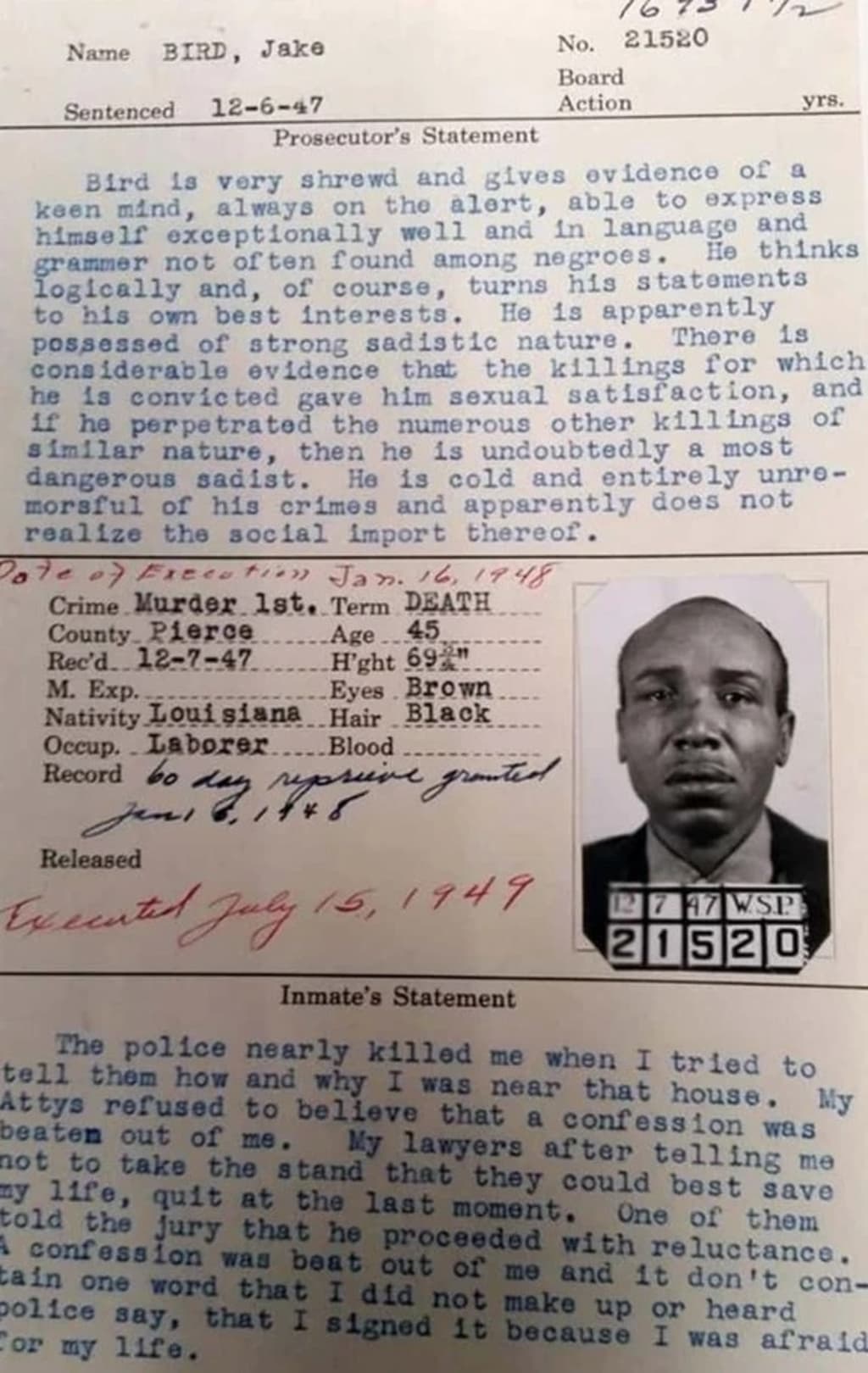
A botched burglary in Tacoma’s Hilltop district unraveled into one of the largest serial murder confessions in American history.
Before dawn on October 30, 1947, the city dispatched two Tacoma police officers to a house on South 21st Street. Multiple callers reported screaming, which broke the silence of the cold, dark Pacific Northwest night.
As the officers approached, a man burst out of the back door of a home, crashed through a picket fence, and fled the scene. After a brief chase, the officers cornered the agitated man. They found themselves on the wrong side of the man’s knife, and a struggle followed. Within minutes, the officers handcuffed the man and brought him to the Tacoma City Hall, which housed a small jail in the basement.
Inside the house, detectives found a bloody scene. Bertha Kludt, aged fifty-two, and her seventeen-year-old daughter Beverly were dead on the kitchen floor. The man hacked both women to death with an axe. Then he left the murder weapon leaning up against the wall near the door.
The man they caught was Jake Bird. The forty-five-year-old transient had a long record of burglary, assault, and attempted murder. He worked his way across the country as a laborer and railroad hand.
By the time the sun came up, he’d already started talking. At the jail, Detective Lieutenant Sherman Lyons took Bird’s confession in front of four other officers. Bird said he’d slipped in through an unlocked back door. He was looking for an easy burglary, carrying an axe he grabbed from a nearby shed. He explained the axe was meant to scare the homeowner. He took off his shoes and crept quietly into the home. He found a dollar and fifty cents in Bertha’s purse and was in the kitchen when she came up behind him. He told her he only wanted the money and his shoes back. Then, according to Bird, Bertha grabbed him from behind, and a struggle broke out. In the end, both women died.
Detectives found the story hard to believe. Evidence at the scene suggested Bird attempted to assault Bertha before he killed her. It would also show he killed Beverly when she attempted to rescue her mother. Their violent deaths and the brain matter on his shoes didn’t match the account of a panicked burglar Bird was offering.
The court charged Bird the following day, October 31, Halloween, with first-degree murder. At first, they charged him with only Bertha’s death. By the time his trial opened weeks later, that charge became two counts of murder.
The trial lasted three days. On November 26, 1947, a Pierce County jury convicted Bird on two counts of first-degree murder. They deliberated for just thirty-five minutes and recommended the death penalty. At trial, Bird tried to recant the confession he’d signed in jail. He said the police beat him until he confessed. His own attorney argued the same. The jury didn’t buy it.
On December 6, 1947, Judge Edward Hodge made it official: death by hanging. By then, the judge had already turned down Bird’s request for a new trial. When Hodge asked if he had anything to say before he passed the sentence, Bird stood up and spoke for twenty minutes. Before he returned to his seat, he said something that the people in that courtroom could spend the rest of their lives thinking about.
Officials scheduled Bird to hang on January 16, 1948, barely five weeks later. He didn’t. He won a reprieve, and the reason demonstrates the scale of information about to be presented. In early January, with the execution date still looming, Pierce County’s prosecutor and the same detective who’d taken his original confession made the trip to the penitentiary to sit with Bird and listen to his confessions. He had more to say. A lot more.
Over the months that followed, on death row, waiting on an execution date that kept moving, Jake Bird confessed to involvement in as many as forty-four murders across eleven states, stretching back into the 1920s. Detectives dismissed some cases outright, and they solved a fraction of cold cases based on evidence provided by Bird. At least one case overlapped another man’s confession.
That man was Clarence Lukehart, who sat imprisoned, two thousand miles away in Iowa.
In 1928, an eight-year-old boy named Harvey Boyd went missing near Crater Lake. Police located his body five weeks later. Lukehart, already serving time on an unrelated conviction, became the prime suspect, and after hours of interrogation, confessed. The court tried Lukehart for the murder. His defense argued he had the mental capacity of a child and acted without control over himself. The judge sentenced him to life in prison. Even though he confessed, he maintained his innocence the entire time.
By 1948, Jake Bird, a man with no known connection to Lukehart, to Crater Lake, or to Iowa, confessed to Harvy Boyd’s murder. He had details that only the killer would know. By this point, Lukehart had been in prison for nearly twenty years for a crime he didn't commit.
Whether that confession ever changed anything for Lukehart isn’t entirely clear from the records. What is clear is that questions remain. How many of Bird’s confessions were real? Did a man with nothing left to lose embellish stories to claim notoriety? And how many men like Lukehart served time for crimes that belonged to someone else entirely.
Bird hung at the Washington State Penitentiary in Walla Walla at 12:20 a.m. on July 15, 1949. It was two years after he crashed through that picket fence on that night. History remembers him as one of the most prolific serial killers the country has ever produced. Even the number of his victims remains unsolved. The amount lands somewhere between two women in that Tacoma kitchen, and forty-some confessions no one ever finished checking.
Remember the promise he made back in the courtroom in December of 1947, the one that had everyone thinking twice? He kept it. When the judge and jury convicted him, Bird didn’t stop killing. At least not according to what happened to several of the men who put him there. The hex part of the story has its own name in Tacoma, and its own body count, which varies from historian to historian.
About the Creator
Teresa Nordheim Liu
Teresa Nordheim-Liu is the author of seven traditionally published books of narrative nonfiction spanning true crime, history, paranormal, and urban exploration. For additional information you can visit http://www.teresanordheim.com
Enjoyed the story? Support the Creator.
Subscribe for free to receive all their stories in your feed.
Comments
There are no comments for this story
Be the first to respond and start the conversation.