
He Was Forced to Take Out a Loan in Myanmar. Does He Have to Pay It Back?
The law says no. Your credit report and a debt collector may say otherwise.
I
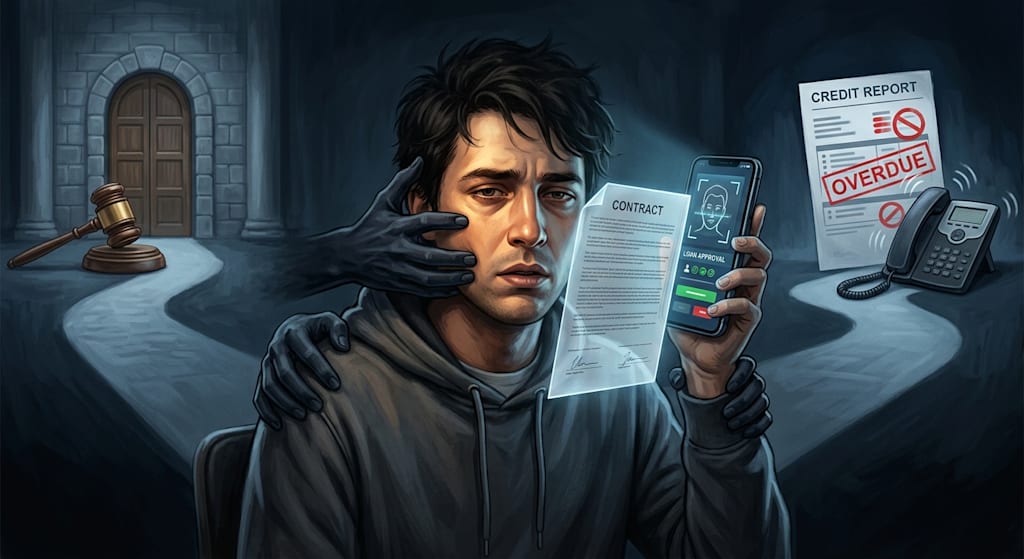
On that afternoon in the Myanmar compound, someone took Wang Xing’s phone. A hand pressed his shoulder. Another hand turned his face toward the screen. Facial recognition passed. The loan application went through. The money arrived and left before he could see the balance.
The whole thing took less than ten minutes.
In interviews, he told the story without tears or anger. He sounded like he was describing someone else’s day. One line he repeated twice: “I never touched that money.”
That line carries legal weight. It can strip a loan contract of its foundation.
II
Article 150 of China’s Civil Code says a person who is coerced by another party or a third party into a civil act against their true intention can ask a court or arbitration body to rescind it.
Two words matter here. The first is “third party.” The gang in the compound was not the lender. The law does not care who applied the pressure. If the contract was signed under coercion, the victim can ask to cancel it. The second word is “intention.” A contract needs voluntary consent. When someone controls your body, takes your phone, and forces your face through a loan app, the consent is fake. The gang used Wang Xing’s face to pass an identity check. The decision was theirs, not his.
Reports say all the loan money went to offshore shell accounts. Wang Xing never used it. He got nothing from it. If a court cancels the contract, the contract has no legal force from the start. Wang Xing should not owe principal or interest. The lender should chase the gang that took the money, not the man they coerced.
That is what the law says.
But the law does not act on its own. Wang Xing has to ask for the cancellation.
III
The right to cancel does not last forever. Under Article 152 of the Civil Code, a victim of coercion must exercise that right within one year after the coercion ends. After that, the right disappears.
Wang Xing would have to file a civil lawsuit within a year of leaving the compound. He had just returned from northern Myanmar. He was traumatized. He faced complex procedures, high costs, and a proof problem that is almost impossible to solve.
Civil lawsuits follow a simple rule: the person who makes a claim must prove it. To cancel the contract, Wang Xing would have to prove he was coerced when he signed the loan. Under Article 109 of the Supreme People’s Court interpretation on civil procedure, proof of coercion must reach “beyond reasonable doubt.” That is stricter than the “high probability” standard used in most civil cases.
“Beyond reasonable doubt” is a criminal standard. In a civil case, it means the judge must be certain Wang Xing was coerced, with no room for doubt.
Wang Xing could not have saved evidence. He was inside a scam compound. His freedom was gone. His phone was gone. The people around him were the criminals. He could not record audio or video. He could not find a neutral witness. He could not call the police and get a receipt. His later statement alone does not prove much.
The lender, by contrast, has a full paper trail. The identity information belongs to Wang Xing. The facial recognition passed. The loan system completed the application automatically. The disbursement records are clear. The lender can argue the contract is valid and the facial scan proves consent. If Wang Xing says he was coerced, the lender can say it knew nothing and ask why he cooperated with the facial scan.
In that fight, Wang Xing would likely lose. He would fail to prove his case. He would still owe the money. He might also pay court costs and face a lawsuit for overdue payments, damage to his credit, and enforcement.
IV
Wang Xing has another route. He does not have to prove coercion himself. He can let a criminal judgment prove it for him.
When a case has both criminal and civil elements, facts established in a valid criminal judgment carry weight in later civil litigation. Under relevant judicial interpretations, facts already established by a valid criminal judgment do not need to be proved again in a related civil case, unless there is contrary evidence strong enough to overturn them.
If the gang in northern Myanmar goes to trial, and the judgment states that Wang Xing was coerced, that his freedom was controlled, and that his phone was used to take out loans, then that judgment becomes evidence. Wang Xing can use it to ask a civil court to cancel the loan contract. He would not need to prove “I was coerced.” The criminal judgment would already say so.
The documentary Chronicle of the Fall of Northern Myanmar Telecom Fraud, produced by the Ministry of Public Security and China Media Group, says the Shanghai procuratorate has charged 17 members of the gang. The main suspect, who allegedly recruited people with fake casting notices, has been arrested. That makes a future criminal judgment possible.
But criminal proceedings take time. No one knows when the judgment will take effect or which facts it will establish. Wang Xing cannot wait forever. Debt collectors and credit bureaus move faster than courts.
V
Wang Xing chose to repay the loan in installments.
Legally, he should not have to. In reality, two things arrived before the law did: credit reporting and debt collection.
If he did not pay, the overdue record would go into his personal credit report. The next time he applied for a mortgage, the bank manager would point to that line and ask what happened. He would have to explain. Then he would explain again for every loan and every credit card. As a public figure, he would also face gossip and reputational damage.
Debt collection is faster. Calls would go to his mother. Someone would say, “Your son owes money and won’t pay. Did you know?” Texts would go to his friends. His debt would appear on social media. Anyone who has dealt with online loan collectors knows the playbook: phone bombardment, threats, harassment of family and friends, fake legal documents, home visits, and public shaming. These tactics sit on the edge of legality. They still wear a person down.
Wang Xing had just escaped a compound in northern Myanmar. He knew what it cost to fight a criminal gang. He did not want another endless war.
So he paid first. He protected his credit. He could seek recovery later through the criminal judgment.
But paying is not the same as admitting the debt is his. In legal terms, the money should not have been his responsibility. After a criminal judgment confirms the coercion, he can sue the gang for the payments he made. The gang is overseas. The money went into shell accounts. Recovery will be hard. He will likely never see that money again.
VI
Wang Xing’s case shows more than one man’s bad luck.
A person was held in an overseas compound. His phone was taken. Facial recognition ran in an abnormal environment. The money arrived and moved offshore within minutes. The lender’s risk system should have flagged these signals. If it did, it failed to stop the loan. If it did not, its facial recognition and anti-fraud systems have serious holes. Either way, the lender should not dump all the risk on the user.
Credit reporting also lacks a fast repair channel. If a debt comes from coercion or fraud, a victim should be able to use a police report and a criminal judgment to mark or remove the bad record. The victim should not have to wait for a civil cancellation judgment. During a long lawsuit, the victim’s credit is already ruined and their life is already disrupted.
Criminal and civil procedures do not connect well. Victims often run between the two. That wastes time and energy. A coordination mechanism should make the preclusive effect of criminal judgments work in practice.
Debt collection should be restricted when a debt clearly involves a crime. A lender cannot ignore its own risk control failures and then use violent collection against a victim. Regulators should state that before criminal facts are clear, victims must not face malicious collection or credit punishment.
VII
So should an online loan taken under coercion be repaid?
The legal answer is no. A contract made under coercion can be canceled. Once canceled, it is void from the start. The victim does not owe the debt.
But for that legal no to become a real-world no, the victim needs evidence, procedure, time, and institutional support. When those are missing, the choice is often between paying and watching life fall apart.
Wang Xing paid. That was a practical decision. It was not an admission that the debt belonged to him.
If you or someone you know faces this, do these things. Call the police and get a report receipt. Keep every message, transfer record, and screenshot. File an objection with the credit reporting agency. Talk to a lawyer about using a criminal judgment to cancel the loan. Do not face debt collectors alone. Do not admit the debt just to make them stop.
The law is on your side. You have to make it act.
About the Creator
Jin
Writer of reamstories
https://reamstories.com/jin
Enjoyed the story? Support the Creator.
Subscribe for free to receive all their stories in your feed. You could also become a paid subscriber, letting them know you appreciate their work.
Comments
There are no comments for this story
Be the first to respond and start the conversation.