
He Mowed My Lawn Every Saturday for Six Years. Then the FBI Knocked on My Door.
The neighbor I trusted completely was hiding something none of us could have imagined I want to start by saying that I am not a naive person.
M Mehran
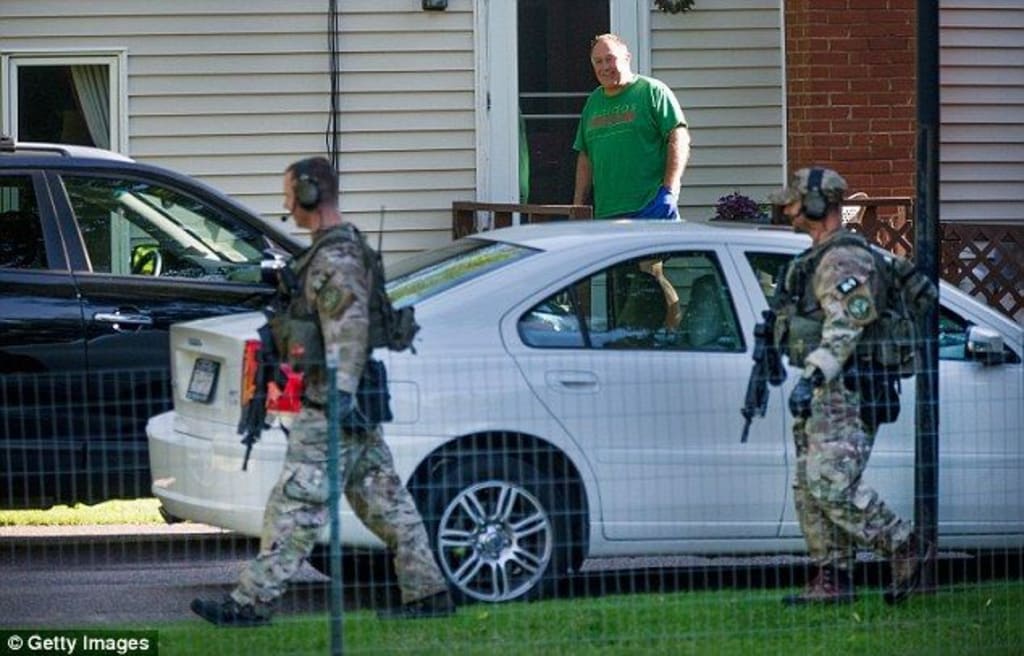
I want to start by saying that I am not a naive person. I grew up in a rough part of Cleveland. I worked thirty-one years as a school principal in neighborhoods where crime was not a headline — it was a Tuesday. I have seen things that would make most people flinch, and I stopped flinching a long time ago. And yet. I did not see it. Six years, and I did not see a single thing. His name was Robert Tulley. He moved into the house at the end of Birchwood Lane in the spring of 2015, and within two weeks he had introduced himself to every neighbor on the block, helped the Garcias carry a new refrigerator up their porch steps, and fixed the broken fence post at the edge of my property without being asked. He was fifty-two years old, recently retired from what he described as "government contracting," and he lived alone. He had a gray beard kept always at the same length, a green John Deere cap he wore almost every day, and a laugh that started slow and built like a train gathering speed. He mowed my lawn every Saturday. I never asked him to. The first time, he simply appeared one morning with his mower running and waved when I came to the window. I opened the door and called out that he didn't have to do that. "I know," he said. And kept mowing. That was Robert. For six years, he was the kind of neighbor people write letters about. He organized the block's first snow-clearing rotation. He drove elderly Mrs. Patton to her chemotherapy appointments every third Thursday. He remembered every child's name on the street and kept a jar of butterscotch candies on his porch railing that the kids raided freely. My daughter called him "the mayor of Birchwood Lane." We all laughed. He came to my granddaughter's fifth birthday party. He sat at the picnic table and made a balloon animal giraffe that was, objectively, terrible — lopsided and drooping — and he held it up anyway with total confidence and said, "Behold. A giraffe." My granddaughter laughed so hard she fell off her chair. I think about that afternoon a lot now. The FBI agents came on a Wednesday morning in October 2021. Two of them. A man and a woman, both in plain clothes, both carrying the specific kind of stillness that federal agents carry — a practiced calm that tells you, before they've said a word, that something is very wrong. They showed me a badge and asked if I knew Robert Tulley. I said he was my neighbor and one of my closest friends. They asked if I would come inside and sit down. I will not share every detail of what they told me, because some of it is still part of an ongoing legal matter and some of it I simply cannot bring myself to write. What I can tell you is this: Robert Tulley was not who he said he was. He had not worked in government contracting. His real name was not Robert Tulley. For nearly two decades before moving to Birchwood Lane, he had been operating a financial fraud network that had stolen retirement savings from more than three hundred families across nine states. Some of those families had lost everything. Elderly couples who had worked their entire lives and found themselves, in their seventies, with nothing. People who had trusted a man with a warm laugh and a confident handshake — just like I had. He had served a short prison sentence under a plea deal in the early 2000s, been released, rebuilt under a different name, and done it again. When they arrested him that Wednesday, he was standing in his driveway polishing his car. The agents said he did not run. He did not argue. He simply set down his cloth, looked at his reflection in the car door for a long moment, and put his hands behind his back. I testified at his sentencing hearing eight months later. I did not testify about the fraud — I had no knowledge of it. I testified as a character witness, at his attorney's request, and then I stayed in my seat while the victims' families gave their statements. I listened to a seventy-four-year-old woman describe losing her husband's entire pension. I listened to a man my age explain that his daughter had to drop out of nursing school because the family could no longer afford tuition. I sat with their words the way you sit with something too heavy to put down. Robert received eleven years. I have not been back to Birchwood Lane since I sold the house in 2022. I don't know who mows the lawn at the end of the street now. People ask me, still, whether I feel angry. Whether I feel foolish. The truth is more complicated than either of those things. Criminal psychology tells us that the most effective con artists are not the ones who seem suspicious. They are the ones who seem like the person you always wanted as a neighbor — reliable, warm, quietly generous. The warmth is not fake, exactly. That is the hardest part to understand. The kindness Robert showed on Birchwood Lane was real. And it was also a tool. Both things were true at the same time. I think about the giraffe balloon. I think about my granddaughter on the grass, laughing. I think about three hundred families who trusted a man with a warm laugh. I have no tidy conclusion to offer you. Only this: the people we think we know most completely are sometimes the people we have never seen at all.
About the Creator
Enjoyed the story? Support the Creator.
Subscribe for free to receive all their stories in your feed.
Comments
There are no comments for this story
Be the first to respond and start the conversation.