
From Antwerp to Rotterdam: The Rise of Europe’s Drug Smuggling Superhighway
How two of Europe’s largest commercial ports became central to international cocaine trafficking, revealing the relationship between organised crime, global commerce and political power.

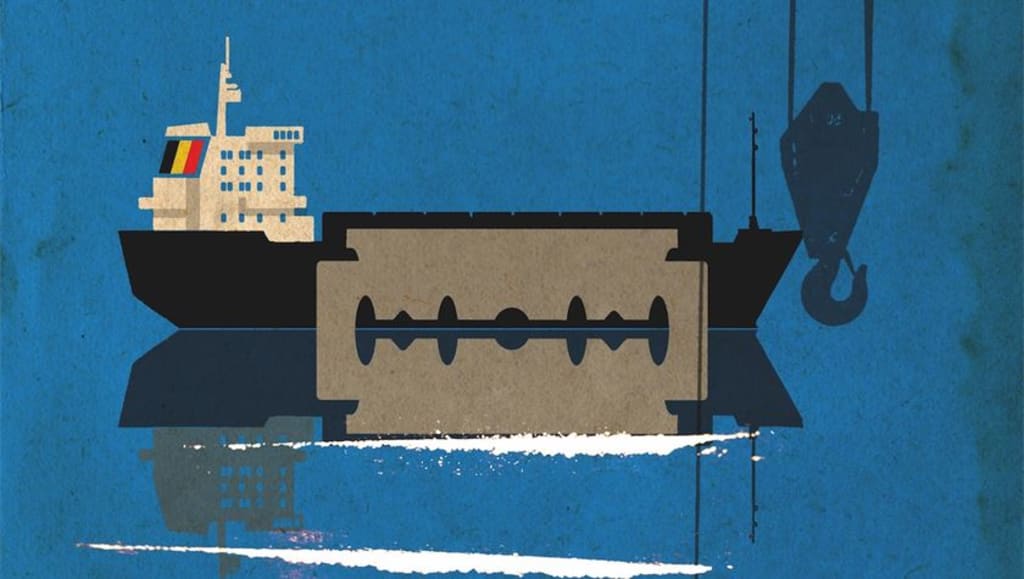
Organised Crime and the Geography of Trade
The ports of Antwerp and Rotterdam are among Europe's most important commercial gateways. Every year, enormous quantities of goods pass through their terminals, connecting European markets with producers and suppliers across the world. Their economic importance rests upon the efficiency of international trade, the movement of shipping containers, the organisation of transport networks and the commercial relationships that allow goods to travel between continents.
Yet the same infrastructure that sustains legitimate trade has also become an opportunity for international criminal organisations. Hidden among commercial shipments, cocaine arrives from Latin America before being distributed through European markets. According to the European Union Drugs Agency (EUDA), the exploitation of maritime shipping containers has become one of the principal mechanisms sustaining cocaine availability in Europe.
What I find particularly interesting is the contradiction within this relationship. The development of international commerce has made the movement of goods faster, more extensive and increasingly interconnected. Criminal organisations have learned to take advantage of precisely these characteristics, using existing transportation networks and exploiting weaknesses in the institutions responsible for regulating them.
But how did these networks become so influential, and how did Albanian-speaking criminal groups, once associated primarily with regional trafficking operations, establish themselves as significant participants in the international cocaine trade?
The Albanian Mafia and the Expansion of Criminal Networks
To understand this development, we must first consider the geographical and historical position of the Balkans.
For decades, the region has formed part of an established trafficking corridor connecting Asia with Western Europe. The so-called Balkan route became particularly important for heroin originating in Afghanistan and transported through Iran, Turkey and southeastern Europe. Albania occupied a position along one of its branches, while the country's proximity to Italy created opportunities for both legitimate commercial exchange and illegal trafficking.
During the 1990s and 2000s, Albanian criminal organisations also developed a considerable presence in the cultivation and trafficking of cannabis, particularly towards Italian markets. Their activities brought some groups into contact with established Italian criminal organisations, including the Calabrian 'Ndrangheta, which had already developed extensive international cocaine-trafficking connections.
However, we should distinguish between these criminal networks and Albanian communities more generally. The term Albanian mafia can suggest a single, centralised organisation, whereas European law enforcement investigations describe a variety of networks with different memberships, geographical connections and methods of operation. Their participation in organised crime cannot be understood as a characteristic of a nationality.
The distinction becomes especially important when we consider the historical circumstances through which Albanian communities established themselves elsewhere in Europe.

The Vlora Exodus and the Changing Balkans
In August 1991, following the collapse of Albania's communist regime, the cargo ship Vlora arrived in Bari, Italy, carrying thousands of Albanians seeking refuge from the political and economic instability of their country. The photographs of the overcrowded vessel remain among the most recognisable images of Europe's post-Cold War migration history. For the people aboard, the journey represented an attempt to escape uncertainty and pursue a different future, during a period when the political institutions and economic arrangements that had governed their lives were rapidly disintegrating.
The movement of Albanians towards Italy and other European countries subsequently created extensive communities across the continent. At the same time, the instability of Albania's political and economic transition presented opportunities for illegal markets and criminal organisations. Nevertheless, the Vlora should not be presented as the origin of Albanian organised crime in Italy, as it is sometimes used. The migration of thousands of people seeking better living conditions and the development of criminal enterprises are distinct historical processes. Their relationship requires evidence rather than an assumption that migration itself explains criminal expansion. What can be established is that particular Albanian-speaking criminal networks developed connections across national borders and gradually became involved in increasingly sophisticated trafficking operations.

From Intermediaries to International Suppliers
For many years, the Calabrian 'Ndrangheta occupied an influential position in the European cocaine market through its relationships with South American suppliers. Other criminal organisations often participated in particular stages of the operation, providing transportation, local distribution, protection, logistical assistance etc. Over time, some Albanian networks moved beyond these intermediary roles. One of the clearest examples emerged in September 2020, when Europol announced the dismantling of KOMPANIA BELLO, a cocaine-trafficking organisation investigated through international cooperation involving ten countries. According to Europol, the network had developed a business model that connected negotiations with South American suppliers directly to the distribution of cocaine across Europe. Its alleged leader, based in Ecuador, coordinated shipments destined for major European ports, while associates in Albania, Italy and the Netherlands helped organise distribution.
This development is particularly revealing because it demonstrates how criminal organisations can increase their influence by controlling several stages of a supply chain. Instead of depending entirely upon separate intermediaries, they seek greater authority over procurement, transportation, distribution and the profits generated by the final market. Ecuador has become especially important in this international network, functioning as a major departure and transit point for cocaine produced elsewhere in South America. Its commercial ports and established export connections provide access to global shipping routes. The growing availability of cocaine has also intensified competition. Criminal organisations from the Western Balkans, Italy, the Netherlands, Belgium and several other countries cooperate, negotiate and compete for access to suppliers and distribution networks. It would therefore be misleading to imagine a single criminal organisation controlling the entire European market. The reality is a complicated system of alliances, rivalries and commercial relationships, which can change according to opportunities, police investigations and shifting economic interests.

Rotterdam: Europe's Largest Port Under Pressure
Rotterdam is Europe's largest seaport and one of the continent's most important transportation and distribution centres. Its extensive terminals connect international shipping with road, rail and inland waterway networks, making it an indispensable part of European commerce. These same characteristics have made the port attractive to cocaine traffickers.
In 2021, the Dutch authorities' Hit and Run Cargo team intercepted approximately 70.6 tonnes of cocaine in the Port of Rotterdam, an increase of 74% compared with the previous year. The figures demonstrated the scale of the challenge facing customs officials and law enforcement agencies. Smuggling operations have involved cocaine concealed inside commercial containers, the exploitation of shipping information and the recruitment or intimidation of people with access to port facilities. Europol has also documented the misuse of container reference codes, which can allow criminal groups to obtain access to shipments through compromised logistical procedures.
This creates a difficult situation for port authorities. The economic importance of Rotterdam depends upon the rapid movement of enormous quantities of commercial goods. Customs officials, however, must identify relatively small numbers of suspicious shipments among legitimate imports without bringing international trade to a standstill. The challenge is frequently described as searching for a needle in a haystack. But there is another dimension to the problem: the people who operate the machinery, maintain the shipping records, transport the containers and provide security may themselves become targets of criminal pressure.
Corruption and intimidation can therefore transform an otherwise legitimate commercial operation into an opportunity for organised crime. Yet the seizure figures have changed considerably since the original publication of this article. According to the Dutch Public Prosecution Service, approximately 25.9 tonnes of cocaine were intercepted at Rotterdam in 2024, falling to around 11.5 tonnes in 2025.
Does this mean that Rotterdam has successfully reduced its role in international cocaine trafficking? Perhaps increased security measures have made certain operations more difficult. Nevertheless, a reduction in seizures does not necessarily demonstrate an equivalent reduction in trafficking. Criminal organisations may adjust their methods, use smaller shipments or redirect their activities towards alternative ports. This is one of the difficulties of measuring success against organised crime. Authorities can identify the quantities they intercept, but the volume that escapes detection remains uncertain


Antwerp: When Organised Crime Reaches Residential Streets
Across the border in Belgium, Antwerp has experienced a similarly disturbing relationship between commercial activity and cocaine trafficking. Its geographical position and extensive container facilities have made it a major destination for shipments arriving from Latin America. In 2022, Belgian customs officers seized approximately 110 tonnes of cocaine at the port, a record at the time. But the figures announced in January 2023 coincided with an event that revealed a far more immediate consequence of the drug trade. On 9 January 2023, an 11-year-old girl was killed when gunmen opened fire on a house in the Antwerp district of Merksem. Two other children were injured. The city's mayor linked the attack to violence between criminal groups involved in drug trafficking.
The death of a child inside a residential home revealed something that statistics alone could not communicate. International cocaine trafficking was no longer a distant activity associated exclusively with shipping containers, criminal syndicates and illicit financial transactions. Its consequences had entered the ordinary spaces of urban life. Antwerp had already experienced incidents involving shootings, explosions and intimidation associated with criminal rivalries. The increasing financial value of the cocaine market, alongside competition over trafficking routes and distribution, contributed to an environment in which violence became a means of protecting or contesting criminal interests. The problem becomes especially disturbing when criminal conflicts extend beyond those directly involved, threatening families, neighbourhoods and people who have no participation in the illegal market.
Meanwhile, the port's seizure figures continued to fluctuate. Belgian customs reported more than 120 tonnes of cocaine intercepted in 2023, followed by approximately 44 tonnes in 2024 and nearly 55 tonnes in 2025. These figures illustrate both the continuing importance of Antwerp and the changing methods employed by traffickers. They also demonstrate why the success of law enforcement cannot be measured solely by the quantity of drugs seized in a particular year.
Criminal Power and the Vulnerability of Institutions
The relationship between organised crime and international commerce raises another question that I believe deserves closer examination. How does a criminal organisation acquire power within an economic system whose institutions are supposedly designed to exclude its activities?
It would be simplistic to claim that the shipping industry itself is responsible for international drug trafficking. Ports, transport companies and logistics workers provide essential economic services, while many are also victims of criminal infiltration, threats and corruption. Nevertheless, the structure of international commerce presents vulnerabilities that organised crime can exploit. The enormous scale of container transportation, the involvement of numerous private companies and the dependence upon complex digital and logistical systems create opportunities for individuals or networks capable of interfering with their operation. Criminal power is not exercised exclusively through violence. It may also emerge through access to information, financial resources, personal relationships and the ability to influence or intimidate those whose cooperation is necessary. The danger, then, concerns the gradual erosion of the boundary between legitimate economic activity and criminal influence. This is not a suggestion that the two are fundamentally identical. Rather, it raises a question about the conditions under which institutions created to facilitate public and commercial life can become vulnerable to private networks operating beyond legal and democratic accountability.
The Battle Against Smuggling
European governments have increasingly recognised that the problem cannot be addressed through isolated national investigations. In January 2024, the European Commission launched the European Ports Alliance, bringing together public authorities and private-sector participants to strengthen security against organised crime and drug trafficking. The initiative included investments in scanning technology, closer law enforcement cooperation and measures designed to protect port infrastructure, personnel and logistical information.
International investigations have also targeted the financial and organisational structures behind trafficking operations, including the networks responsible for coordinating shipments from South America. However, these measures confront a criminal market that continues to change. The European Union Drugs Agency reported that EU Member States seized approximately 330 tonnes of cocaine in 2024, compared with 419 tonnes in 2023. At the same time, the number of seizures increased, while evidence pointed towards the growing exploitation of smaller ports and alternative transportation methods.
This apparent contradiction matters. A decline in the total quantity seized cannot automatically be interpreted as a decline in the availability of cocaine. Changes in routes, concealment techniques and the distribution of shipments may significantly influence the figures. There is also the question of demand. As long as substantial European markets for cocaine continue to exist, criminal organisations will have an economic incentive to supply them. Enforcement is therefore one part of a wider problem that also involves public health, addiction, prevention, treatment and the social conditions surrounding drug consumption. The consequences of trafficking should not be reduced to the competition between criminal groups and police authorities. They include the exploitation of workers, corruption, violence, the vulnerability of local communities and the health problems associated with the availability and consumption of cocaine.
What Lies Beyond the Ports?
Looking at Antwerp and Rotterdam, I am reminded of how difficult it can be to separate the economic achievements of globalisation from the vulnerabilities created by its enormous scale. The ports represent international cooperation, technological development and the movement of goods across geographical boundaries. They also reveal how the same commercial infrastructure can be exploited by organisations that operate through violence, corruption and the pursuit of illegal profit.
There is something particularly unsettling about the ability of criminal networks to adapt. When one trafficking route becomes more difficult, another may emerge. When established organisations lose influence, competitors may occupy their position. When authorities strengthen the security of major ports, smaller or less protected facilities may become attractive alternatives. Perhaps the more important question is not simply how many tonnes of cocaine European authorities manage to seize, but how criminal organisations establish and maintain influence over the people, institutions and economic relationships upon which their operations depend.
The history of Albanian-speaking criminal networks illustrates one aspect of that development, but the problem extends far beyond any particular nationality or criminal organisation. It concerns the international systems through which money, goods and power circulate, and the capacity of public institutions to prevent those systems from being exploited. For the residents of Antwerp, the workers of Rotterdam and the communities affected by the wider cocaine market, these questions have consequences that reach considerably further than the walls of a shipping container. An economy may become increasingly efficient at moving goods across the world. Whether the institutions governing that movement can provide the same degree of protection to the people living within it remains a different question.
Written and published by Sergios Saropoulos

Sources and Selected Bibliography
European Union Drugs Agency (EUDA). European Drug Report 2026: Cocaine — The Current Situation in Europe. 9 June 2026. Statistics on cocaine seizures, availability, changing trafficking methods and public health consequences.
https://www.euda.europa.eu/publications/european-drug-report/2026/cocaine_enEuropean Union Drugs Agency (EUDA). Cocaine: Increasingly Attractive for a Wider Range of Criminal Networks. EU Drug Markets analysis. Examines trafficking networks from the Western Balkans, South American connections, organised crime cooperation and changes in distribution models.
https://www.euda.europa.eu/publications/eu-drug-markets/cocaine/criminal-networks_enEuropean Union Drugs Agency (EUDA). EU Drug Market: Heroin and Other Opioids — Trafficking and Supply. Historical analysis of the Balkan heroin route and its geographical branches.
https://www.euda.europa.eu/publications/eu-drug-markets/heroin-and-other-opioids/trafficking-and-supply_enEuropol. Joint Investigation Team Leads to Dismantling of One of Europe's Most Active Albanian-Speaking Networks Trafficking Cocaine into Europe. 17 September 2020. Primary law enforcement account of the KOMPANIA BELLO investigation and its international supply network.
https://www.europol.europa.eu/media-press/newsroom/news/joint-investigation-team-leads-to-dismantling-of-one-of-europe%E2%80%99s-most-active-albanian-speaking-networks-trafficking-cocaineEuropol. Criminal Networks in EU Ports: Risks and Challenges for Law Enforcement. 5 April 2023. Joint analysis involving the ports of Antwerp, Rotterdam and Hamburg, documenting criminal infiltration, corruption and the misuse of container reference codes.
https://www.europol.europa.eu/publications-events/publications/criminal-networks-in-eu-ports-risks-and-challenges-for-law-enforcementDutch Public Prosecution Service (Openbaar Ministerie). HARC-team onderschept 72.808 kilo cocaïne in 2021. 10 January 2022. Official figures for Rotterdam's cocaine seizures in 2021.
https://www.om.nl/actueel/nieuws/2022/01/10/harc-team-onderschept-72.808-kilo-cocaine-in-2021Dutch Public Prosecution Service (Openbaar Ministerie). 2025: Minder kilo's cocaïne en meer cannabisvangsten in Rotterdam en Vlissingen. 13 February 2026. Official 2025 seizure results and comparison with 2024.
https://www.om.nl/actueel/nieuws/2026/02/13/2025-minder-kilos-cocaine-onderschept-in-rotterdam-en-vlissingenBelgian Federal Government / Federal Public Service Finance. Douane onderschepte opnieuw meer cocaïne en zeer grote hoeveelheden marihuana in de haven van Antwerpen in 2025. 21 January 2026. Official Belgian customs figures for Antwerp's 2025 seizures.
https://news.belgium.be/nl/douane-onderschepte-opnieuw-meer-cocaine-en-zeer-grote-hoeveelheden-marihuana-de-haven-vanBelga News Agency. Child Killed During Shooting in Merksem; Attack Related to Drug War, Says Antwerp Mayor. 10 January 2023. Contemporary reporting on the fatal shooting and the authorities' initial statements.
https://www.belganewsagency.eu/child-killed-during-shooting-in-merksem-attack-related-to-drug-war-says-antwerp-mayorEuropean Commission, Directorate-General for Migration and Home Affairs. European Ports Alliance to Fight Drug Trafficking and Organised Crime. 24 January 2024. Official announcement explaining the initiative and its security objectives.
https://home-affairs.ec.europa.eu/news/european-ports-alliance-fight-drug-trafficking-and-organised-crime-2024-01-24_enEuropean Union Drugs Agency (EUDA). EU Seaports Must Join Forces to Tackle Maritime Drug Trafficking and Strengthen Data Reporting, New Report Finds. 2025. Findings from the joint EUDA–World Customs Organization analysis of drug seizures linked to European ports between 2019 and June 2024.
https://www.euda.europa.eu/news/2025/eu-seaports-must-join-forces-tackle-maritime-drug-trafficking-and-strengthen-data-reporting-new-report-finds_mtHellenic Foundation for European and Foreign Policy (ELIAMEP). The Italy–Albania Agreement on Migration: From the Fiction of Non-Entry to Functional Entry. 2024. Historical background on Albanian migration to Italy and the arrival of the Vlora in 1991.
https://www.eliamep.gr/en/to-protokollo-italias-alvanias-gia-ti-metanastefsi-apo-to-plasma-dikaiou-tis-mi-eisodou-fiction-of-non-entry-sti-leitourgiki-eisodo-functional-entry/
About the Creator
Sergios Saropoulos
As a Philosopher, Writer, Journalist and Educator. I bring a unique perspective to my writing, exploring how philosophical ideas intersect with cultural and social narratives, deepening our understanding of today's world.
Enjoyed the story? Support the Creator.
Subscribe for free to receive all their stories in your feed.
Comments
There are no comments for this story
Be the first to respond and start the conversation.