
What’s This?
On breaking something small and carrying it for years Submitted for the “I Made It Worse” challenge

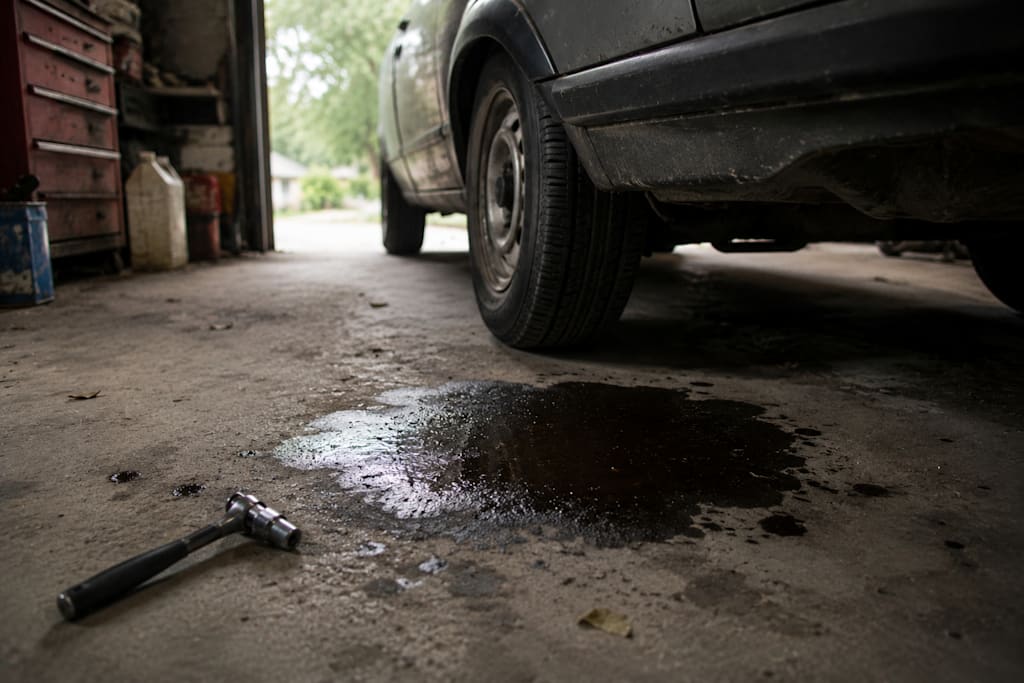
My brother had a 1987 Ford Escort that ran technically, but the carburetor was flooded. He knew this because when you'd turn the key, you'd get this drowning sound. Like the engine was trying to cough up something it shouldn't have swallowed. He'd described it to me three times. I finally said, "Just let me look at it."
This was stupid. I didn't know anything about carburetors. My knowledge of cars extended to: you put gas in, it goes. Oil is important. That's it. But there's something about being asked to fix something that makes you feel like you might actually be capable. Like your general competence in other areas might transfer.
It didn't.
I got under there with my dad's socket wrench, too large, and a pair of needle-nose pliers that belonged to nobody and had been rattling around in my mom's junk drawer for years. The engine was still warm from his attempt to start it that morning. I burned my knuckle on the manifold. It bled a little. This should have been the sign to stop.
Instead, I loosened something. A bolt that looked like it probably wasn't that important. When I pulled it, I was expecting resistance. There wasn't any. The bolt came free, and with it came a small rubber piece, a washer or a seal or something that clearly had a job. I held it in my palm and understood, with the clarity of complete incompetence, that I had no idea how to get it back where it was supposed to go.
I should have told my brother immediately. "I loosened a thing. There's a rubber piece. I don't know what it does."
Instead, I put the bolt back in without it.
The first time he started the car, something was definitely wrong. Not flooded, that problem was gone. But there was now a new problem: a leak. Oil, black and somehow shiny even as it pooled under the car. It pooled fast. Within an hour, there was enough to stain the concrete.
"What did you do?" he asked.
"Nothing. I just looked at the carburetor."
"There's oil everywhere."
"It was probably already leaking."
This was the lie. The first real lie, not the lie of omission. And it worked because my brother isn't confrontational. He just looked at the oil, looked at me, and I saw him decide it wasn't worth the fight.
He took it to a mechanic. A real mechanic. The kind with a shop and a lift and tools that had specific purposes. The mechanic called him and said the head gasket needed to be replaced. The head gasket, that's where you're dealing with actual engine internals, where a job costs somewhere between six hundred and two thousand dollars depending on how many things go wrong when you start opening things up.
My brother called me and didn't accuse me directly. He just said, "I'm taking your advice cost me six hundred bucks."
"I didn't tell you to..."
"You said you'd fix the carburetor."
"I didn't touch the head gasket."
Which was technically true. I hadn't touched the head gasket. I'd touched something else. That rubber piece. Which, when the mechanic finally got the engine apart, turned out to be a critical seal that, when missing, had allowed oil to seep into places oil shouldn't be, which had then contaminated the head gasket, which had then started to fail.
There's something specific about the shame of this. It's not the money. It's that I lied first, and then I was wrong about the lie. That there was a moment where I could have just said, "I loosened something and I don't know what it was," and my brother would have been annoyed but it would have been fine. Instead, I got defensive. I got protective of myself. And in doing that, I turned a small mistake into proof that I shouldn't be trusted.
We didn't talk about it after. Not really. He paid for the repair. The car ran fine after the mechanic fixed it. But there's a specific distance that developed between us after that, not huge, not dramatic. Just a thing where, if he mentioned having car problems, I wouldn't offer to help anymore. And he wouldn't ask.
I think about that bolt sometimes. That small rubber piece that had a specific job. I keep thinking: if I'd just called him in immediately, said "I loosened this, I don't know what it is, help me figure out where it goes," the whole thing would have resolved in five minutes. Maybe twenty. He would have laughed about me trying to fix something I knew nothing about. We would have reseated the seal. No leak. No head gasket. Not six hundred dollars and no specific kind of distance that happens when someone who should be able to help you actually makes things worse.
The thing nobody tells you about making things worse is that it's not always about the final outcome. Sometimes the damage isn't to the object. It's to the person who trusted you to help.
I never got good at cars. I also got weirdly anxious about being asked for help with anything mechanical. Like I was afraid I'd do it again, that I'd approach something with enough confidence to seem capable but not enough knowledge to actually help, and I'd break something else, something more important.
My brother had a leaky sink years later. He mentioned it to my mom, not to me, even though I was standing right there. Our mom told him to call a plumber. He did. She didn't say it to make a point. But we both knew it was a point. It was a small moment where the entire history of the carburetor was acknowledged without being spoken about.
That was maybe ten years ago now. He's never asked me to help with anything since. I've tried to help unbidden a couple times, like, I'll see something that needs fixing and I'll just start, thinking I could prove I'd learned something. He's always said something like, "I got it," or "I'm going to get someone." Which is reasonable. Which is fair.
But what kills me is that it was so small. It was a rubber washer. It was a bolt that maybe took forty-five seconds to reassemble correctly. If I'd just not been so certain. If I'd just said, "I don't actually know what I'm doing," everything would be different.
Instead, I made it worse. And then I lied about it. And then ten years happened and we never really fixed it.
I think about that sometimes when I see him and his kids at family stuff. His youngest is maybe five. Smart kid. Curious. He watches his dad, learns things from him, trusts him to teach him. And I wonder if there's someone in his life who's going to mistake confidence for competence and break something small that matters. Who's going to lie instead of asking for help. Who's going to spend the next decade feeling that distance.
I should have called him in immediately. I should have held up that rubber piece and said, "What's this?"
That's the thing I'd do differently. Not the fixing part. Just the asking.
About the Creator
Aarsh Malik
Poet and storyteller who believes in the quiet power of words.
My first book, QUIET FLAME
Buy Coffee
⏳ 90 days. $2,000
If my words stay with you, a little tip can help me get there.
Enjoyed the story? Support the Creator.
Subscribe for free to receive all their stories in your feed. You could also become a paid subscriber, letting them know you appreciate their work.
Comments
There are no comments for this story
Be the first to respond and start the conversation.