
I Thought My Husband Was the Problem—Until I Read Our Old Messages
What I found in our past conversations exposed the truth I had been avoiding—and the role I played in creating the distance between us
I Thought My Husband Was the Problem—Until I Read Our Old Messages
What I found in our past conversations exposed the truth I had been avoiding—and the role I played in creating the distance between us
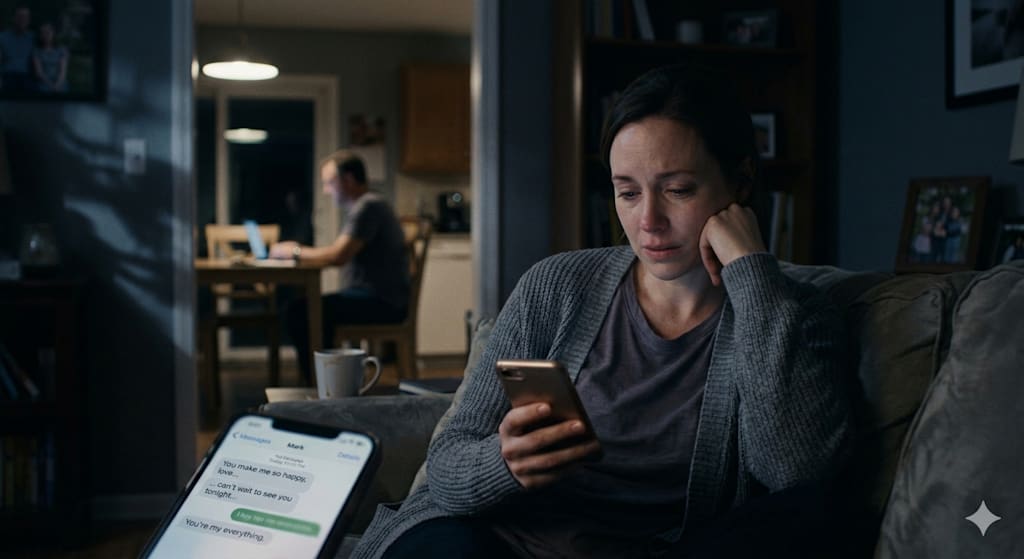
I used to tell my friends the same story over and over again. “My husband has changed.” It was always said with a sigh, the kind that suggests patience worn thin. They would nod, sometimes too quickly, as if they already knew the ending. And I would go on—listing things like evidence in a case I had already decided. “He doesn’t listen anymore.” “He’s always on his phone.” “He used to care.” There was comfort in that narrative. It made everything simple. There was a problem, and the problem had a name—and it wasn’t mine. For a long time, I didn’t question it. It started on a quiet afternoon. The house was unusually still. No television humming in the background, no clatter from the kitchen, no small interruptions demanding my attention. Just silence—and my phone. I wasn’t looking for anything important. Just scrolling. Old photos, old chats, old versions of myself I barely recognized. That’s when I found it. Our messages. Not the recent ones—the dry, functional exchanges about groceries and schedules—but the older ones. From years ago. From before everything became… routine. I opened the thread without thinking. At first, it felt almost embarrassing to read. There I was, sending long messages filled with unnecessary details. Telling him about my day, my thoughts, even the smallest things that made me smile. And him—responding instantly. Playful, attentive, present. “You didn’t tell me how your meeting went. I’ve been waiting.” “I miss you already. It’s only been three hours.” “I can’t wait to come home to you.” I paused. Scrolled further. More of the same. Effort. Curiosity. Energy. And then, slowly, something shifted. Not suddenly. Not dramatically. Just… gradually. My messages became shorter. “Okay.” “Fine.” “We’ll see.” His stayed warm for a while, like someone trying to keep a fire alive with fewer and fewer logs. But eventually, even his tone changed. “Did you get home safe?” “Let me know if you need anything.” “Okay.” The conversation didn’t collapse—it faded. And I had never noticed when it happened. I told myself it was normal. This is what marriage does, right? It settles. It becomes practical. Less talking, more doing. But as I kept scrolling, that explanation started to feel… thin. Because the truth was harder to ignore. He didn’t just stop trying. He slowed down. After I did. There was one message that stopped me completely. It was from him. Sent late at night. “I feel like you’re not really here anymore, even when you’re sitting next to me.” I stared at it. I didn’t remember this. I scrolled up to see what I had replied. Nothing. No response. Not even a “what do you mean?” Just silence. It’s strange how memory works. I remembered feeling ignored. Overlooked. Unappreciated. But I didn’t remember this version of him—the one reaching out, trying to say something uncomfortable, something real. And I didn’t remember ignoring it. But there it was. Proof, in plain text. I kept reading. Looking for something—anything—that would confirm my version of the story. Something that would prove I was right. That he had changed first. That he had become distant, careless, inattentive. But the more I searched, the more uncomfortable it became. Because the pattern was clear. He would reach out. I would respond briefly—or not at all. He would try again, softer this time. I would stay distant. And eventually, he stopped reaching. I put the phone down. For a moment, I felt defensive. This wasn’t fair. People change. Life gets busy. Responsibilities grow. You can’t expect the same energy forever. But that argument didn’t hold up for long. Because this wasn’t about energy. It was about attention. And I had quietly withdrawn mine. The realization didn’t hit all at once. It came in layers. First, discomfort. Then resistance. Then something heavier. Responsibility. I thought about all the times I had complained. To friends. To myself. About how he didn’t ask about my day anymore. How he didn’t notice things. How he seemed… absent. And for the first time, I asked a different question. When was the last time I asked about his? Not out of habit—but out of genuine interest. I couldn’t remember. It’s easy to point at what’s missing. Harder to examine what you’ve stopped giving. I had been measuring him against a version of himself from years ago. But I hadn’t asked if I was still that version of myself either. I wasn’t. Not even close. That evening, when he came home, nothing looked different. Same routine. Same quiet. He placed his keys on the table, glanced at me, gave a small smile. “Hey.” “Hey.” That was it. A normal exchange. The kind I had been using as evidence of how things had changed. But now, it felt different. Because I could see what wasn’t happening behind it. No attempt. No curiosity. No effort to go deeper. Not from him. But also—not from me. I almost said something. Something honest. Something uncomfortable. But I didn’t. Not yet. Because I realized something important. This wasn’t a conversation I could rush. It wasn’t about pointing out what had gone wrong. It was about understanding how I had quietly participated in it. That night, I opened our messages again. Not to blame. Not to defend. Just to see. And what I saw was simple. We didn’t fall apart because one of us stopped caring. We faded because one of us stopped showing it—and the other eventually followed. The next morning, I did something small. Almost insignificant. I sent him a message. Not about groceries. Not about schedules. Just: “How did your meeting go today? I remember you were nervous about it.” I stared at the screen after sending it. It felt unfamiliar. Almost awkward. Like speaking a language I hadn’t used in years. A few minutes passed. Then his reply came. “It went better than I expected, actually. Thanks for asking.” There was nothing extraordinary about it. But it wasn’t empty either. It was… a response. I didn’t suddenly fix everything. There was no dramatic conversation. No instant transformation. Just small shifts. Questions asked. Answers listened to. Moments noticed. I used to think the problem had a name. That it was something external. Something I could point at. But the truth was less convenient. And far more useful. The problem wasn’t just him. It wasn’t even mostly him. It was the space between us. And the quiet ways I had helped create it. It’s uncomfortable to admit that. There’s no satisfaction in it. No easy blame. But there’s something else. Something better. Control. Because if I helped create the distance… Then maybe, just maybe… I can help close it too.
About the Creator
Enjoyed the story? Support the Creator.
Subscribe for free to receive all their stories in your feed.
Comments
There are no comments for this story
Be the first to respond and start the conversation.