
I Thought It Needed Water
That was the beginning of the problem

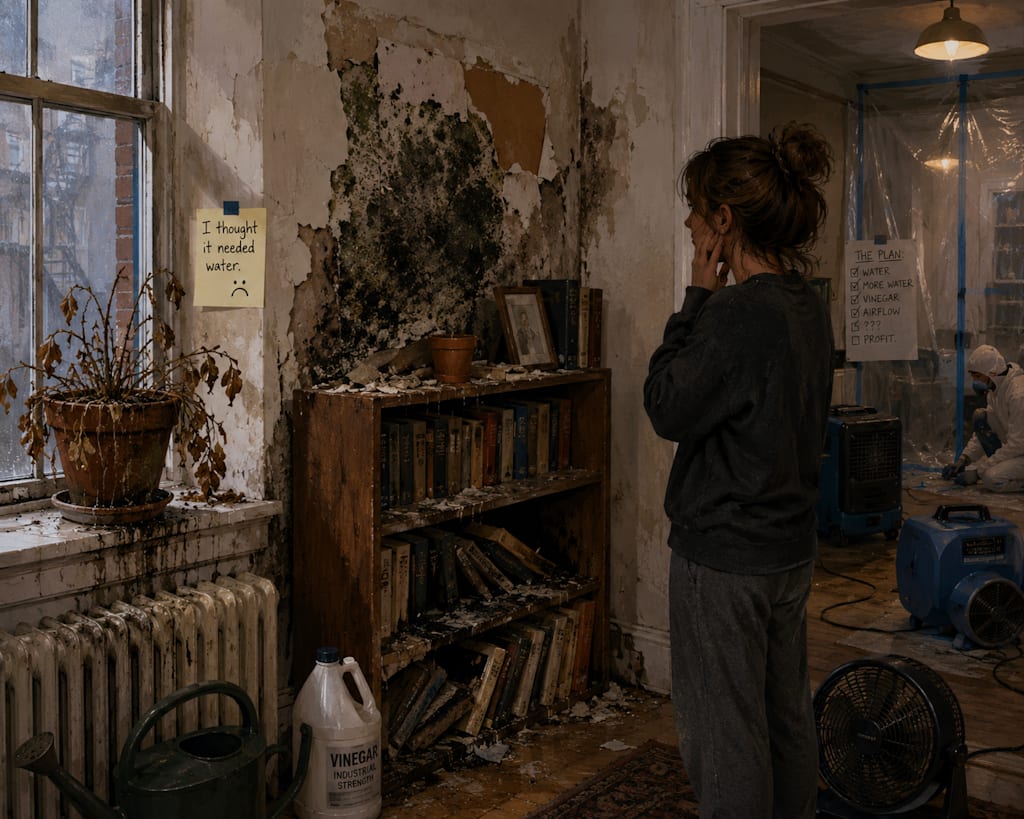
The plant looked dry.
That’s important context, because I’d like it noted from the start that my intentions were good. Negligent people don’t notice dryness. Negligent people walk past suffering every day. I noticed. I acted. If anything, this situation began with empathy.
Unfortunately, the plant was not dry.
It was dead.
I understand now that these are different conditions, though at the time the distinction felt unnecessarily technical. The leaves were brown, the soil looked pale, and one side leaned slightly toward the window in a manner I interpreted as weakness rather than structural collapse.
So I watered it.
Not excessively.
At first.
Just enough to "help".
The issue with dead plants, I’ve since learned, is that they do not improve gradually. They remain visually uncooperative no matter how supportive your behavior becomes. Two days later, the leaves looked worse. Crispy, somehow. More emotionally distant.
I interpreted this as thirst.
Again: reasonable.
So I watered it more.
At that point, the pot began leaking slightly onto the windowsill. Not dramatically. Just enough to create a thin line of moisture that traveled toward the stack of unopened mail beside it.
This is where another mistake occurred.
Rather than move the mail, I moved the plant.
The new location was above the radiator.
In hindsight, placing an overwatered dying plant directly beside a heat source created conditions that professionals might describe as "ideal", though unfortunately not for the plant.
For mold.
At first it was subtle.
A smell.
Not terrible. Earthy, if anything. Organic. The kind of smell people pay money to experience in cafés with reclaimed furniture.
Then the soil developed texture.
Not bad texture.
Just… ambition.
Small pale threads appeared along the surface. The plant itself remained emotionally unavailable, but the soil had become active in a way I considered encouraging.
I now understand this was not encouragement.
Still, I didn’t panic.
I googled.
This was a mistake because the internet has only two opinions about mold:
1- It’s harmless.
2- Your house is already condemned.
Neither felt useful.
So I decided to handle the problem myself.
The logical solution, I thought, was airflow.
Plants like airflow. Mold dislikes airflow. This felt scientifically balanced.
I opened the window.
Unfortunately, it was February.
The radiator compensated aggressively. The sudden temperature shift created condensation on the inside wall, directly behind the bookshelf.
I didn’t notice immediately because the bookshelf was, technically, against the wall.
That’s what bookshelves do.
The first sign was the sound.
Not a dramatic collapse. More of a damp sigh.
One evening around midnight, the lower shelf gave way just enough for several books to slide sideways at once. I assumed I’d overloaded it, which seemed fair. Some of those hardcovers were unnecessarily committed to being hardcovers.
When I pulled the shelf away from the wall, the wallpaper came with it.
That was new.
Behind the bookshelf was a dark shape roughly the size of a medium-to-large regret.
At this stage, a more mature person might have contacted the landlord.
I chose vinegar.
In every article online, vinegar appeared with unreasonable confidence. People described it the way medieval villagers described holy water.
So I bought industrial vinegar.
Not regular vinegar.
The strong kind.
The kind sold in containers that imply legal waivers.
I sprayed the wall generously.
Too generously, as it turns out, because vinegar atomizes. The room became instantly uninhabitable. My eyes watered. The air itself developed hostility.
I opened more windows.
This worsened things structurally.
The apartment entered a climate cycle no building should experience indoors: heat, cold, moisture, evaporation, condensation, repeat.
The mold expanded.
Not aggressively.
Efficiently.
I began sleeping in the living room.
The plant remained near the radiator throughout all this because by then I felt we were committed to seeing the situation through together.
Then came the inspection.
Not because I requested one. Because the downstairs neighbor reported water stains on her ceiling resembling "continental drift".
A maintenance worker arrived on Thursday.
He looked at the wall for a very long time.
Then he looked at the plant.
Then back at the wall.
There was a silence during which I understood, for the first time, that this might not remain a private issue.
"What happened here"? he asked.
And this is where things became difficult to explain concisely.
Because technically, yes, the wall had mold. And yes, moisture damage had spread behind the shelving. But the root cause was compassion. The root cause was that I had attempted to care for something visibly struggling.
The maintenance worker touched the wall once.
His finger went in slightly.
That seemed to affect him emotionally.
By Monday, there were fans in the apartment.
Large industrial fans. The kind used after floods or crimes. Plastic sheeting sealed off half the bedroom. Two men in masks spoke in low professional tones while carrying equipment that suggested spores were no longer the primary concern.
The landlord asked if I had noticed "ongoing moisture issues".
I said, honestly, "Not ongoing at first".
This answer did not help.
Apparently, moisture had spread into the adjacent unit’s wall cavity. There was discussion of insulation replacement. Someone used the phrase "secondary contamination", which felt unnecessarily judgmental.
Meanwhile, the plant finally died completely.
I know what you’re thinking.
You’re thinking it was already dead.
That’s unfair.
At minimum, it was transitioning.
But now it became unmistakably deceased. The stem collapsed inward with the emotional posture of someone who had lost an argument with existence itself.
Oddly, this upset me more than the wall damage.
I had invested time by then.
Attention.
Effort.
Multiple cleaning products.
The landlord eventually asked me to dispose of it because, in his words, "we’re trying to reduce organic complications".
I moved it to the hallway temporarily.
This created another issue because the hallway receives better natural light than the apartment itself. One of the neighbors assumed the plant was communal and watered it.
Which, under ordinary circumstances, would have been kind.
Under these circumstances, it restarted the smell.
Three days later, someone filed another complaint.
At the emergency building meeting, there was considerable discussion about moisture responsibility, ventilation standards, and whether tenants should be "cultivating biological material" in shared spaces.
I remained mostly quiet.
Partly from shame.
Partly because every time I tried to explain the sequence aloud, it sounded less believable.
"It was just a plant" loses persuasive strength around the moment industrial drying equipment enters the narrative.
In the end, the wall had to be opened completely.
Sections removed.
Insulation replaced.
The bookshelf was unsalvageable. Several books fused together permanently into what the restoration company called "a moisture composite".
The plant disappeared during cleanup.
No one admitted throwing it away, but I assume someone did.
Or perhaps it finally understood the effect it was having on the building and left voluntarily.
Either feels possible.
The apartment still smells faintly strange when it rains.
Not strongly.
Just enough to suggest memory.
The landlord avoids eye contact now. The downstairs neighbor refers to me as "the ecosystem lady," despite the fact that I am neither an ecosystem nor a lady.
And the worst part is this:
A week ago, I noticed another plant in the lobby.
Its leaves looked slightly dry.
I almost watered it.
About the Creator
Alain SUPPINI
I’m Alain — a French critical care anesthesiologist who writes to keep memory alive. Between past and present, medicine and words, I search for what endures.
Enjoyed the story? Support the Creator.
Subscribe for free to receive all their stories in your feed. You could also become a paid subscriber, letting them know you appreciate their work.
Comments
There are no comments for this story
Be the first to respond and start the conversation.