
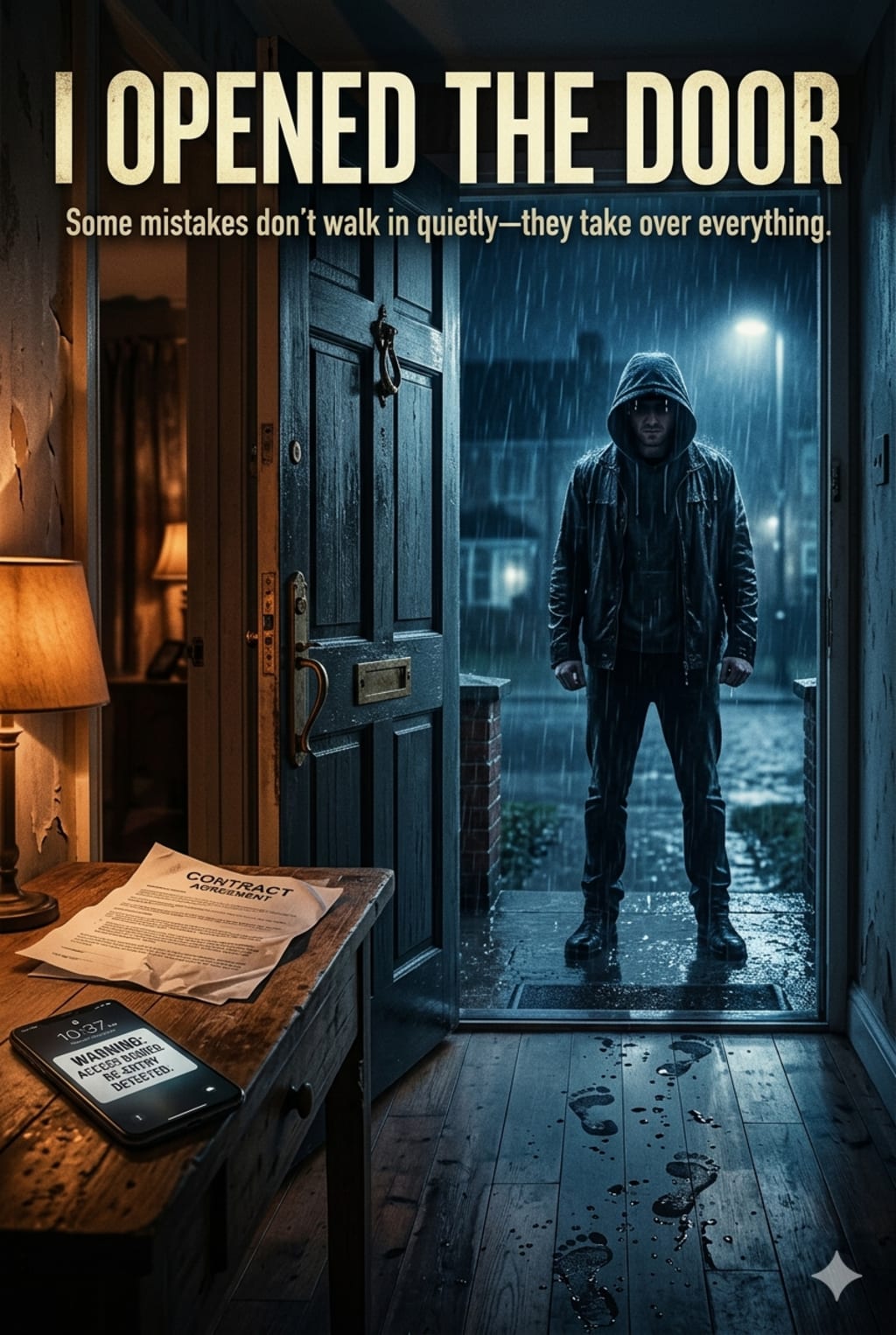
I Opened the Door
I shouldn’t have opened it
Not because it was late. Not because of the rain hammering against the roof like something trying to get in. But because of who was standing on the other side. Arman didn’t knock twice. He never did. One knock, then silence—like the rest was your responsibility. I stood there longer than I should have, staring at the door as if it might explain itself. My phone buzzed again on the table behind me. Same unknown number. Same message. He’s going to come back. Don’t let him in. Too late. I opened the door. He looked smaller than I remembered. That was the first thing that struck me. Not older. Not tired. Just… reduced. Like someone had taken the version of him I knew and pressed it inward. “Still take your time opening doors?” he said, a faint smile forming. I didn’t return it. “What do you want?” “Just talk.” People like Arman always say that. Just talk. As if words hadn’t ruined everything the last time. Rainwater dripped from his jacket onto my floor. He didn’t ask to come in. He stepped forward, and I stepped back. That was the moment. The first shift. Small enough to ignore. Big enough to matter. I told myself I was in control. We sat across from each other like strangers pretending not to be. I didn’t offer him tea. He didn’t ask. “You changed your number,” he said. “You lost the right to have it.” He nodded slowly, like he agreed. He always agreed at the beginning. “I heard things didn’t go well,” he added. I laughed—sharp, automatic. “You heard?” “People talk.” Of course they did. They talked when he left, too. About the money. About the accusations. About how I should have seen it coming. “You came all this way to say what?” I asked. “That you’re sorry?” “I came to fix things.” There it was. The word that always sounds better than it is. Fix. I leaned back. “You don’t fix things, Arman. You break them and then explain why it wasn’t your fault.” Something flickered across his face. Not anger. Not yet. Something quieter. Calculation, maybe. “You still think that’s what happened?” he said. I should have ended it there. Told him to leave. Closed the door I had already opened. Instead, I said, “Isn’t it?” That was the second mistake. He started small. He always started small. “Do you remember the contract?” he asked. “The one you signed without reading properly?” I felt it immediately—that subtle shift from defense to doubt. “I read it.” “Not all of it.” “I read enough.” He smiled again, softer this time. “That’s what I mean. Enough.” The rain got louder. Or maybe the room got quieter. “You trusted me,” he continued. “That’s not a crime. But it’s not my fault either.” I leaned forward. “You took everything.” “I used what you gave me.” The words landed clean, precise. Like he had practiced them. And maybe he had. My phone buzzed again. I ignored it. That was the third mistake. “Why are you really here?” I asked. He hesitated. Just for a second. But I saw it. “There are people asking questions,” he said. “About both of us.” “There is no ‘both of us.’” “There always is.” I stood up. “You need to leave.” But I didn’t move toward the door. Neither did he. “You think shutting me out fixes anything?” he said. “You think this goes away if you pretend I don’t exist?” “I’m not pretending.” “You are,” he said quietly. “And it’s making things worse.” Worse. That word again. I realized, too late, that the conversation wasn’t about the past anymore. It was moving forward—into something I hadn’t agreed to. Or maybe I had. The moment I stepped back and let him in. He reached into his jacket. I tensed. “What are you doing?” “Relax,” he said, pulling out a folded piece of paper. “Just something you should see.” I didn’t take it. “Take it,” he insisted. I should have refused. I didn’t. It wasn’t long. Just a single page. But it was enough. My name. My signature. Numbers that didn’t make sense. At least, not the way I remembered them. “What is this?” I asked. “Protection,” he said. “For who?” He didn’t answer. He didn’t need to. The buzzing on my phone stopped. The silence that followed felt heavier than the noise. “You’ve been ignoring your messages,” he said. “How do you know that?” He tilted his head toward the table. “Because I know what they’re about.” Something cold settled in my chest. “You brought this here,” he continued, tapping the paper. “But you don’t have to carry it alone.” “I’m not carrying anything,” I said, but my voice had changed. I could hear it. “Yes, you are,” he said. “And it’s going to get worse.” Worse. Everything was getting worse. “I tried to fix it,” I said suddenly. I wasn’t even sure why I said it. “After you left. I tried to clean it up.” “I know.” “How?” “I’ve been watching.” That was the moment everything snapped into place. Not slowly. Not subtly. All at once. The messages. The contract. The questions. Him. Standing in my house like he belonged there. “You need to leave,” I said again. But this time, I moved. I walked to the door and opened it. The rain had slowed. The night felt different now. Quieter. Like it was waiting. I turned back. “Get out.” He stood up slowly, studying me. “You think closing the door now fixes it?” he asked. “No,” I said. “But it stops you from making it worse.” For a second, I thought he might argue. He didn’t. He walked past me, out into the night, without another word. I closed the door. Locked it. Stood there with my hand still on the handle. My phone buzzed again. This time, I picked it up. A message. We warned you. I looked at the paper still in my hand. Then at the door. Then back at the paper. I had opened the door to fix a problem. All I had really done… was let it in.
About the Creator
Enjoyed the story? Support the Creator.
Subscribe for free to receive all their stories in your feed.
Comments
There are no comments for this story
Be the first to respond and start the conversation.