
Bugs in the Agreed 60-Day Roadmap Between the US & Iran
Why the Ceasefire May Not Guarantee Peace and What Could Still Derail the Agreement

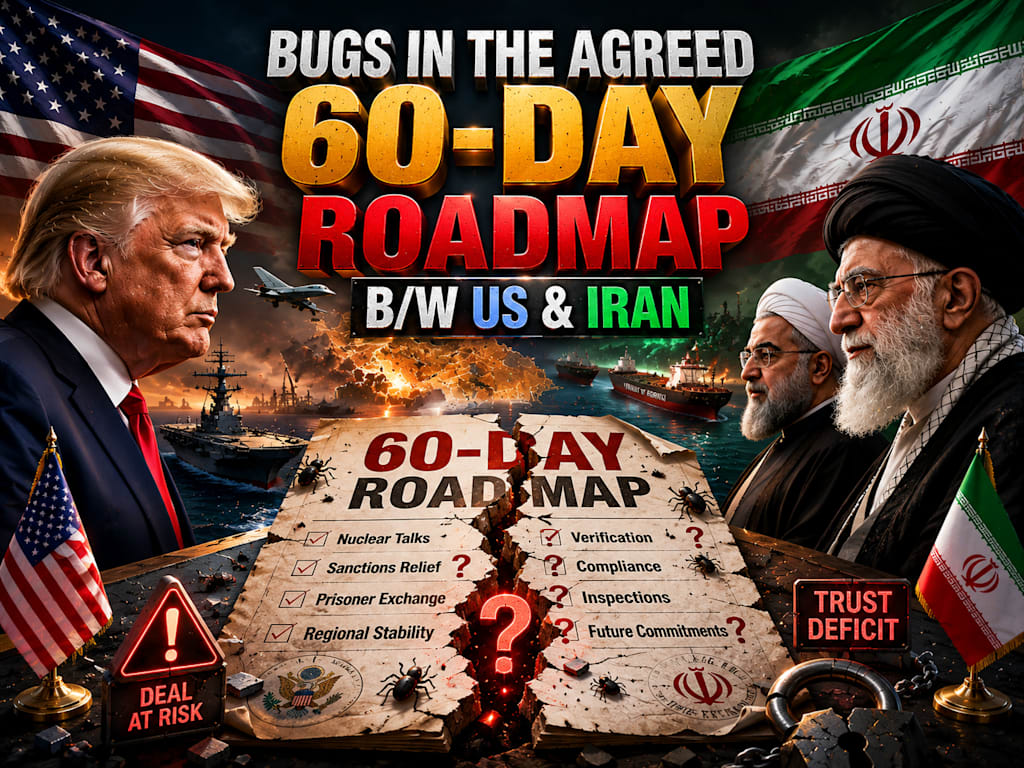
Bugs in the Agreed 60-Day Roadmap Between the US & Iran
The recently announced 60-day roadmap between the United States and Iran has been welcomed by many governments as a significant diplomatic breakthrough. After months of military tensions, missile exchanges, economic uncertainty, and fears of a wider regional conflict, the agreement offers a rare opportunity for both sides to step back from confrontation and focus on diplomacy. However, while the roadmap has generated optimism, many experts believe it contains several weaknesses, loopholes, and unresolved issues that could threaten its success.
The first and perhaps most important problem is the issue of trust. For decades, relations between Washington and Tehran have been characterized by deep suspicion and political hostility. Previous agreements have often collapsed because one side believed the other was not fully honoring its commitments. Even if both governments enter negotiations with good intentions, decades of mistrust make cooperation extremely difficult. Every action is likely to be viewed through a lens of skepticism.
A second challenge involves Iran's nuclear program. The roadmap reportedly includes discussions regarding uranium enrichment, inspections, and transparency measures. However, these subjects have been among the most controversial issues in US-Iran relations for years. The United States seeks stronger monitoring and restrictions, while Iran insists on protecting what it considers its sovereign right to peaceful nuclear development. Finding a compromise acceptable to both sides remains one of the biggest obstacles.
Another potential bug in the roadmap concerns sanctions relief. Iran expects economic benefits if it complies with negotiated conditions. At the same time, American policymakers face domestic political pressure regarding sanctions policy. Questions remain about the timing, scope, and verification of sanctions relief. If expectations are not met quickly enough, frustration could grow on both sides and undermine confidence in the agreement.
Regional security represents another complicated issue. The Middle East includes numerous actors with different interests and priorities. Even if the United States and Iran make progress, actions by regional groups or neighboring countries could create new tensions. A military incident involving proxy forces, missile attacks, or border clashes could rapidly increase pressure on the diplomatic process.
The Strait of Hormuz remains a particularly sensitive area. As one of the world's most important energy corridors, it plays a critical role in global trade and oil transportation. The roadmap may reduce immediate tensions, but disagreements over maritime security, military patrols, and freedom of navigation could still lead to future disputes. Any incident involving commercial shipping or naval vessels could quickly become an international crisis.
Domestic politics also present a major risk. Leaders in both countries must consider public opinion, political rivals, and national security institutions. Agreements reached at the negotiating table sometimes face resistance at home. Changes in political leadership, election outcomes, or shifts in public sentiment could affect the implementation of the roadmap and create uncertainty about long-term commitments.
Another weakness involves the limited timeframe itself. Sixty days may be enough to start negotiations, but it is a very short period for resolving decades of disputes. Complex issues such as nuclear verification, sanctions policy, regional security arrangements, and economic cooperation typically require months or even years of detailed discussions. There is a risk that expectations are unrealistically high.
Communication failures are another concern. History shows that misunderstandings and miscalculations have often contributed to international crises. Military operations, intelligence reports, and political statements can sometimes be interpreted differently by opposing sides. Without effective communication mechanisms, even small incidents could escalate into larger confrontations.
Economic uncertainty could also complicate the process. Businesses and investors often wait for clear evidence of stability before making long-term decisions. If markets perceive the roadmap as fragile or temporary, economic benefits may be delayed. This could reduce incentives for continued cooperation and increase pressure on negotiators.
Despite these concerns, the roadmap still represents an important opportunity. The fact that both sides have agreed to engage in structured negotiations is itself a positive development. Diplomatic engagement provides a mechanism for addressing disagreements peacefully rather than through military action. International support from regional and global actors may also help maintain momentum.
The success of the roadmap will depend on several factors: political will, effective communication, realistic expectations, and a commitment to compromise. Neither side is likely to achieve all of its objectives immediately. Progress will require patience and a willingness to focus on long-term stability rather than short-term political victories.
In conclusion, the 60-day roadmap between the United States and Iran offers hope for reducing tensions, but it is far from a guaranteed solution. Trust deficits, nuclear disagreements, sanctions disputes, regional security concerns, and political pressures all represent significant challenges. Whether the agreement becomes a foundation for lasting peace or another failed diplomatic experiment will depend on the actions taken during the coming weeks. The world is watching closely, aware that the stakes extend far beyond the two countries directly involved.
About the Creator
Wings of Time
I'm Wings of Time—a storyteller from Swat, Pakistan. I write immersive, researched tales of war, aviation, and history that bring the past roaring back to life
Enjoyed the story? Support the Creator.
Subscribe for free to receive all their stories in your feed.
Comments
There are no comments for this story
Be the first to respond and start the conversation.