History
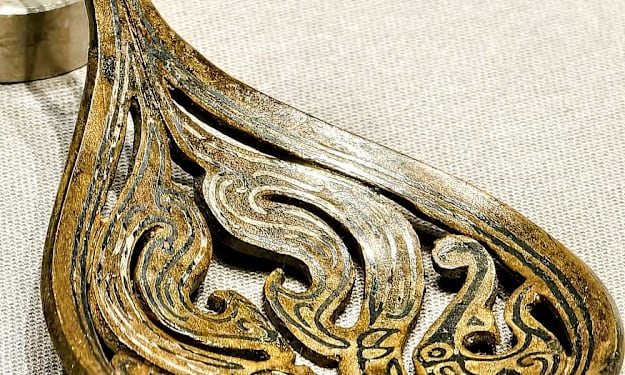
A Showcase of Museums of Ancient China——战国·错银铜匕
This bronze utensil was photographed at the 'Seeing China: Pre-Qin Silk Treasury Special Exhibition' in the Jingzhou Museum. It was unearthed in 1982 from Tomb No. 1 at Mashan, Hubei, a Warring States period tomb famous for its large collection of intact silk textiles. But this 2,000-year-old Chu spoon is just as exquisite. As a practical item from ancient daily life, it’s much more refined than what we use now.
By cn_exploreabout a month ago in Chapters
A Showcase of Museums of Ancient China——铜獬豸
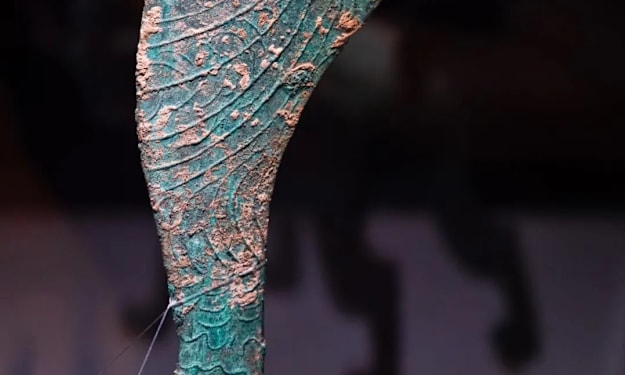
I came to the National Museum just to catch a glimpse of this Han Dynasty "铜獬豸" artifact exhibited here from the Gansu Provincial Museum. The lighting makes it appear even more magnificent than it did at the Gansu Provincial Museum.
By cn_exploreabout a month ago in Chapters
How the Dream of Reaching Paris Turned Into a Tragedy
Arriving in Paris, the family was robbed by a thief on their very first day. They lost everything — from documents to personal belongings. But the most frightening part wasn't the robbery itself; it was the complete inaction of the police, who drove past every day and did nothing about a person sleeping on a bench. No social service was willing to help, and even the Red Cross was powerless. Only kind people — of many different nationalities — kept offering help.
By Maryna Timofieievaabout a month ago in Chapters
One Idiom a Day: Chinese Wisdom in Stories
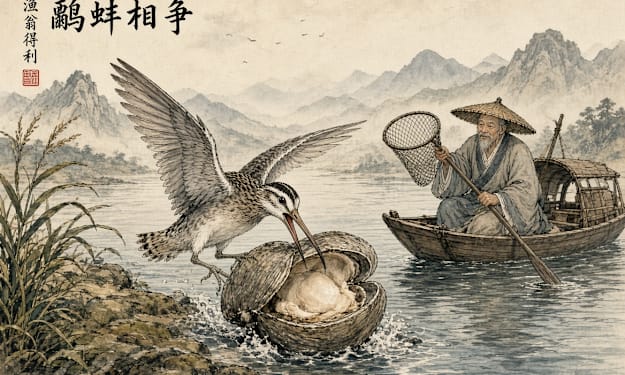
During the Warring States period, the State of Zhao was preparing to attack the State of Yan. Yan sent a diplomat named Su Dai to persuade the King of Zhao not to go to war. Instead of giving the king a long lecture, Su Dai told him a simple story.
By Frances Gaoabout a month ago in Chapters
What were the different types of beggars in ancient China, and what was their living situation like?
In ancient China, during the Han Dynasty, beggars were referred to as "qi gai" (乞丐), but at that time, beggars were not merely those seeking basic necessities such as food. Some also relied on unique personal skills to obtain various resources. Before the Song Dynasty, beggars were commonly known by different terms such as "qi ren" (乞人), and "gai ren" (丐人). It was only after the Song Dynasty that the term "qi ge" began to refer specifically to individuals who sought only survival resources.
By cn_exploreabout a month ago in Chapters
Why did they make thick porridge for the disaster victims in ancient times instead of just rice?
Cooking porridge (or “providing porridge”) is one of the oldest and most widespread relief measures in Chinese history. The reasons are as follows: It is the most efficient and has the widest coverage: Porridge is a liquid food. With the same amount of grain, when cooked into porridge, it can provide more people with food and enable more people to survive temporarily. The phrase “cooking with rice” is the most economical distribution method in times of extreme food shortage. Saving food: The victims of disasters are physically weak and it is difficult for them to digest dry food. However, liquid porridge is easier to absorb and can make the most of the limited food resources. When the government or local officials open their granaries to release food, if they simply distribute rice, the quantity is limited and it may lead to looting. Cooking and distributing porridge in a centralized manner can ensure fairness (at least in form). It is convenient for management and preventing fraud: Cooking porridge uniformly in a fixed porridge factory (relief site) makes it easier for the government to supervise and prevents the food from being repeatedly deducted at each level during distribution. Many capable officials in times of disaster relief would personally supervise the ratio of rice and water at the porridge factory to prevent the handlers from cooking it too thin. Caring for the weak: For the elderly, the weak, the sick, and the disabled, or those with missing teeth, porridge is the only food they can swallow. Food variety: The main ingredients are coarse grains, with rice and wheat as secondary. Regional differences: In rice-producing areas in the south, the relief food may be mainly rice; but in the north, it is more common to have millet (sorghum), wheat, beans, and even mixed porridge made from coarse grains (such as sorghum, bran, etc.). TV dramas usually only show white rice porridge, which is an artistic simplification. The quality of the food: The food used for disaster relief is often the old grain in the government granary or even the grain that is about to spoil or has spoiled. These grains are yellow in color and have poor taste, far from being comparable to new rice. In extremely severe famines, even these are not available, and “糠粥” (a mixture of rice bran and a small amount of grain) or even “substitute foods” such as tree bark and grass roots may be used to satisfy hunger. The consistency of the porridge: It is the key to survival. The consistency of the porridge directly affects the lives of the disaster victims. There is a famous standard in history, called “If a chopstick can stand upright in the porridge, it means the porridge is thick enough to save lives.” This means that if the chopstick can stand upright in the porridge, it indicates that the porridge is thick enough to sustain life. If it is as thin as water, the chopstick will fall over, and it will not be able to satisfy hunger.
By cn_exploreabout a month ago in Chapters
Episode 3: "Who Are the 'Tsogo' People?"
Greetings, everyone, and welcome back to another episode of "The African Latino." On the previous episode, I explained the history of the 'Ateke' people and how they survived through hardships. Today's episode will be about the 'Tsogo' people.
By Michael Reynoso2 months ago in Chapters
Episode 2: “Who Are The ‘Ateke’ People?”
Greetings, everyone. Welcome to “The African Latino.” In today’s episode, I will share with you in-depth information about the ‘Ateke’ peoples: who they are, their meaning, what they did during their daily lives, migration, survival, and staying true to their traditions.
By Michael Reynoso2 months ago in Chapters
From the Grimore of Livanna Thorn
A thousand lines circle in the air around us. Breaking and creating with each decision we make. New lines form when choices are made that were not first options in any given path. Others dissolve once a decision is past. It’s always changing and at times it’s impossible to watch them all. It feels special being able to watch them. Even if I will never know all the secrets that lie within them. Not in this life time at least. Perhaps the next. But there is one problem. There isn’t very many of us who can anymore. In part because witches are dying out. In part because no one really wants to learn about them. But I see them. And I have loved learning about them.
By Lane Burns4 months ago in Chapters
The Early history of Georgia
Georgia, a country at the crossroads of Europe and Asia, boasts a rich history that stretches back to ancient times. Its strategic location in the Caucasus region, between the Black and Caspian Seas, has made it a cultural and political hub for millennia. The story of Georgia’s origins, language, and writing reflects a unique blend of indigenous development and influences from neighboring civilizations.
By Gus Woltmann4 months ago in Chapters