
Alliance Against Pakistan & Turkey Underway
India Signs Defence Pact with Cyprus Amid Rising Regional Tensions

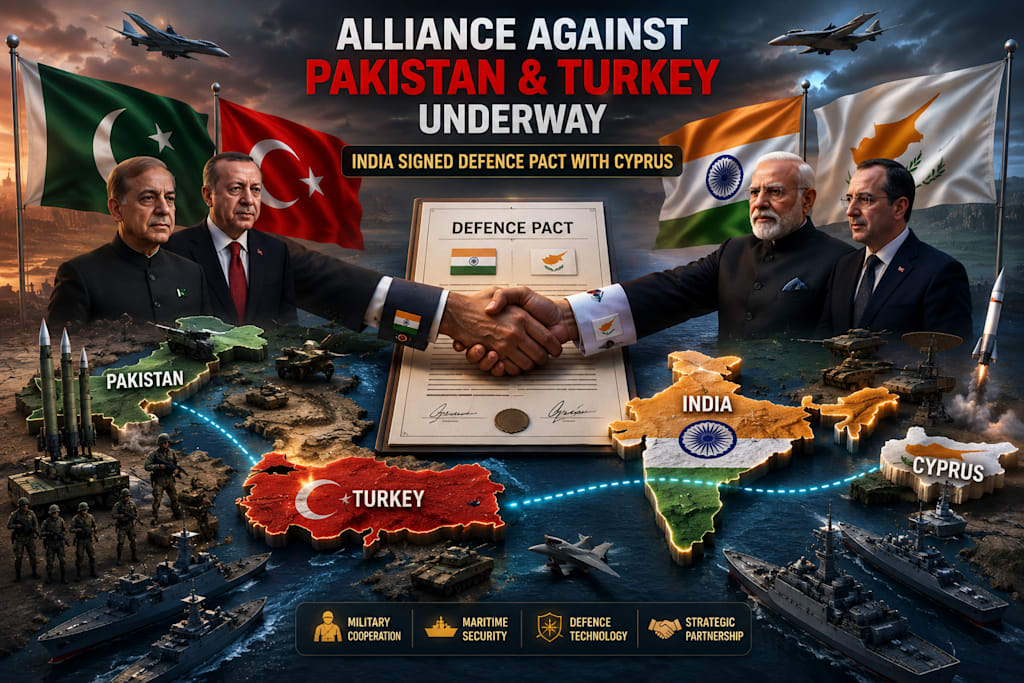
Alliance Against Pakistan & Turkey Underway
A new wave of geopolitical developments has increased international attention after India signed an important defence and strategic cooperation agreement with Cyprus. Analysts in South Asia and the Middle East are debating whether this growing partnership represents part of a wider regional alliance aimed at balancing the influence of countries such as Pakistan and Turkey. The agreement has triggered political discussions, diplomatic reactions, and growing concern about changing power dynamics in the Eastern Mediterranean and South Asia.
India’s expanding international defence partnerships have become a major part of its foreign policy in recent years. New Delhi has strengthened military, economic, and strategic ties with several countries across Europe, the Middle East, and the Indo-Pacific region. The defence pact with Cyprus is viewed by many experts as another step in India’s effort to increase its global diplomatic and military presence.
Cyprus holds an important strategic location in the Eastern Mediterranean, a region connected to Europe, the Middle East, and North Africa. The island has long-standing political tensions with Turkey because of territorial and maritime disputes. Turkey supports Northern Cyprus politically and militarily, while Cyprus maintains close relations with Greece and the European Union. Because of this regional background, India’s growing defence relationship with Cyprus has attracted significant international attention.
Some analysts believe the partnership indirectly challenges Turkey’s influence in the Mediterranean region. Turkey and Pakistan maintain strong diplomatic, military, and political relations, often supporting each other on international issues such as Kashmir and regional security. As a result, closer India-Cyprus cooperation is being interpreted by some commentators as part of a larger strategic balancing effort involving regional alliances.
India and Turkey have experienced diplomatic disagreements in recent years, especially regarding Kashmir and international political statements. Turkish leaders have publicly expressed support for Pakistan’s position on Kashmir, which has caused tension between Ankara and New Delhi. India, in response, has increased engagement with countries that have strategic differences with Turkey, including Greece, Armenia, and Cyprus.
The new defence agreement reportedly includes cooperation in military training, maritime security, defense technology, intelligence sharing, and strategic dialogue. The Mediterranean region has become increasingly important because of energy exploration projects, shipping routes, and military competition among regional powers. Stronger India-Cyprus ties could therefore influence wider geopolitical relationships in Europe and the Middle East.
Pakistan is carefully monitoring these developments because regional alliances can affect diplomatic balance and international influence. Pakistan and Turkey share strong military cooperation, defense production projects, and cultural ties. Turkish defense technology, including drones and naval cooperation, has strengthened military relations between Islamabad and Ankara over the years.
Some political analysts warn that rising military alliances can increase regional polarization. When countries form strategic partnerships based on rivalry, tensions often grow between competing blocs. History shows that military alliances can sometimes create instability if diplomacy and communication are ignored.
At the same time, supporters of India’s foreign policy argue that every sovereign nation has the right to develop international partnerships according to its national interests. India views itself as a rising global power with growing influence in defense, technology, and international trade. Expanding strategic partnerships with countries in Europe and the Mediterranean helps India increase its international reach.
Turkey’s role in global politics has also become more significant in recent years. Ankara has expanded influence through military technology, regional diplomacy, and economic cooperation across Asia, Africa, and the Middle East. Turkey’s independent foreign policy sometimes creates friction with Western countries, Greece, and other regional actors.
The Eastern Mediterranean has become one of the world’s most sensitive geopolitical regions because of gas reserves, maritime boundaries, military bases, and international trade routes. Countries including Greece, Cyprus, Turkey, Egypt, France, and Israel are all deeply involved in strategic competition there. India’s entry into regional defense cooperation adds another important dimension to this evolving landscape.
Modern international alliances are no longer limited to military agreements alone. Technology sharing, cybersecurity, trade routes, artificial intelligence, satellite systems, and energy security now play major roles in global strategic partnerships. Countries increasingly cooperate not only for defense but also for economic and technological advantages.
Media and social platforms have amplified public reactions to the India-Cyprus pact. Supporters describe it as smart diplomacy and strategic expansion, while critics fear it may increase divisions between regional powers. Social media discussions often become highly emotional, especially when national security and international rivalries are involved.
Experts believe diplomacy remains the most important tool for preventing conflict. Strong international communication, economic cooperation, and peaceful negotiations can reduce misunderstandings between nations. Military alliances may provide strategic advantages, but long-term stability depends on balanced diplomacy and mutual respect.
In conclusion, the India-Cyprus defence pact reflects changing geopolitical realities in today’s world. The agreement has raised questions about emerging alliances involving Pakistan, Turkey, India, and Mediterranean countries. Whether viewed as strategic cooperation or regional balancing, the development highlights how global politics is becoming increasingly interconnected. The future of regional stability will depend on diplomacy, careful leadership, and peaceful international cooperation rather than confrontation alone.
About the Creator
Wings of Time
I'm Wings of Time—a storyteller from Swat, Pakistan. I write immersive, researched tales of war, aviation, and history that bring the past roaring back to life
Enjoyed the story? Support the Creator.
Subscribe for free to receive all their stories in your feed.
Comments
There are no comments for this story
Be the first to respond and start the conversation.