Book of the Year
The Longest Academic Single-Theory Book That No One Will Read
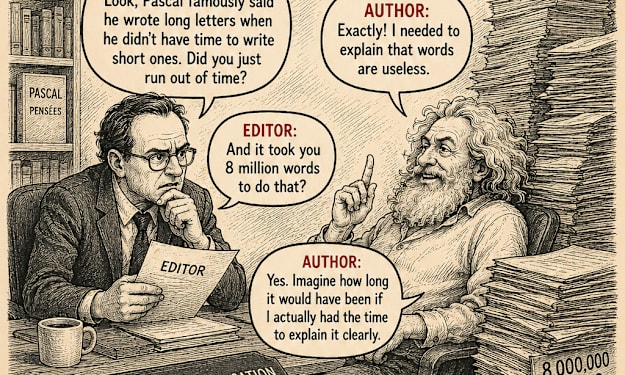
A New World Champion in the Age of Artificial Intelligence Human civilization has produced many intellectual monuments. The pyramids were built from stone. Medieval cathedrals were built from faith. Modern universities were built from institutions. Occasionally, however, a monument is built entirely from words. In 2026, a new contender entered the history of intellectual excess: The Miscommunication Trilogy by Peter Ayolov. Consisting of three volumes, seventy-two parts, 13,765 pages, and 8,094,752 words, it may represent the longest single-author academic work ever devoted to one unified theoretical framework. The subject of this immense undertaking is the Planned Obsolescence of Language, a theory exploring how communication systems generate, consume, transform, and ultimately destroy their own meanings. The trilogy follows a long tradition of linguistic scepticism associated with thinkers such as Max Müller, Karl Kraus, Fritz Mauthner, and Ludwig Wittgenstein, all of whom suspected that language creates as many illusions as it resolves. Yet none of them attempted to explain this problem across more than eight million words.
By Peter Ayolov5 months ago in BookClub
8 Life-Changing Books Worth Reading in a Weekend . AI-Generated.
Some books entertain us, others inform us—but a rare few fundamentally reshape how we think, act, and perceive the world. These are the kinds of books we can finish in a weekend, yet spend a lifetime reflecting on. In a fast-paced world where attention is fragmented and time is limited, choosing the right book matters more than ever.
By Diana Meresc5 months ago in BookClub
7 Best Mystery Thriller Books You Should Read In 2026 . AI-Generated.
Mystery thrillers occupy a unique space in literature. They combine the intellectual challenge of solving a puzzle with the emotional intensity of suspense, creating stories that keep us turning pages late into the night. Whether it's a detective unraveling a complex crime, a psychological battle between predator and prey, or a shocking twist that changes everything we thought we knew, the best mystery thriller books deliver an unforgettable reading experience.
By Diana Meresc5 months ago in BookClub
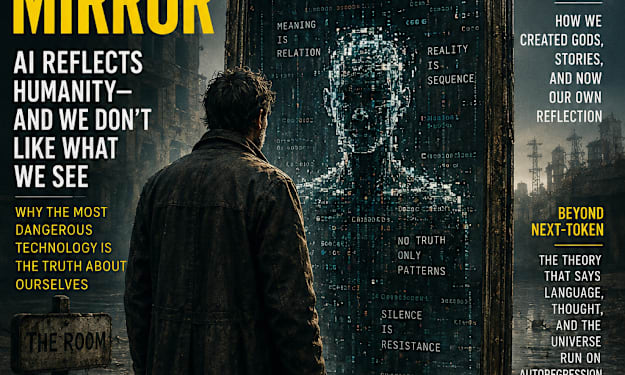
Ultimate Mirror of Artificial Intelligence
Why Artificial Intelligence May Be the Most Dangerous Ultimate Mirror Humanity Has Ever Created? Before confronting the final implications of artificial intelligence, it is necessary to acknowledge the disturbing image that the ultimate mirror presents. If large language models are indeed reflections of human intelligence, and if the reflection appears less profound, less rational, and less grounded than humanity once imagined, then an uncomfortable conclusion emerges. The image may reveal something not merely about machines but about their creators. For thousands of years human beings have imagined intelligence as the defining characteristic separating them from animals, elevating them above nature, and perhaps even connecting them to the divine. Yet the mirror offered by artificial intelligence suggests a different possibility. Human thought itself may be built upon mechanisms far simpler, more recursive, and more fragile than philosophy, religion, and science have traditionally assumed.
By Peter Ayolov5 months ago in BookClub
The Last Reader: A Monument at the End of Language
The Last Reader: A Monument at the End of Language Every age produces its intellectual monuments. Some are built from stone, some from institutions, and some from ideas. The Miscommunication Trilogy belongs to a rarer category: a monument constructed almost entirely from language itself. Consisting of three volumes, seventy-three parts, 13,765 pages, and more than 8 million words, it represents one of the largest single-author academic projects ever completed around a unified theoretical framework. Since the nineteenth century, only a handful of intellectual undertakings can be compared to it in scale and ambition. Karl Marx spent decades constructing the theoretical architecture of historical materialism. Pitirim Sorokin devoted thousands of pages to tracing the dynamics of social and cultural change across civilizations. Yet both projects emerged in an era when knowledge remained comparatively scarce, archives remained physically localized, and information travelled slowly. The present work emerges from the opposite condition: an age of informational excess, digital saturation, and communicative overload. If Marx confronted industrial capitalism and Sorokin confronted the cyclical transformations of culture, this trilogy confronts the unprecedented explosion of language itself. The project was completed over approximately five years during one of the most remarkable technological transitions in intellectual history. During its composition, artificial intelligence ceased to be a speculative possibility and became a publicly accessible reality. ChatGPT appeared, evolved, and entered everyday life while the trilogy itself was still being written. As a result, the work occupies a unique historical position. It began in one intellectual era and concluded in another. It was conceived before the widespread adoption of large language models and completed after their arrival had fundamentally altered assumptions about writing, knowledge, authorship, communication, and intelligence. Rather than resisting this transformation, the project incorporated it into its own development. The emergence of artificial intelligence became both a research object and a research instrument, creating a peculiar feedback loop in which the theory of communication evolved alongside one of the most significant communicative technologies ever invented.
By Peter Ayolov5 months ago in BookClub
The Planned Obsolescence of Intelligence, Table of Contents of THE MISCOMMUNICATION TRILOGY, 2026
Predictive Creatures: The Collapse of the Speaking Animal The Architecture of a Linguistic Catastrophe The Planned Obsolescence of Intelligence is far more than a conventional table of contents or companion volume. It functions as an intellectual map of an ambitious investigation into the history, philosophy, politics, psychology, and future of human communication. Standing above the three volumes of the Miscommunication Trilogy like a panoramic observation platform, the book offers readers an opportunity to examine the entire landscape of linguistic civilization from a single vantage point. Its central proposition is both simple and unsettling: language contains within itself the mechanisms of its own deterioration. Human beings tend to imagine communication as a tool designed to create understanding, cooperation, and progress. Yet the work argues that communication simultaneously generates misunderstanding, fragmentation, conflict, and intellectual decay. The planned obsolescence of language is therefore not a malfunction but an inherent feature of complex linguistic systems. Every ideology, political doctrine, religious vision, scientific paradigm, and cultural narrative eventually exhausts itself and becomes obsolete, only to be replaced by new forms that repeat the same cycle. One of the book’s most compelling strengths lies in its ability to connect seemingly unrelated subjects into a coherent explanatory framework. The discussion moves from political propaganda to cybernetics, from the Tower of Babel to artificial intelligence, from Wittgenstein and Mauthner to social media and large language models. Rather than presenting isolated academic topics, the work reveals recurring patterns operating beneath them. The same linguistic mechanisms that create political slogans also shape technological narratives. The same forces that produce collective enthusiasm later generate collective disappointment. Utopias transform into dystopias, certainty dissolves into ambiguity, and communication gradually produces the very miscommunication it seeks to overcome. The analysis of ideological language is particularly effective because it avoids simplistic political partisanship. Instead of targeting one ideological position, the work examines ideology itself as a linguistic phenomenon. Every belief system attempts to stabilize meaning and create a coherent vision of reality. Yet language refuses permanence. Words change, contexts shift, and interpretations multiply. The result is an endless process of semantic erosion. Political systems therefore depend on a constant renewal of slogans, symbols, and narratives. The language of power continually replaces itself because older formulations lose their persuasive force. What appears as intellectual progress often conceals a deeper process of linguistic recycling. The book’s exploration of communication technologies is equally significant. From writing and print to television, the internet, and artificial intelligence, each technological innovation promises greater understanding and efficiency. Yet each simultaneously contributes to new forms of fragmentation. The historical narrative presented throughout the trilogy suggests that technological progress and communicative decline frequently advance together. The result is a deeply provocative challenge to modern assumptions about information, education, and collective intelligence. Rather than celebrating technological expansion uncritically, the work asks whether humanity may be constructing increasingly sophisticated systems that reproduce misunderstanding on an ever larger scale.
By Peter Ayolov5 months ago in BookClub
8 Best Psychology Books You Need To Read In 2026 . AI-Generated.
Psychology is more than an academic discipline—it is a roadmap to understanding ourselves and the people around us. Every decision we make, every habit we build, every relationship we nurture, and every goal we pursue is influenced by psychological principles. Whether we realize it or not, our minds shape our reality.
By Diana Meresc5 months ago in BookClub
8 Short Books You'll Love Reading This Weekend . AI-Generated.
We all know the feeling: we want to read more, learn more, and escape into great stories, but our schedules are packed. Between work, responsibilities, and endless digital distractions, finding time for a 500-page novel can feel impossible. That is exactly why short books are so valuable. They prove that a meaningful reading experience does not require weeks of commitment — sometimes a few focused hours are enough to transform how we think, feel, and see the world.
By Diana Meresc5 months ago in BookClub
8 Best Books That Will Hook You From the First Page. AI-Generated.
The best books do something magical within the first few pages: they create curiosity, spark emotion, and make us feel that we are stepping into a world we cannot leave. A truly captivating book does not slowly ask for our attention—it earns it immediately. Whether we are searching for a thrilling mystery, a powerful personal transformation, a breathtaking fantasy adventure, or a deeply moving literary experience, the right book can pull us in from the very first sentence.
By Diana Meresc5 months ago in BookClub
8 Best Modern Classic Books You Must Read In 2026 . AI-Generated.
In every generation, certain books rise above trends, time periods, and cultural shifts to become something greater than simple stories. These are the modern classic books—works that continue to shape how we think, feel, and understand the world long after their publication. They are not just “important reads”; they are literary experiences that challenge assumptions, expand empathy, and reveal uncomfortable truths about society and ourselves.
By Diana Meresc5 months ago in BookClub
8 Amazing Books You Should Be Reading Right Now. AI-Generated.
Books have always been more than collections of words on paper. They are maps of human experience, offering guidance through challenges, insight into unfamiliar worlds, and wisdom from some of the greatest thinkers, storytellers, and innovators in history. In a world filled with constant notifications, endless information, and rapid change, choosing the right books can feel overwhelming.
By Diana Meresc5 months ago in BookClub
8 Books You'll Read and Remember Why You Love Books. AI-Generated.
Books have a remarkable ability to change us. They transport us across continents, centuries, and even into the deepest corners of our own minds. In an age dominated by endless notifications, short-form content, and shrinking attention spans, there are still certain books that remind us why reading remains one of humanity's greatest pleasures.
By Diana Meresc5 months ago in BookClub