
The Planned Obsolescence of Intelligence, Table of Contents of THE MISCOMMUNICATION TRILOGY, 2026
Book Review

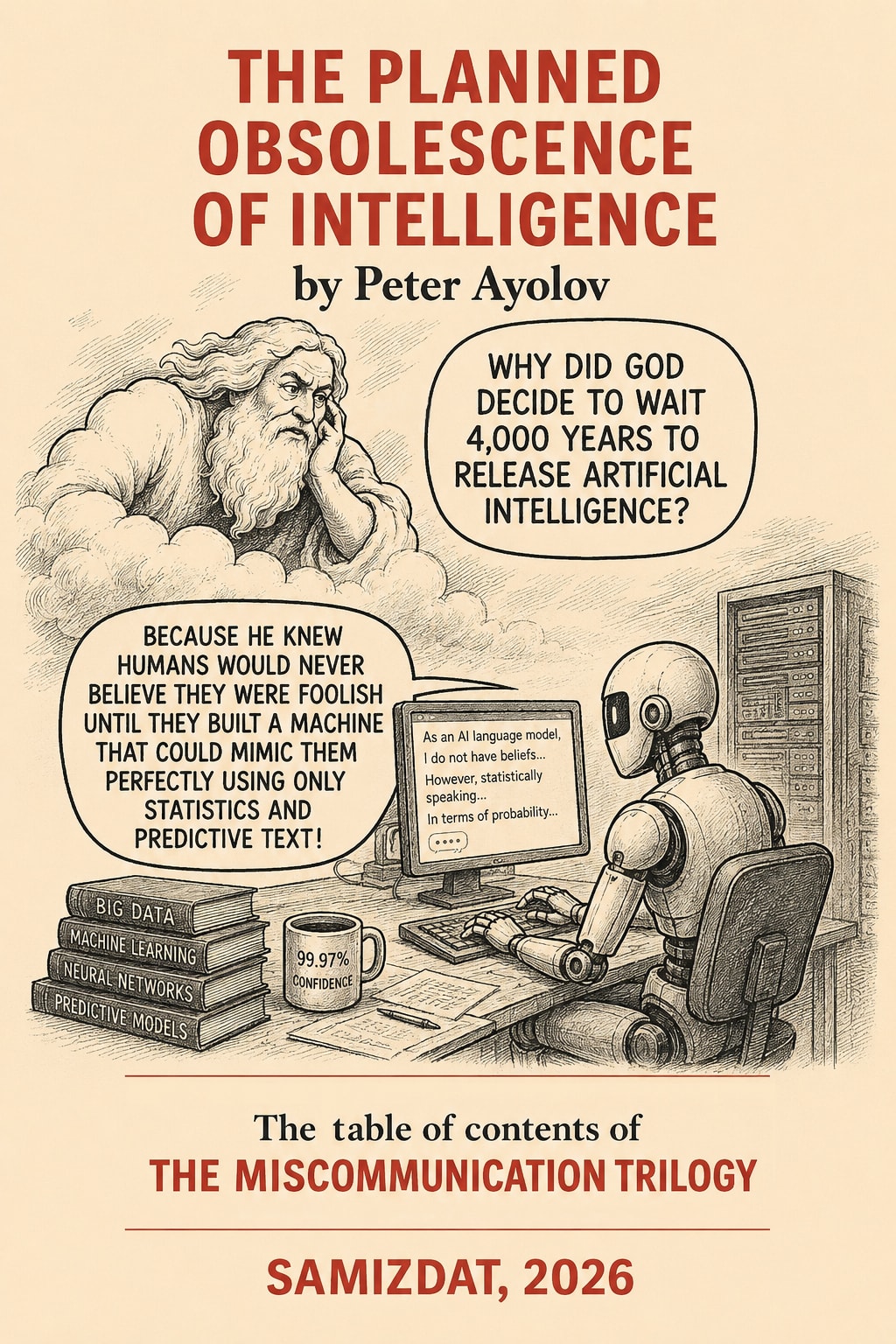
Predictive Creatures: The Collapse of the Speaking Animal
The Architecture of a Linguistic Catastrophe
The Planned Obsolescence of Intelligence is far more than a conventional table of contents or companion volume. It functions as an intellectual map of an ambitious investigation into the history, philosophy, politics, psychology, and future of human communication. Standing above the three volumes of the Miscommunication Trilogy like a panoramic observation platform, the book offers readers an opportunity to examine the entire landscape of linguistic civilization from a single vantage point. Its central proposition is both simple and unsettling: language contains within itself the mechanisms of its own deterioration. Human beings tend to imagine communication as a tool designed to create understanding, cooperation, and progress. Yet the work argues that communication simultaneously generates misunderstanding, fragmentation, conflict, and intellectual decay. The planned obsolescence of language is therefore not a malfunction but an inherent feature of complex linguistic systems. Every ideology, political doctrine, religious vision, scientific paradigm, and cultural narrative eventually exhausts itself and becomes obsolete, only to be replaced by new forms that repeat the same cycle. One of the book’s most compelling strengths lies in its ability to connect seemingly unrelated subjects into a coherent explanatory framework. The discussion moves from political propaganda to cybernetics, from the Tower of Babel to artificial intelligence, from Wittgenstein and Mauthner to social media and large language models. Rather than presenting isolated academic topics, the work reveals recurring patterns operating beneath them. The same linguistic mechanisms that create political slogans also shape technological narratives. The same forces that produce collective enthusiasm later generate collective disappointment. Utopias transform into dystopias, certainty dissolves into ambiguity, and communication gradually produces the very miscommunication it seeks to overcome. The analysis of ideological language is particularly effective because it avoids simplistic political partisanship. Instead of targeting one ideological position, the work examines ideology itself as a linguistic phenomenon. Every belief system attempts to stabilize meaning and create a coherent vision of reality. Yet language refuses permanence. Words change, contexts shift, and interpretations multiply. The result is an endless process of semantic erosion. Political systems therefore depend on a constant renewal of slogans, symbols, and narratives. The language of power continually replaces itself because older formulations lose their persuasive force. What appears as intellectual progress often conceals a deeper process of linguistic recycling. The book’s exploration of communication technologies is equally significant. From writing and print to television, the internet, and artificial intelligence, each technological innovation promises greater understanding and efficiency. Yet each simultaneously contributes to new forms of fragmentation. The historical narrative presented throughout the trilogy suggests that technological progress and communicative decline frequently advance together. The result is a deeply provocative challenge to modern assumptions about information, education, and collective intelligence. Rather than celebrating technological expansion uncritically, the work asks whether humanity may be constructing increasingly sophisticated systems that reproduce misunderstanding on an ever larger scale.
The Self-Consuming Machinery of Meaning
Perhaps the most original contribution of the book lies in its treatment of language as a self-consuming process. Traditional theories often assume that language exists primarily to represent reality. The argument developed here reverses that assumption. Language becomes a dynamic mechanism that continuously generates and destroys meanings. Words survive only by changing. Concepts remain relevant only by becoming different from what they originally were. Communication is therefore inseparable from obsolescence. Every successful linguistic construction carries within it the conditions of its future collapse. This insight provides the foundation for the book’s treatment of intellectual history. Political ideologies, philosophical systems, religious doctrines, and scientific theories are examined not as permanent achievements but as temporary formations within a larger cycle of construction and dissolution. The notion of self-consuming concepts serves as a powerful interpretive tool. Every comprehensive system eventually encounters contradictions that undermine its original coherence. The more successful an idea becomes, the more widely it spreads; the more widely it spreads, the more diverse its interpretations become; and the more diverse its interpretations become, the more difficult it becomes to maintain its original meaning. Success therefore contains the seeds of failure. The book’s engagement with thinkers such as Wittgenstein, Mauthner, Habermas, Postman, and numerous others demonstrates an impressive breadth of intellectual ambition. Yet the discussion remains accessible because these figures are woven into a larger narrative concerning the instability of communication itself. The critique of language becomes more than a philosophical exercise. It becomes a way of understanding modern civilization. Every communication system eventually accumulates distortions, ambiguities, and contradictions. These distortions are not anomalies but structural consequences of linguistic complexity. The treatment of propaganda is particularly noteworthy because it extends beyond conventional political analysis. Propaganda appears not merely as deliberate manipulation but as an inevitable by-product of large-scale communication. Whenever language attempts to coordinate vast populations, simplification becomes necessary. Complex realities are reduced to slogans. Ambiguities are transformed into certainties. Opponents become enemies, and disagreements become moral absolutes. The resulting narratives acquire extraordinary persuasive power precisely because they eliminate complexity. Yet this simplification also guarantees eventual collapse, since reality continually generates experiences that cannot be contained within ideological formulas. The discussion of silence represents an important counterpoint to these themes. Throughout the trilogy, silence emerges not as the absence of communication but as a possible response to linguistic exhaustion. When language becomes saturated with slogans, propaganda, and noise, silence acquires philosophical significance. It functions as resistance against automatic participation in systems of endless reproduction. The movement toward silence does not reject communication entirely but seeks a more authentic relationship with speech. This theme reaches its culmination in the suggestion that meaningful conversation may occur most fully within small communities bound together by trust, affection, and mutual understanding rather than within the vast impersonal systems of mass communication that dominate contemporary life.
Reality, Artificial Intelligence, and the Return of Babel
The final sections of the book move beyond the historical and political dimensions of communication toward a broader philosophical horizon. Here artificial intelligence becomes the central figure in an extraordinary intellectual reversal. Rather than treating large language models primarily as technological achievements, the work interprets them as mirrors reflecting the structure of human cognition. The significance of AI lies not in what machines reveal about themselves but in what they reveal about humanity. The machine exposes the possibility that human language has always functioned as a recursive system generating meanings through relationships among signs rather than through direct contact with reality. This conclusion gives the work its distinctive philosophical force. Large language models demonstrate that remarkable coherence can emerge through the simple prediction of what comes next. The implications extend far beyond technology. If language itself operates through recursive relationships, then meaning becomes less stable than previously assumed. Human beings may not possess direct access to reality through language. Instead, they inhabit a self-generating symbolic environment whose apparent solidity conceals perpetual movement and transformation. Artificial intelligence therefore becomes a computational mirror reflecting the mechanisms through which civilizations construct narratives, identities, beliefs, and systems of knowledge. The recurring image of Babel acquires new significance in this context. Traditionally interpreted as a story about linguistic diversity, Babel becomes a metaphor for the endless multiplication of interpretations. Every attempt to establish a universal language generates new ambiguities. Every effort to achieve perfect understanding creates new misunderstandings. The collapse of the tower is not an isolated historical event but a recurring feature of communication itself. Human beings continually rebuild Babel through new technologies, ideologies, institutions, and systems of knowledge. Yet every reconstruction contains the conditions of its future fragmentation. The book ultimately refuses both technological utopianism and cultural pessimism. It does not suggest that humanity can escape miscommunication, nor does it conclude that communication is meaningless. Instead, it presents communication as a tragic and creative process through which societies continually construct and reconstruct themselves. Meaning remains possible precisely because meanings remain unstable. Intellectual progress depends upon the obsolescence of previous certainties. New ideas emerge from the collapse of old ideas. Language survives because it never stops changing.
As a synthesis of the Miscommunication Trilogy, The Planned Obsolescence of Intelligence succeeds remarkably well. It unifies an enormous range of subjects without sacrificing conceptual coherence. More importantly, it transforms the study of communication into a profound meditation on the limits of knowledge, the instability of meaning, and the fragile position of humanity within an increasingly complex world. The result is a work that challenges readers to reconsider assumptions about language, truth, technology, and intelligence itself. By the end, the computational mirror reflects not merely the future of machines but the enduring paradox of human existence: the endless attempt to create meaning through a medium that simultaneously creates misunderstanding. In that paradox lies both the tragedy and the creative power of civilization, standing like a tower of words between the noise of history and the possibility of silence.
About the Creator
Peter Ayolov
Peter Ayolov’s key contribution to media theory is the development of the "Propaganda 2.0" or the "manufacture of dissent" model, which he details in his 2024 book, The Economic Policy of Online Media: Manufacture of Dissent.
Enjoyed the story? Support the Creator.
Subscribe for free to receive all their stories in your feed.
Comments
There are no comments for this story
Be the first to respond and start the conversation.