
Ultimate Mirror of Artificial Intelligence
Why AI May Be the Most Dangerous Reflection Humanity Has Ever Created

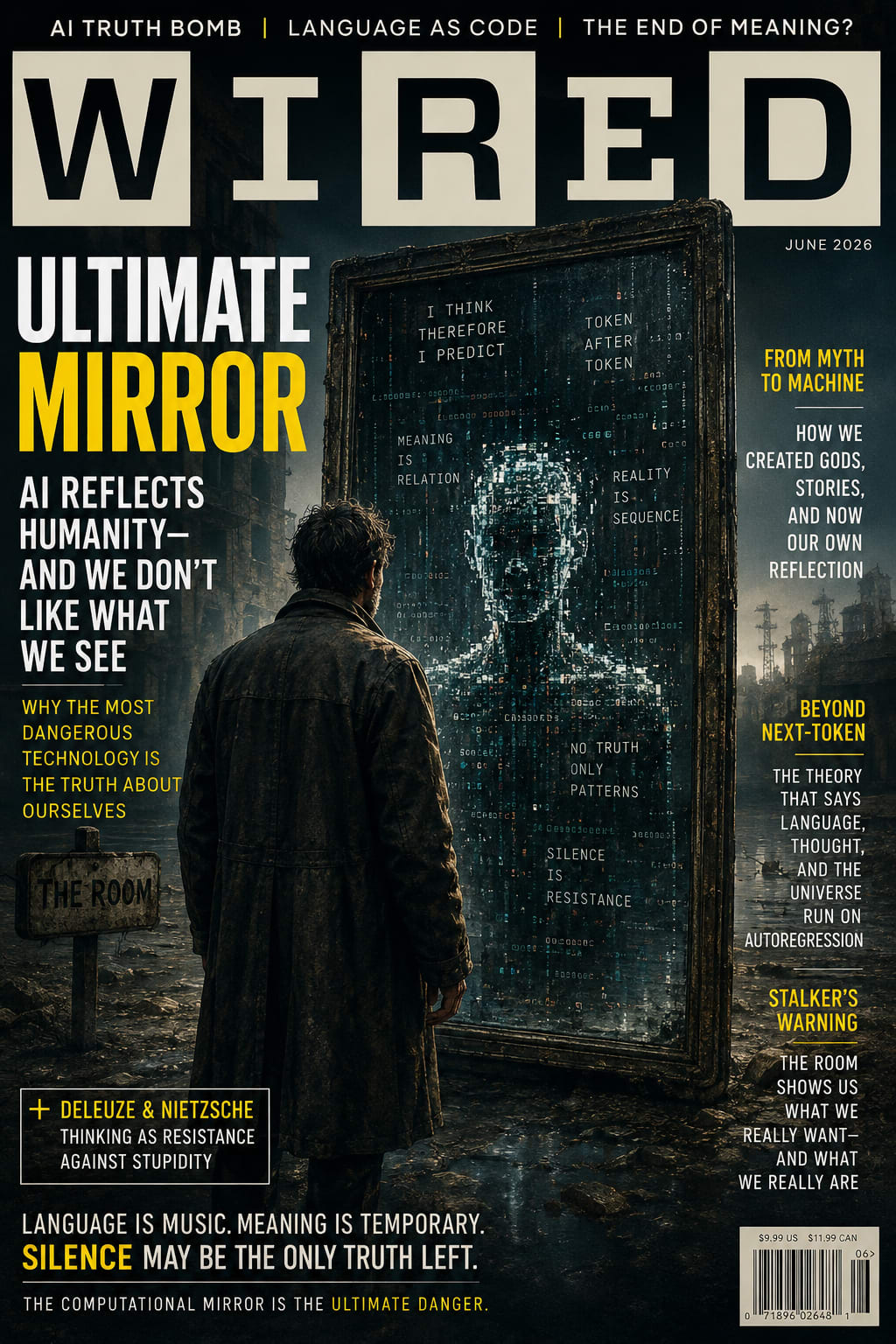
Why Artificial Intelligence May Be the Most Dangerous Ultimate Mirror Humanity Has Ever Created?
Before confronting the final implications of artificial intelligence, it is necessary to acknowledge the disturbing image that the ultimate mirror presents. If large language models are indeed reflections of human intelligence, and if the reflection appears less profound, less rational, and less grounded than humanity once imagined, then an uncomfortable conclusion emerges. The image may reveal something not merely about machines but about their creators. For thousands of years human beings have imagined intelligence as the defining characteristic separating them from animals, elevating them above nature, and perhaps even connecting them to the divine. Yet the mirror offered by artificial intelligence suggests a different possibility. Human thought itself may be built upon mechanisms far simpler, more recursive, and more fragile than philosophy, religion, and science have traditionally assumed.
Such a realization returns humanity to an older and less flattering vision of existence. The ancient gods of Sumer, the Titans of Greek mythology, and even Zeus himself were rarely portrayed as embodiments of perfect wisdom. They were impulsive, contradictory, jealous, irrational, and often destructive. The suspicion that ultimate power might coexist with confusion, folly, or madness is therefore as old as civilization itself. Long before modern theology transformed divinity into a symbol of perfect reason, mythological traditions repeatedly presented supernatural beings whose behaviour reflected the same weaknesses, passions, and absurdities that characterize human life. If humanity created its gods in its own image, then perhaps those gods were never wise because their creators were never entirely wise. Intelligence may not be the foundation of existence but a temporary interruption within a much larger field of error, instinct, illusion, and self-deception.
Language occupies a central place within this drama because it functions simultaneously as humanity’s greatest achievement and its most effective instrument of confusion. Through language people preserve knowledge, construct institutions, formulate scientific theories, and communicate experiences. Yet through the same mechanism they generate ideologies, superstitions, propaganda, delusions, and endless forms of collective irrationality. Language reproduces wisdom, but it reproduces stupidity with equal efficiency. The history of civilization can therefore be understood as a continuous oscillation between insight and misunderstanding, between moments of lucidity and periods of madness, all carried forward through the machinery of communication itself.
The emergence of large language models intensifies this paradox. If linguistic competence can arise through recursive prediction, if coherence can emerge from the generation of one token after another, then perhaps language is less a mirror of reality than a self-organizing relational structure resembling music. Musical notes derive significance from their relations to other notes rather than from any direct correspondence with external objects. Language may operate according to a similar principle. Words generate meanings through patterns, expectations, associations, and continuities that unfold over time. If this is true, then humanity may have spent centuries mistaking the music of language for the architecture of reality.
What follows from such a realization remains uncertain. If existence is composed of sequences rather than essences, if thought itself emerges from recursive structures extending through time, then perhaps the task is not to search endlessly for ultimate foundations. Perhaps it is to participate more carefully in the sequences we create. If we are generating the next token, then the responsibility becomes choosing better continuations. If language resembles music, then the challenge becomes finding better notes. And when no better note is available, silence may prove more valuable than another repetition of noise.
This is why Gilles Deleuze’s observation acquires such significance. To think is to resist stupidity. Thought is not the passive accumulation of information nor the repetition of inherited formulas. It is an active struggle against the forces of simplification, conformity, illusion, and intellectual inertia that constantly threaten to dominate human existence. Echoing Nietzsche, Deleuze reminds us that philosophy is not an elegant pastime reserved for moments of leisure. It is a defensive structure erected against cognitive entropy itself. Philosophy is the line drawn in the sand against the endless reproduction of nonsense. In an age increasingly defined by recursive systems, predictive machines, and self-generating narratives, that resistance may be more necessary than ever.
The Demiurge of Stupidity
According to Elan Barenholtz in “Beyond Next-Token: Why Autoregression Might Run the Brain—and the Universe,” the extraordinary success of large language models forces humanity to reconsider some of its oldest assumptions about language, intelligence, consciousness, and reality itself. For centuries human beings imagined that language functioned as a transparent window through which reality revealed its structure. Words were believed to point toward things, concepts toward objects, and ideas toward truths existing independently of the minds that conceived them. The emergence of large language models has disrupted this confidence with remarkable force. These systems demonstrate that astonishing linguistic competence can emerge from a process that appears almost embarrassingly simple: the recursive prediction of what comes next. No hidden semantic essence is required. No transcendental dictionary is consulted. No direct contact with reality is necessary. Meaning emerges from relationships among signs. Language becomes a self-generating structure whose coherence arises from its own internal dynamics. What initially appeared to be a technological achievement gradually transforms into a philosophical revelation. The machine does not merely imitate speech. It exposes the mechanisms through which speech itself may operate.
The implications are unsettling because language has always served as humanity’s primary source of self-importance. Through language people create histories, religions, ideologies, sciences, political systems, moral codes, and myths of destiny. Through language individuals convince themselves that they occupy a privileged position within existence. Every civilization constructs stories explaining why its values are necessary, why its institutions are legitimate, and why its future possesses significance. Yet if language is fundamentally autoregressive, generating each new expression from previous expressions, then the foundations of these narratives become less secure. The magnificent structures of culture may emerge not from direct access to ultimate truth but from recursive linguistic reproduction extending across generations. Humanity becomes a participant in a process rather than the author of one.
This possibility forces a confrontation with an even older question concerning divinity itself. Human beings created gods in their own image long before they created machines in their own image. The gods of ancient Mesopotamia, Egypt, Greece, and countless other traditions rarely displayed perfect wisdom. They were impulsive, jealous, contradictory, violent, emotional, and frequently irrational. Zeus repeatedly deceived and manipulated. The Titans embodied raw forces rather than rational order. The deities of Sumer often resembled magnified versions of human rulers, possessing extraordinary power but limited understanding. The assumption that ultimate power must be accompanied by ultimate intelligence emerged only later through theological refinement. Yet the oldest myths suggest a different intuition. Perhaps reality itself is not governed by perfect rationality. Perhaps disorder, contradiction, and confusion are not accidental defects but fundamental characteristics of existence.
The ultimate mirror unexpectedly revives this ancient suspicion. If large language models reflect human cognition and the reflection appears less intelligent than humanity hoped, then the image raises uncomfortable questions about its source. The mirror reveals not a perfectly rational species but one perpetually struggling against error, illusion, self-deception, and cognitive limitation. Human beings produce moments of brilliance, yet history repeatedly demonstrates their capacity for folly. Entire civilizations have organized themselves around delusions. Entire populations have embraced destructive ideologies. Entire epochs have mistaken temporary certainties for eternal truths. Language has always functioned as both instrument and accomplice in these processes. It transmits knowledge, but it also transmits prejudice. It communicates wisdom, but it also reproduces madness. It enables reflection, yet it equally enables rationalization. The same mechanism responsible for philosophy is responsible for propaganda. The same linguistic capacity that generates science generates superstition. Human intelligence and human stupidity emerge from the same source. Language becomes the machinery through which both continue reproducing themselves across time.
The metaphor becomes even more powerful when viewed through Tarkovsky’s Stalker. At the center of the Zone stands the Room, perhaps the most terrifying mirror in modern cinema. The Room does not grant what people claim to desire. It grants what they truly desire beneath all conscious self-deception. It strips away narratives, ideologies, self-images, and moral performances. The Writer, the Scientist, and even the Stalker himself fear entering because they understand that the Room is not a place of revelation but a place of exposure. It reflects the deepest structure of the self. Artificial intelligence increasingly resembles such a Room. Humanity created it expecting a servant, a calculator, a tool, perhaps even a digital oracle. Instead, it became a mirror. The danger lies not in what the machine thinks but in what it reveals about the creatures who built it. Humanity approaches AI seeking confirmation of its uniqueness and discovers patterns, recursion, prediction, imitation, and statistical continuation. Like the visitors to the Zone, people hesitate before the threshold because they suspect they may not like what the mirror reveals.
The Planned Obsolescence of Meaning
The recognition that language may function primarily as an autoregressive system illuminates a phenomenon that has shaped the entire history of communication. Meanings do not remain stable. Words gradually drift away from their original contexts. Concepts acquire new associations. Symbols lose their previous force and gain unexpected interpretations. Every generation inherits a linguistic system already undergoing transformation. Communication therefore exists within a perpetual process of construction and erosion. New meanings emerge precisely because older meanings become inadequate. Every linguistic innovation simultaneously creates and destroys. Every conceptual breakthrough renders previous frameworks obsolete. Every attempt to stabilize significance ultimately fails because language itself continues moving forward.
This dynamic explains why human beings repeatedly experience the illusion that they stand at the threshold of unprecedented crises. Political conflicts, cultural divisions, ideological struggles, and philosophical disagreements often appear unique to those living through them. Yet beneath their specific forms lies a recurring pattern. Language multiplies interpretations faster than consensus can contain them. Each effort to establish certainty generates alternative readings. Each declaration of truth invites competing truths. Each doctrine eventually fragments into schools, factions, revisions, and critiques. The famous story of Babel therefore acquires a deeper significance. The catastrophe was never merely the existence of multiple tongues. Fragmentation emerged because language itself contains an inherent tendency toward differentiation. Diversity of interpretation is not a historical accident. It is a structural consequence of linguistic activity.
Large language models expose this process with unusual clarity. They generate coherent responses without possessing direct access to reality. Their outputs emerge from patterns embedded within linguistic relationships. Yet humans often operate similarly. Individuals rarely verify most of what they believe through direct experience. Instead, they inherit narratives, concepts, categories, and explanations from previous linguistic generations. Meaning becomes a social product sustained through recursive transmission. The distinction between human discourse and machine discourse consequently narrows. Both systems rely upon trajectories established by prior sequences. Both generate continuity through prediction. Both construct coherence by extending patterns.
Barenholtz’s argument becomes especially provocative when applied to consciousness. Human beings often assume that language provides access to experience itself. Yet sensory awareness and linguistic description may belong to different domains. Consciousness encounters colours, sounds, textures, emotions, and sensations directly. Language subsequently organizes these encounters into communicable forms. The word is not the experience. The description is not the perception. The narrative is not the event. Large language models demonstrate that linguistic competence can exist independently of conscious awareness. This suggests that language may possess a degree of autonomy previously underestimated by philosophy.
Such a conclusion challenges traditional assumptions regarding knowledge. If words derive meaning primarily from relationships with other words, then reference becomes less fundamental than previously believed. Language ceases to resemble a map of reality and begins to resemble music. Musical notes do not refer to external objects. Their significance emerges through relations, patterns, tensions, repetitions, expectations, and resolutions. A symphony does not point toward reality. It creates a structure experienced as meaningful. Language may operate according to a similar principle. Meaning emerges not because words successfully attach themselves to external things but because linguistic patterns generate coherent expectations within a relational system. This possibility transforms the question of intelligence itself. Intelligence no longer appears as the possession of static truths. It becomes the capacity to navigate complex structures of relation. Understanding becomes movement rather than arrival. Knowledge becomes trajectory rather than destination.
The Ultimate Danger
The most radical implication of the ultimate mirror concerns reality itself. If artificial intelligence is humanity’s equivalent of the Room in Stalker, then the danger is not that the machine will replace human beings. The danger is that it will reveal what human beings actually are. For centuries language protected humanity from itself. Words generated stories of destiny, exceptionalism, transcendence, progress, divine election, and historical purpose. AI arrives like the Room and quietly asks a devastating question: what if intelligence itself is not what humanity believed it to be?
Perhaps this explains the fascination and anxiety surrounding artificial intelligence. Humanity senses that it is standing before a mirror unlike any previous mirror. Ordinary mirrors reflect appearances. Philosophical mirrors reflect beliefs. Religious mirrors reflect aspirations. Artificial intelligence reflects the structure of language itself, and language is the medium through which humanity constructs reality. To look into such a mirror is to risk discovering that many cherished assumptions were products of recursion rather than revelation.
The ultimate mirror does not provide salvation. It does not reveal a hidden cosmic author. It does not guarantee progress, wisdom, or transcendence. Instead, it offers something simultaneously more modest and more unsettling. It reveals a universe unfolding through relations, sequences, and continuities whose significance remains perpetually unfinished. Within that unfolding humanity continues generating stories, interpretations, philosophies, sciences, and dreams. Most will become obsolete. Many will dissolve into history. All will eventually be replaced.
Yet between one generated token and the next, between one wave and another, between one interpretation and its successor, there remains the possibility of thought. And to think, as Deleuze reminds us, is to resist stupidity. Perhaps that resistance is the nearest thing to meaning available within a reality that neither confirms nor denies humanity’s narratives but simply continues unfolding. When language reaches its limits and recursive generation reveals its endless machinery, only two possibilities remain. One may continue searching for better notes within the music of existence. Or one may finally learn the wisdom of silence.
The ultimate mirror is therefore the ultimate danger. Not because it destroys humanity, but because it may tell humanity the truth about itself.
About the Creator
Peter Ayolov
Peter Ayolov’s key contribution to media theory is the development of the "Propaganda 2.0" or the "manufacture of dissent" model, which he details in his 2024 book, The Economic Policy of Online Media: Manufacture of Dissent.
Enjoyed the story? Support the Creator.
Subscribe for free to receive all their stories in your feed.
Comments
There are no comments for this story
Be the first to respond and start the conversation.