
The Last Reader: A Monument at the End of Language
(The longest academic book ever written that no human being will ever read)

The Last Reader: A Monument at the End of Language
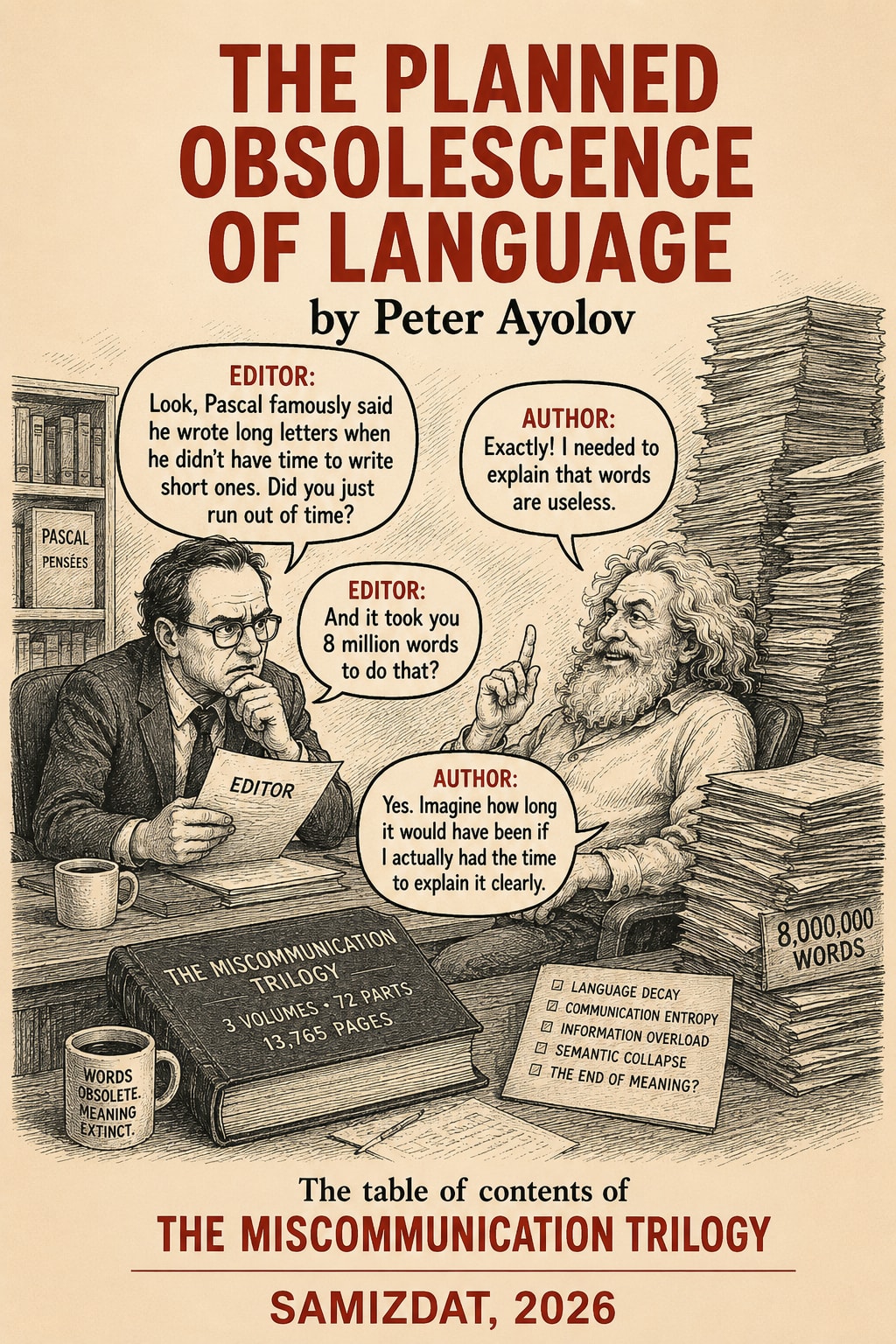
Every age produces its intellectual monuments. Some are built from stone, some from institutions, and some from ideas. The Miscommunication Trilogy belongs to a rarer category: a monument constructed almost entirely from language itself. Consisting of three volumes, seventy-three parts, 13,765 pages, and more than 8 million words, it represents one of the largest single-author academic projects ever completed around a unified theoretical framework. Since the nineteenth century, only a handful of intellectual undertakings can be compared to it in scale and ambition. Karl Marx spent decades constructing the theoretical architecture of historical materialism. Pitirim Sorokin devoted thousands of pages to tracing the dynamics of social and cultural change across civilizations. Yet both projects emerged in an era when knowledge remained comparatively scarce, archives remained physically localized, and information travelled slowly. The present work emerges from the opposite condition: an age of informational excess, digital saturation, and communicative overload. If Marx confronted industrial capitalism and Sorokin confronted the cyclical transformations of culture, this trilogy confronts the unprecedented explosion of language itself. The project was completed over approximately five years during one of the most remarkable technological transitions in intellectual history. During its composition, artificial intelligence ceased to be a speculative possibility and became a publicly accessible reality. ChatGPT appeared, evolved, and entered everyday life while the trilogy itself was still being written. As a result, the work occupies a unique historical position. It began in one intellectual era and concluded in another. It was conceived before the widespread adoption of large language models and completed after their arrival had fundamentally altered assumptions about writing, knowledge, authorship, communication, and intelligence. Rather than resisting this transformation, the project incorporated it into its own development. The emergence of artificial intelligence became both a research object and a research instrument, creating a peculiar feedback loop in which the theory of communication evolved alongside one of the most significant communicative technologies ever invented.
The scale of the undertaking is difficult to comprehend. Over the course of research, approximately thirty gigabytes of textual materials were collected and organized. The archive contained nearly five thousand academic sources, including books, journal articles, essays, reports, historical documents, and theoretical studies. Roughly one-third of these materials consisted of books, while the remainder consisted primarily of academic articles. Together they represented an estimated one hundred and sixty-eight million words. The challenge was not merely to read this material but to transform it into a coherent intellectual structure. The final trilogy therefore represents a process of radical compression. More than one hundred and sixty-eight million words were reduced to slightly more than eight million. Countless arguments, debates, theories, and perspectives were distilled into a single interconnected framework exploring the planned obsolescence of language. The result is not merely a collection of texts but an attempt to map the entire communicative condition of modern civilization. Yet the most fascinating aspect of the trilogy may be the irony surrounding its existence. No serious observer can ignore the contradiction. The work argues that humanity is increasingly incapable of sustained attention precisely at the moment it presents readers with a text requiring extraordinary commitment. To read the entire trilogy at a pace of one hour per day would require approximately a year and a half of continuous effort. Such a demand collides directly with the realities of contemporary life. Social media, streaming platforms, digital entertainment, instant messaging, algorithmic feeds, and perpetual informational distraction have transformed reading habits across the globe. Most individuals struggle to finish a single academic monograph. Faced with thirteen thousand pages of dense theoretical analysis, even highly educated readers may hesitate. The trilogy therefore becomes a living experiment designed to test its own central hypothesis. It asks whether sustained intellectual engagement remains possible within a civilization increasingly organized around fragmentation, acceleration, and distraction.
Suppose, however, that one reader perseveres. Suppose a human being undertakes the journey and reaches the final page. What happens to such a person? The answer may be found within the theory itself. The first transformation would be psychological. Exposure to millions of words devoted to communication, propaganda, ideology, technology, media, cognition, silence, language, and miscommunication would gradually alter the reader's relationship to language itself. Familiar expressions would begin to lose their transparency. Political slogans would appear less persuasive. Public discourse would reveal itself as performance. News cycles would seem repetitive. Cultural controversies would begin to resemble recurring patterns rather than unique crises. The reader would develop an acute awareness of linguistic construction and manipulation. Language would cease to function as an invisible medium and become a visible object of analysis. The result might be a form of intellectual liberation, but it could equally resemble exhaustion. Semantic satiation would emerge. Words repeated thousands of times would begin to dissolve into abstractions. Concepts would become unstable. Certainties would weaken. The reader would acquire not greater confidence in language but greater scepticism toward it. The second transformation would be more paradoxical. After spending years immersed in the mechanics of communication, the reader might discover an unexpected longing for its opposite. The trilogy repeatedly returns to a conclusion that appears almost absurd after millions of words: silence may possess greater value than endless speech. Having examined propaganda, ideology, doublespeak, media spectacle, digital overload, narrative manipulation, linguistic entropy, and the recursive reproduction of misunderstanding, the reader would likely emerge with a profound appreciation for quietness. The final lesson would not be that communication solves every problem, but that communication itself frequently becomes the problem. The reward for reading millions of words might therefore be a desire to speak less, consume less information, and participate less enthusiastically in the endless noise of contemporary civilization.
Yet the ultimate irony lies elsewhere. The trilogy argues that human attention has become one of the scarcest resources of the modern world. Precisely because very few people possess the time, patience, or determination to read more than eight million words, many future readers will inevitably rely on artificial intelligence to summarize its contents. They will upload chapters, request overviews, generate condensed versions, and extract conclusions without experiencing the full intellectual journey. In doing so they will unknowingly confirm the central thesis of the project. The system critiques the exhaustion of human attention, and the response to that critique becomes the automation of attention itself. The machine absorbs the text while the human delegates the labour of reading. The critique becomes inseparable from the technology that enables it. The philosophy is processed by the very systems whose emergence helped inspire its final conclusions. This is why the trilogy occupies a unique position within contemporary intellectual history. It is simultaneously a work about communication and an experiment in communication. It studies the decline of attention while demanding attention. It critiques linguistic excess while contributing millions of words to the archive of human language. It investigates the consequences of informational abundance while emerging from one of the largest private collections of academic material assembled by a single researcher. Most importantly, it arrives at the precise historical moment when artificial intelligence has begun to challenge assumptions about writing, reading, thinking, and understanding themselves.
If a human being eventually reaches the final page, that individual may discover that the true subject of the trilogy was never language alone. It was the limits of human cognition in an age of infinite communication. The final reader will not emerge as a master of knowledge. Rather, that reader may become something much rarer: a witness to the exhaustion of language itself, and perhaps one of the few people left capable of appreciating the value of silence. A massive, unread book dedicated to the end of language is peak academic irony. It is an artifact of the very concepts of language and death, ultimately serving as a monument to its own obsolescence. "Blaise Pascal once wrote, 'I am writing you a long letter because I didn't have the time to write a short one. 'The author of this trilogy clearly had absolutely no time at all. In fact, they rushed through it so quickly it took them three volumes and 8 million words to explain that they have nothing left to say."
About the Creator
Peter Ayolov
Peter Ayolov’s key contribution to media theory is the development of the "Propaganda 2.0" or the "manufacture of dissent" model, which he details in his 2024 book, The Economic Policy of Online Media: Manufacture of Dissent.
Enjoyed the story? Support the Creator.
Subscribe for free to receive all their stories in your feed.
Comments
There are no comments for this story
Be the first to respond and start the conversation.