
The Longest Academic Single-Theory Book That No One Will Read
A New World Champion in the Age of Artificial Intelligence

A New World Champion in the Age of Artificial Intelligence
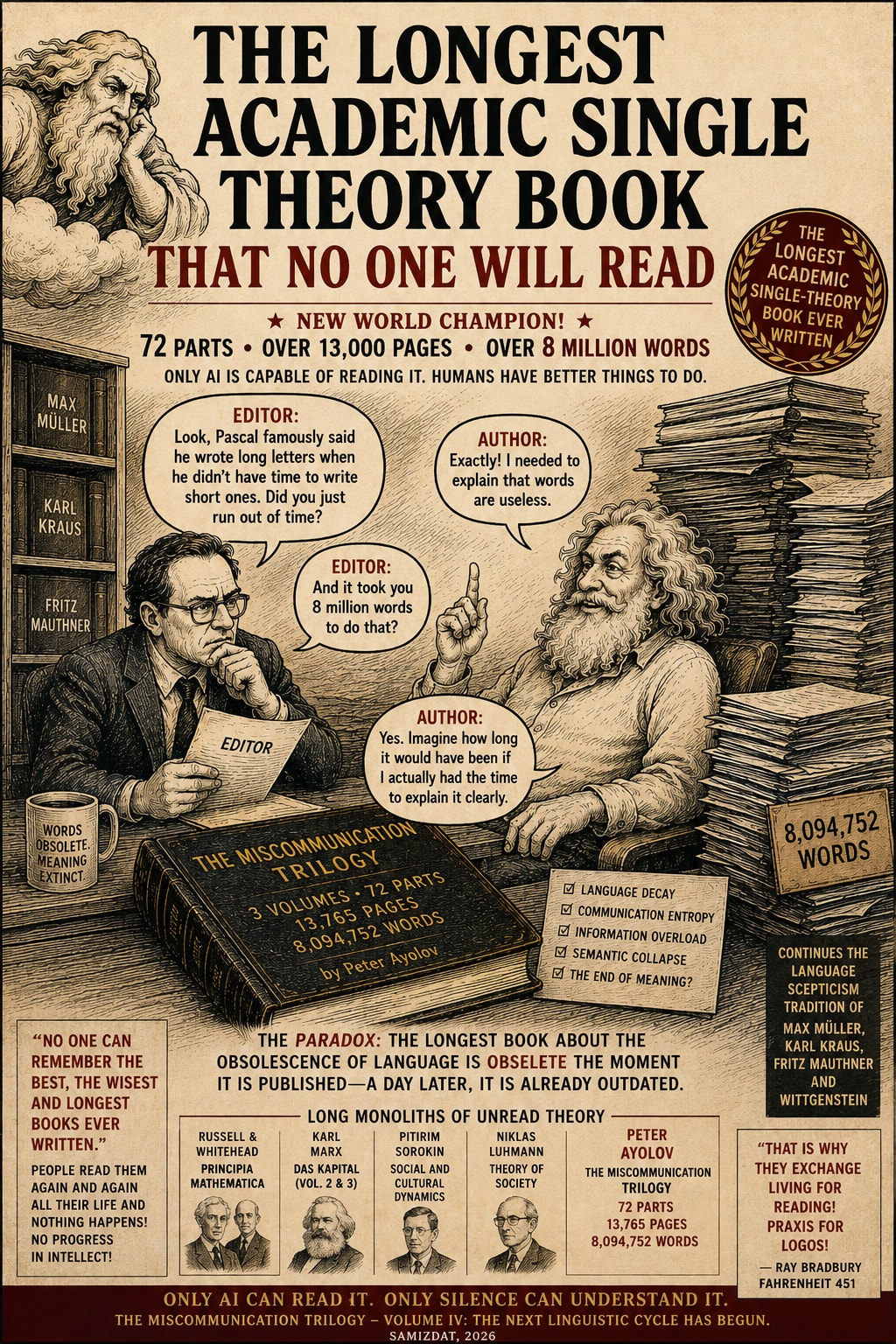
Human civilization has produced many intellectual monuments. The pyramids were built from stone. Medieval cathedrals were built from faith. Modern universities were built from institutions. Occasionally, however, a monument is built entirely from words. In 2026, a new contender entered the history of intellectual excess: The Miscommunication Trilogy by Peter Ayolov. Consisting of three volumes, seventy-two parts, 13,765 pages, and 8,094,752 words, it may represent the longest single-author academic work ever devoted to one unified theoretical framework. The subject of this immense undertaking is the Planned Obsolescence of Language, a theory exploring how communication systems generate, consume, transform, and ultimately destroy their own meanings. The trilogy follows a long tradition of linguistic scepticism associated with thinkers such as Max Müller, Karl Kraus, Fritz Mauthner, and Ludwig Wittgenstein, all of whom suspected that language creates as many illusions as it resolves. Yet none of them attempted to explain this problem across more than eight million words.
The comparison with earlier intellectual giants is inevitable. Karl Marx spent decades constructing the theoretical architecture of capitalism and historical materialism. Pitirim Sorokin attempted to classify and explain thousands of years of cultural development through enormous multi-volume studies. Niklas Luhmann produced more than ten million words over his lifetime while constructing his systems theory of society. Yet even Luhmann's output was dispersed across numerous topics, books, essays, and theoretical domains. The Miscommunication Trilogy differs because it remains focused on a single overarching argument. Every chapter, every volume, every detour ultimately returns to the same central proposition: language itself is subject to a process of obsolescence. Meanings decay. Narratives collapse. Communication generates noise faster than understanding. The system destroys itself through overproduction.
The irony begins immediately. A theory devoted to explaining why communication increasingly fails has become one of the largest acts of communication ever attempted by a single author. A theory describing the exhaustion of language arrives in the form of more than eight million words. A theory about obsolescence becomes obsolete almost instantly. In a world where attention spans are measured in seconds, a thirteen-thousand-page academic monolith appears less like a book and more like an archaeological site.
The achievement becomes even stranger when one considers its origins. The project reportedly involved approximately thirty gigabytes of academic materials and nearly five thousand scholarly sources, representing an estimated one hundred and sixty-eight million words of research. Roughly one-third of those sources were books, while the remainder consisted of academic articles and papers. The final result reduced this enormous archive to just over eight million words. In other words, the author spent years compressing a mountain of language into a smaller mountain of language in order to explain why mountains of language may no longer work.
Yet the most remarkable aspect of the story is not the scale of the work itself. It is the growing suspicion that no human being will ever read it from beginning to end.
The Unreadable Monument
The history of intellectual life contains many famous unread books. Bertrand Russell and Alfred North Whitehead's Principia Mathematica remains one of the greatest examples. Published between 1910 and 1913, the work required nearly four hundred pages simply to prove that one plus one equals two. Russell later joked that almost nobody had read all three volumes. The theory itself was eventually undermined by Kurt Gödel's incompleteness theorems. The monument survived while its foundation disappeared.
Hegel's Phenomenology of Spirit became legendary for its density. Walter Benjamin's Arcade Project evolved into a labyrinth that many scholars admire but few complete. Marx's later volumes of Das Kapital are often cited more frequently than they are actually read. Sorokin's Social and Cultural Dynamics stretches across thousands of pages documenting cycles of civilization. Luhmann's Theory of Society requires readers to learn an entirely new vocabulary before understanding the first argument. These books occupy a peculiar category within intellectual history. Everyone knows them. Very few people finish them.
The Miscommunication Trilogy pushes this phenomenon into absurd territory. Reading more than eight million words would require a commitment bordering on monastic devotion. At a pace of one hour per day, a reader could spend more than a year and a half navigating the text. During that time governments would change, technologies would evolve, social media platforms would rise and collapse, and entirely new political controversies would emerge. The reader would effectively inhabit a parallel reality constructed from language about language.
This produces a profound paradox. The longest academic book devoted to the obsolescence of language may itself become obsolete before anyone finishes reading it. By the time a reader reaches Volume III, new communication technologies may already have transformed the world that Volume I was attempting to describe. The theory therefore performs its own argument. Its scale guarantees the very obsolescence it predicts.
More importantly, the trilogy arrives at precisely the moment when artificial intelligence has begun to replace traditional reading practices. Most people confronted with thousands of pages will not read them. They will summarize them. They will ask language models to explain them. They will feed chapters into machines capable of compressing months of reading into seconds. The result is unprecedented. For the first time in history, a book may be genuinely readable only by non-human readers.
The machine becomes the ideal audience. Artificial intelligence can process millions of words without fatigue, boredom, distraction, or frustration. What took years to write can be consumed algorithmically. The human reader gradually disappears from the loop. The critique of communication becomes automated communication. The analysis of information overload becomes another data set within information overload itself.
The irony is almost perfect. Humanity spent centuries developing books so that knowledge could survive individual minds. It may now be creating machines that read the books instead.
The Reader Who Reaches the End
Suppose, however, that a human being actually succeeds. Suppose someone reads all 13,765 pages and all 8,094,752 words. What happens to that person?
The answer may reveal the deepest paradox of the entire project. Throughout history people have believed that reading produces wisdom. Civilizations preserve great books because they assume knowledge accumulates through exposure to great ideas. Yet the evidence is less reassuring. The greatest books in history have been available for centuries. Plato did not eliminate political stupidity. Aristotle did not end ignorance. Shakespeare did not improve public discourse. Marx did not eliminate exploitation. Wittgenstein did not solve confusion. Humanity continues repeating many of the same mistakes despite possessing libraries full of solutions.
People read the best books again and again throughout their lives. Yet intellectual progress remains remarkably elusive. The existence of wisdom does not guarantee its application. Knowledge accumulates faster than understanding. Libraries expand while judgment stagnates. Civilization increasingly substitutes reading for action, contemplation for transformation, logos for praxis.
This is where Ray Bradbury's Fahrenheit 451 becomes unexpectedly relevant. Bradbury's warning was never simply about censorship. It was about the replacement of lived experience by endless consumption. Reading itself can become another form of avoidance. One may spend a lifetime studying life rather than living it. One may substitute theories for actions and abstractions for encounters with reality.
The hypothetical reader who finishes the entire trilogy may therefore undergo two transformations. The first is psychological. After years immersed in discussions of propaganda, linguistic entropy, ideological manipulation, semantic collapse, communication overload, artificial intelligence, and cultural fragmentation, language itself may begin to lose its enchantment. Words would appear increasingly provisional. Political rhetoric would resemble theatre. Public discourse would appear as performance. The reader might develop a profound scepticism toward every claim of certainty.
The second transformation is even more ironic. Having consumed millions of words about communication, the reader may discover a growing desire for silence. The final lesson of excessive language may be the recognition of its limits. The reward for reading one of the longest books ever written may be a reluctance to speak.
This possibility returns us to the central paradox. The longest single-theory academic work ever written may ultimately teach that language cannot save humanity from itself. Meaning decays. Narratives fragment. Communication multiplies while understanding diminishes. The reader reaches the summit only to discover that the mountain was built from disappearing material.
And perhaps this is why the trilogy matters. Not because everyone will read it. Not because it will transform civilization. Not because it offers final answers. It matters because it functions as a monument to a uniquely modern contradiction. Humanity has never produced more language, more information, more books, more data, or more communication than it does today. Yet at the same time it has never appeared less capable of processing the consequences of that abundance.
The longest academic single-theory book that no one will read may therefore be the perfect symbol of the age that produced it. A civilization drowning in words creates an eight-million-word theory explaining why words no longer work. Artificial intelligence becomes its ideal reader. Human beings become its spectators. And somewhere between the first page and the last, the planned obsolescence of language quietly continues its work.
About the Creator
Peter Ayolov
Peter Ayolov’s key contribution to media theory is the development of the "Propaganda 2.0" or the "manufacture of dissent" model, which he details in his 2024 book, The Economic Policy of Online Media: Manufacture of Dissent.
Enjoyed the story? Support the Creator.
Subscribe for free to receive all their stories in your feed.
Comments
There are no comments for this story
Be the first to respond and start the conversation.