
The “Corpse-Skin Needle” Is Korea’s Hottest Anti-Aging Trend. Doctors Say the Data Stops at 20 Weeks.
Chinese women are flying to Seoul for a $450 injection made from donated human skin. The donors are dead. The clinical evidence is thin. And if something goes wrong, there is almost no way to trace it.
They Fly to Seoul to Inject the Dead’s Skin Into Their Faces
1
In August 2026, Fu Na from Guangdong was lying in a dermatology clinic in Seoul when she first heard the name Re2O.
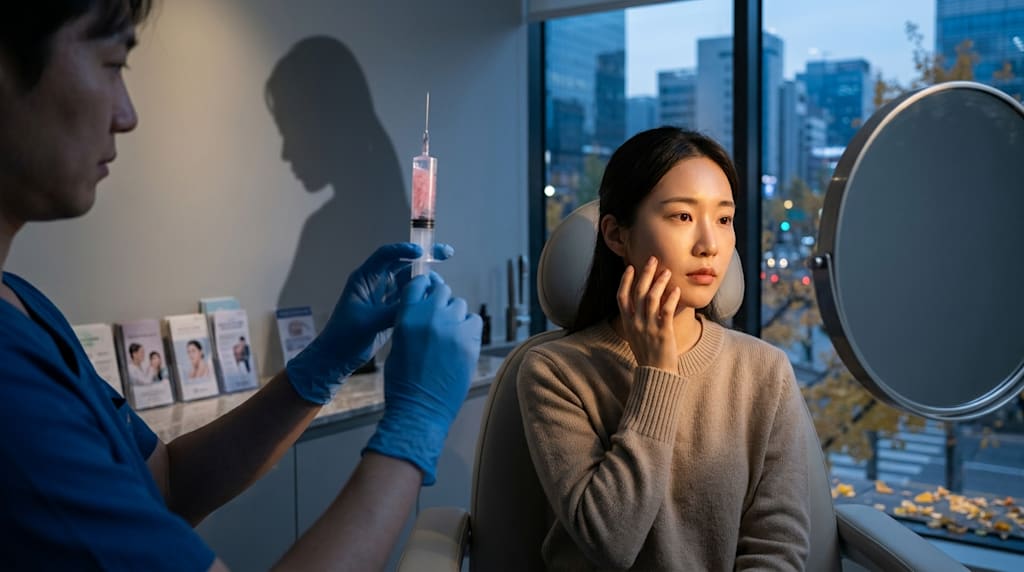
The doctor held a syringe in front of her and said it was the hottest anti-aging treatment in Korea right now. “Return to your 20s, you know?” She knew. She had flown three hours to get here for this one shot. 3,200 yuan, cheaper than she had expected.
When the needle pierced her dermis, she didn’t ask what the raw material was.
Forty minutes later, she sat in a café downstairs from the clinic and filmed a video with her phone’s front camera. Her skin did look brighter, maybe because of the lighting. She posted it on Xiaohongshu with the caption: “One trip to Korea and I basically got a new face. I really shouldn’t have doubted Re2O.”
The first comment was from a friend: “Do you know what this stuff is made of?”
She didn’t.
Three days later, on the flight home, she scrolled past a Weibo post. Re2O’s raw material comes from the skin tissue of deceased donors. Netizens call it the “corpse-skin needle.” She stared at the screen, her stomach churning. The flight attendant asked what she wanted to drink. She said nothing, thanks.
2
Elravie Re2O is made by the Korean biotech company L&C BIO and launched in Korea in November 2024. Re2O stands for “return to your 20s.” In clinics across Korea, Japan, and Singapore, it is packaged in clear syringes with plain labels, looking no different from ordinary hyaluronic acid.
The difference is in the raw material.
L&C BIO’s website says the material comes from “voluntarily donated human skin tissue.” After decellularization, which removes cellular components and genetic material, what remains is an extracellular matrix (ECM) made of collagen, elastin, and other proteins. That matrix is then micronized into an injectable. Once injected into the dermis, the ECM provides a scaffold for the recipient’s own skin cells to grow on, stimulating collagen regeneration and achieving “structural skin repair.”
The theory is elegant. The problem lies in those nine words: “removing cellular components and genetic material.”
Xue Ke, a plastic surgery specialist at Shanghai Pudong New Area Gongli Hospital, puts it more plainly: the goal of decellularization is to reduce immune rejection, but current technology still struggles to remove 100 percent of cells. “If cellular components remain in the extracellular matrix, those cells may carry the donor’s gene fragments. If the donor had a genetic disease, it could pose a health risk to the recipient.”
Chen Youbai, a committee member of the Plastic Surgery and Reconstruction Branch of the Chinese Association of Plastic and Aesthetic Surgery, adds another problem: ECM is a composite material, unlike hyaluronic acid, which is a single component. “Once a problem occurs, it is difficult to investigate and trace.” If hyaluronic acid goes wrong, doctors know it is the hyaluronic acid and can inject hyaluronidase. If ECM goes wrong, you don’t know whether it is the collagen, the elastin, or the 0.1 percent of cell fragments that weren’t properly removed.
Under the Weibo post Fu Na saw, someone asked: “So is there any genetic residue or not?” No one could answer. L&C BIO has not publicly released validation data for its decellularization process.
3
Re2O’s early study lasted 20 weeks.
Twenty weeks. Less than five months. The participants were the researchers who developed the product.
Ben Taylor-Davies, a British aesthetic practitioner, commented: “The marketing of this product has been stronger than the scientific validation.” Yoo Byung-wook, director of the International Healthcare Center at Soonchunhyang University Hospital in Seoul, was more direct at a National Assembly forum: some products are evaluated based on clinical trials with only about 20 participants, which “is insufficient by academic standards.”
Xue Ke offers a frame of reference: “After injection, at least 5 to 10 years of long-term observation and follow-up are needed to verify actual effects.” Re2O has been on the market for less than two years. Five-year follow-up data: zero. Ten-year follow-up data will have to wait until 2034.
In a consultation room at a dermatology clinic in Gangnam, Seoul, a doctor shows a Chinese customer a Re2O brochure. The brochure says “clinically validated” in large letters. Below it, in small print: 20-week follow-up study. The doctor uses a laser pointer to point at “clinically validated” and says, “See, there’s research.” Then he turns the page and starts showing before-and-after photos.
No one turns back to the previous page to ask what happened after those 20 weeks.
4
At the “15th K-Biohealth Forum” at the Korean National Assembly, lawyer Kwon Dong-ju stood up to speak. He said human tissue aesthetic products may violate the legislative intent of the current Human Tissue Safety and Management Act, and may even violate international norms. He called for an explicit ban on cosmetic uses of human tissue and for such products to be brought under drug or medical device approval systems.
Kim Hee-sun, director of the Blood and Organ Policy Division at the Ministry of Health and Welfare, responded with restraint: “The core purpose of the Human Tissue Act is patient treatment. Even in the aesthetic field, use should be limited to public-interest scenarios such as breast reconstruction.”
Public interest. When a donor’s family signs a consent form, they are thinking of burn patients, of women rebuilding after mastectomies. They do not imagine their loved one’s skin being turned into an injectable and shot into a Guangdong woman’s nasolabial folds.
Lee Dong-han, a professor at Sungkyunkwan University, presented survey data at the forum: among 1,034 adults, 60.9 percent supported banning or strictly restricting cosmetic uses of human tissue. About 70 percent of respondents said they were uncomfortable with procedures using tissue from deceased donors.
Korea has about 200 organ and tissue donors per year. If donated tissue is commercialized on a large scale for aesthetic use, no one knows what that number will become.
5
In Korea, Re2O is classified as “human tissue,” not a drug, not a medical device.
That classification decides everything. Drugs and medical devices must undergo rigorous clinical trial approval before market: Phase I, II, III, thousands of subjects, years of follow-up. For “human tissue” products, the regulatory focus is mainly infection control and contamination prevention. Biological safety? Clinical efficacy? Not within that framework.
Kwon Dong-ju pointed out an absurd contrast at the forum: “While other medical devices require years of testing and investment before market, some human tissue products face relatively lax standards.” Because regulators see them as “tissue transplants,” not “injectable fillers.” But their actual use is identical to hyaluronic acid and collagen fillers.
Korea’s Ministry of Food and Drug Safety has begun signaling tighter regulation. The agency said it considers cosmetic uses of human tissue “inappropriate” and is reviewing measures to restrict related advertising. But from “considering it inappropriate” to “issuing concrete regulations” lies a long bureaucratic process, industry lobbying, and more people flying to Seoul.
6
After returning to China, Fu Na deleted the video from Xiaohongshu.
She started searching for information about Re2O. On an aesthetic medicine forum, she saw a post: “Three months after Re2O, hard lumps on my face. Anyone else?” A dozen replies followed. Some said yes. Some said no. Some said, “You probably got a fake.” No one offered a solution.
She tried to contact the Seoul clinic, using a translation app to write a message asking whether the product had long-term safety data. The clinic replied: “Please rest assured, the product is legally marketed in Korea and is safe and effective.” She asked again: “Is there clinical data beyond five years?” The clinic did not reply again.
She considered going to Korea to pursue her rights, but did the math: flights, accommodation, translation, lawyer fees, more than ten times the price of the injection. And she wasn’t sure whether the lump on her face was really related to Re2O. Maybe she hadn’t slept well. Maybe she’d eaten too much spicy food those days. No evidence. The ECM had been metabolized. You cannot trace what it did to your face.
7
L&C BIO established a wholly owned subsidiary, Ains Biotech (Kunshan) Co., Ltd., in Kunshan, Jiangsu, in June 2020, and plans to initiate NMPA registration for Re2O in China in 2026.
Cui Haiyan, chief physician of the Plastic and Aesthetic Surgery Department at Tongji Hospital Affiliated to Tongji University, commented: Re2O “faces practical challenges at the raw material level, including cultural attitudes and social ethics; its safety and efficacy also require more sufficient clinical evidence.”
In practice: 20-week clinical data is extremely unlikely to pass NMPA review. China’s medical device approval requires complete clinical trial reports: sample size, follow-up duration, control group design, statistical methods, each with hard standards. Re2O’s current data does not even reach the first threshold.
For the foreseeable future, Chinese consumers who want Re2O can still only fly to Seoul. And the path to legal recourse for cross-border aesthetic medicine is essentially zero.
8
In the lounge of that dermatology clinic in Gangnam, Seoul, a brochure sits on the coffee table. Open to the first page, it introduces Re2O. The last line reads: “From life, for life.”
Not far away, a Chinese girl is taking a selfie in the mirror. She has just received her second injection. Her cheeks are slightly flushed, and the corners of her mouth keep turning up. She posts on WeChat Moments with the clinic’s logo and her faintly red face. The caption: “Second time. It really works.”
She does not ask the doctor whose skin it was, what that person liked in life, whether they had children, whether those children know that their mother’s skin became a syringe in a Gangnam clinic.
She will never know.
Autumn comes quickly in Seoul. The ginkgo leaves begin to fall. Outside the clinic, leaves are blown against the curb, piling up with cigarette butts, flyers, and disposable coffee cups. A cleaner sweeps them into a garbage bag, ties it shut, and throws it into the compactor truck.
As the truck drives away, the brochure is still on the coffee table, open to the last page, printed with the L&C BIO logo and a line of small text:
“We are committed to human health and beauty.”
No one turns to the next page.
About the Creator
Jin
Writer of reamstories
https://reamstories.com/jin
Enjoyed the story? Support the Creator.
Subscribe for free to receive all their stories in your feed. You could also become a paid subscriber, letting them know you appreciate their work.
Comments
There are no comments for this story
Be the first to respond and start the conversation.