
One Meal a Day for 10 Years: The Surprising Science Behind Louis Koo’s Extreme Discipline – and Why You Shouldn’t Copy It
Autophagy, metabolic cliffs, cortisol, and the gentler 16:8 method that gives you the benefits without the hair loss.
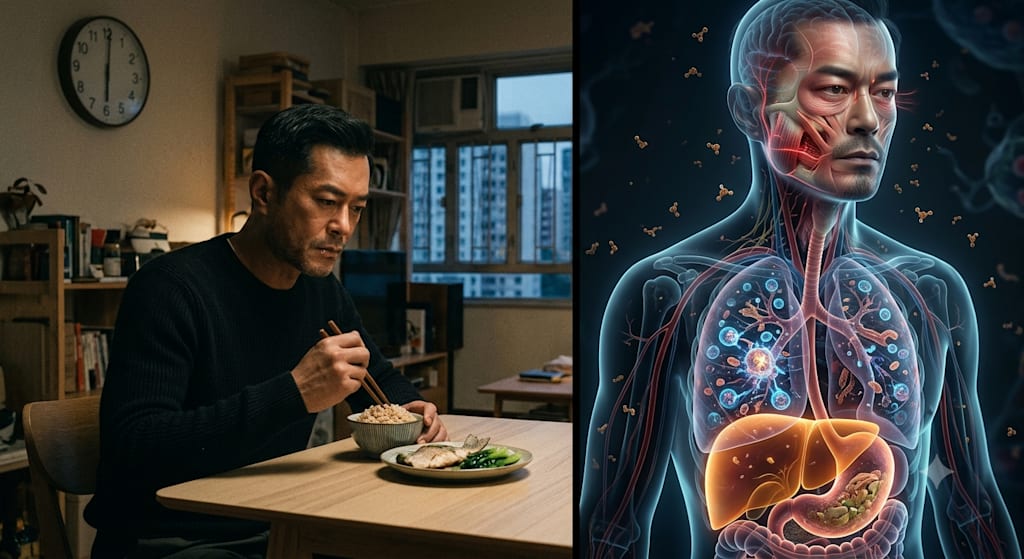
It’s 11 p.m. The cha chaan tengs in Mong Kok are still open.
Steam seeps through the gaps in the kitchen doors, mingling with the clink of ice cubes in iced lemon tea, the sizzle of stir‑fried noodles hitting a hot wok, and the brief screech of plastic chair legs scraping across the floor. For the night‑shift workers, the after‑party crowd, the insomniacs, this is the easiest hour of the day to break a rule. A bowl of wonton noodles. A plate of curry fish balls. Cheap, scalding comfort, available at any corner.
But for fifty‑three‑year‑old Louis Koo, at this hour, none of it exists.
He hasn’t touched a single bite of food at 11 p.m. for ten full years. Not even a peanut.
Ten years. 3,650 days and nights. He eats one meal a day, at 6 p.m., without exception. The rest of the time: no water, no food, nothing. The media calls it “ascetic discipline.” Fans use it as motivation. Wellness accounts package it as “Louis Koo’s secret to longevity.” But all of these narratives sidestep a more fundamental question:
When a person compresses the ritual of survival into a single daily act, is he extending the length of his life, or borrowing against its quality?
In 2016, Japanese cell biologist Yoshinori Ohsumi stood alone on the stage in Stockholm. He received the Nobel Prize in Physiology or Medicine for “the discovery of the mechanisms of autophagy.”
The term sounds like lab jargon. In plain language, it means four words: the body eats itself.
Not self‑destruction in the pathological sense, but a cleaning program that cells activate when starving. Lysosomes act like invisible hands, wrapping up damaged proteins, aging organelles, and excess waste, breaking them down into amino acids and fatty acids, and sending them back to the production line as fuel. When food runs out, the body wastes nothing. It would rather consume its own scrap than let a single calorie slip through its fingers.
In plain terms: hunger is the switch that turns on the body’s deep clean.
A year later, researchers at the University of Wisconsin‑Madison published a paper in Nature Metabolism. They divided mice into four groups: one group ate freely; a second group had 30% of their food replaced with indigestible fiber, providing bulk without calories; a third group ate the same fiber‑supplemented diet but were restricted to three meals a day; the fourth group ate the same fiber‑supplemented diet but were restricted to just one meal a day.
The results? The first three groups were unsurprising: less calories meant less weight. But the fourth group (the mice that had to endure a single daily feeding window) showed two unusual changes.
First, their blood sugar regulation improved dramatically. Insulin sensitivity increased; glucose entered cells faster than before. For the hundreds of millions of type 2 diabetics worldwide, this looked like a faint glimmer of light.
Second, their livers showed elevated levels of methionine. This is a crucial substance in epigenetics. DNA methylation (the process that “covers” genes to silence them and “uncover” them to express them) can’t function without it. In other words, prolonged fasting was reprogramming the mice’s gene expression, shifting them from “growth mode” to “repair mode.”
Even more striking were the long‑term data. The researchers continued feeding these mice until the end of their natural lifespans. The second group (calorie‑restricted but without meal frequency limits) lived only 9% longer than the control group. The third group (calorie‑restricted with three meals a day) also showed only a 9% increase. But the fourth group, fasting the longest, lived 20% longer.
And not just longer. Their fur stayed glossy into old age—no shedding, no graying. They ran faster through mazes. Their memories held up better.
So the researchers added a follow‑up experiment: if “longer intervals” matter more than “eating less,” what happens if you give mice unlimited food but still restrict them to one meal a day? The result was surprising: the effects were highly similar. What matters isn’t eating less. It’s waiting long enough between meals.
From an evolutionary standpoint, this makes perfect sense.
For the hundreds of thousands of years that Homo sapiens wandered out of Africa, there was no such thing as “three square meals a day.” You brought down a deer, you gorged. Then you might find nothing for the next day or two. The body had long since calibrated a backup system for switching between feasting and fasting. Our current state—timed feedings, constant snacking, sugar overload—is, by comparison, foreign to human genes. What Louis Koo is doing, biologically speaking, isn’t madness. He’s simply reverting to the feeding rhythm of the hunting age.
But here’s the problem: extrapolating a mouse experiment directly to a fifty‑three‑year‑old human being. There’s a chasm between them you can’t even see.
Most people who interpret “one meal a day” as “eating less” fall into the same trap.
Louis Koo’s single meal has nothing to do with an ordinary person’s dinner of a few mouthfuls of rice and a chopstickful of greens. He has to pack an entire day’s nutrition into that one window: high‑quality protein, complex carbohydrates, dietary fiber, micronutrients, totaling roughly 1,500 to 2,000 calories. He doesn’t eat three meals. He compresses three meals into one.
This brings us to a harsher physiological reality than mere hunger: the metabolic cliff.
After more than sixteen consecutive hours without food, the glycogen stored in the liver is nearly depleted. The body is forced to switch fuel sources. It begins breaking down fat, producing ketones, and the brain starts running on ketones instead. This state is called “keto‑adaptation.” The upside is mental clarity. The downside: the transition is a minor torture.
Severe headaches, halitosis, electrolyte imbalances, full‑body fatigue, insomnia at night, grogginess by day. You think it’s a failure of willpower. It’s actually your ion channels going on strike. Most people quit by the third day, not because they’re craving food, but because their bodies are screaming alarm.
Louis Koo has lasted ten years. That means his body crossed that cliff long ago and now runs smoothly on ketone fuel. But smooth doesn’t mean unworn.
Long‑term very‑low‑carbohydrate intake directly impacts thyroid function. The synthesis of T3 and T4 requires carbohydrate participation; without it, basal metabolism drops. Cold intolerance, fatigue, hair loss—these aren’t “aging.” They’re hormones declining. Male sex hormones are affected too. What you see on screen is a sharply defined jawline. What you don’t see are the biomarkers slowly drifting out of range.
And then there’s the factor that’s severely underestimated: cortisol.
When the body is starving, it doesn’t distinguish between “I’m voluntarily dieting” and “famine has arrived.” It only recognizes one signal: an energy deficit. The moment that signal appears, the adrenal glands start pumping cortisol to maintain blood sugar and keep you alive through the crisis. But cortisol’s long‑term side effects are robbing Peter to pay Paul. It breaks down muscle, suppresses immunity, and accelerates the loss of collagen.
That’s also why, in recent years, Louis Koo has occasionally been photographed off‑duty with sunken eye sockets and a face that looks both tighter and deeper than his actual age. That’s not thinness. That’s subcutaneous fat and collagen slowly leached away by years of elevated cortisol.
The mice in the experiment had glossy fur—that’s the mice’s business. Human skin, hair, bones, and organs operate on a slower, more hidden, less forgiving ledger. The account is tallied once a decade, and you don’t get to see the details in advance.
Fans who tried to emulate their idol ended up in the emergency room within a week.
Stomach pain, dizziness, hypoglycemic coma, biliary colic—the triage nurse takes one look and knows the story. “Another one who starved themselves into trouble.” To put it bluntly: for those with metabolic flexibility and favorable genetics, one meal a day is discipline. For everyone else, it’s self‑harm.
Roughly 20% of the population has naturally high metabolic flexibility. They switch between glucose and fat effortlessly, with high insulin sensitivity, and can fast for a day without major issues. Louis Koo likely falls into this bracket. But for the other 80%—especially those already with insulin resistance, prediabetes, or sludge‑like gallstones—one meal a day is like throwing stones into your own bile duct.
Bile pools continuously during fasting. Its concentration rises. Cholesterol crystals slowly form into solids that can wake you in agony at 3 a.m. Blood sugar spikes sharply after that single meal; the pancreas is forced to secrete massive amounts of insulin at once; over time, that pump wears out early.
The mouse experiment tells you “fasting longer has benefits.” It doesn’t tell you who’s doing the fasting.
It’s a healthy, young, genetically uniform lab animal. You are not.
But I’m not going to tell you to abandon the idea of “fasting longer.” Because the idea itself is correct. It just needs ninety percent of its intensity cut out.
The thing ordinary people can actually take from Louis Koo and that mouse isn’t “one meal a day.” It’s extending the interval of zero‑calorie intake. You don’t need to eliminate a meal. You just need to push dinner earlier and breakfast later. You’re still eating three meals, but your body gets a continuous fourteen‑to‑sixteen‑hour fasting window.
This method has a name: “16:8 intermittent fasting.” Eat your first meal at 10 a.m., finish your last by 6 p.m. For the remaining sixteen hours, drink only water or unsweetened tea. No full‑day hunger. No metabolic cliff torture. But it still triggers autophagy and still lowers fasting insulin levels.
More importantly, this is historically normal for humans.
In the Qin and Han dynasties, ordinary people ate twice a day: breakfast was called yōng, dinner was called sūn. Lunch didn’t exist. The Old English word for lunch, nonschench, breaks down into “noon” and “drink.” Medieval English people just had a beverage at midday. Three meals a day became the standard only after the Industrial Revolution. The factory whistle set the start and end of the workday; the lunch break appeared; lunch was retrofitted into the schedule.
If “eating by the clock” is an industrial‑age invention, then “eating by need” is a post‑industrial right you can reclaim.
You don’t have to imitate Louis Koo. You just need to move dinner from 8 p.m. to 6 p.m. That one thing, sustained, will deliver results not much worse than eating once a day. And your hair won’t fall out.
Louis Koo once addressed this in an interview. The reporter asked if he ever felt hungry. He paused, then said: “I’m just used to it. I don’t find it painful.”
If you listen closely, there’s an unspoken layer in that sentence: his body chose compliance in this ten‑year negotiation, but he never said the negotiation came without cost.
For the vast majority of people who simply want to live this life well, a little longer, a little more comfortably, the opposite of extreme discipline isn’t indulgence. It’s sustainability. Health is not a hundred‑meter sprint of self‑torture. It’s a marathon of long‑term coexistence. You don’t need to be that glossy‑furred mouse. You don’t need to be the man who hasn’t touched late‑night food in a decade.
There are only three things you need to do: get your gallbladder and blood sugar checked, move dinner up to 6 p.m., and eliminate that one sneaky bite before bed. Research repeatedly emphasizes that even a single sip of sugary drink during the fasting window will break the metabolic switch. Don’t let that one bite undo sixteen hours of waiting.
After all, the length of life isn’t about how many meals you eat.
Fasting a little longer might awaken the body’s repair crew. But fasting too long, and the repair crew goes on strike too.
Discipline is a virtue. But knowing how to find that narrow path between science and your own body—that’s the road an ordinary person can walk for ten years.
About the Creator
Jin
Writer of reamstories
https://reamstories.com/jin
Enjoyed the story? Support the Creator.
Subscribe for free to receive all their stories in your feed. You could also become a paid subscriber, letting them know you appreciate their work.
Comments
There are no comments for this story
Be the first to respond and start the conversation.