
My Face Burned for Years. A Dermatology Rotation Finally Gave It a Name.
What I learned about rosacea, why it gets mistaken for acne, and what actually helps.
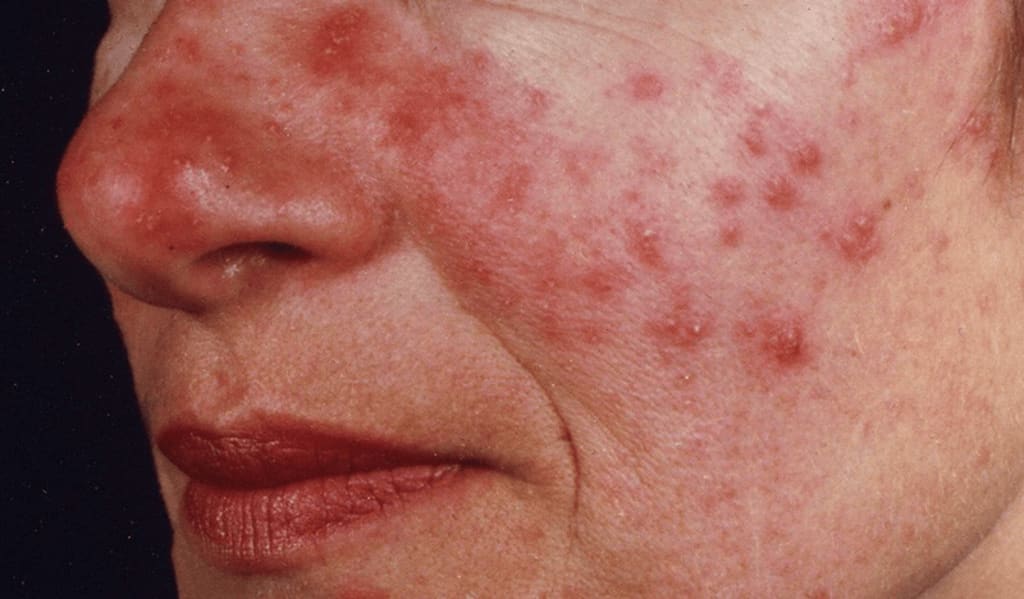
Over the past few years, my skin seems to have become increasingly sensitive.
It often turns red and dry. When I enter a room with a noticeably different temperature, my cheeks quickly become hot. At first I assumed this was simply an inevitable part of getting older, just as even oily skin, as it ages, must eventually embrace facial oils. It was only during my dermatology rotation that I discovered another possible explanation for these symptoms: rosacea.
The best-known symptom of rosacea is “rosacea nose,” but that is a more severe manifestation that appears only in certain subtypes at a later stage, and it is more common in men. Overall, women are the main affected group. Among adults worldwide, about 5.46% have experienced similar symptoms, but most of them do not know it is rosacea and have never received a full diagnosis.
This article draws on my experience both as someone affected by rosacea and as someone involved in diagnosis and treatment during a dermatology rotation. I will discuss the symptoms and causes of rosacea, how it differs from other common skin conditions, and what patients and those close to them can do to prevent it and reduce the chance that symptoms disrupt their lives.
This article is for general health and medical science education only. It does not constitute medical advice, diagnosis, or treatment, and cannot replace individualized evaluation by a doctor, pharmacist, or other qualified medical professional. If you have specific health concerns or need medical guidance, please consult a medical professional familiar with your personal history and circumstances. If you are taking prescription drugs, over-the-counter drugs, or other treatments long term, consult your doctor or pharmacist before starting, stopping, or adjusting any medication, supplement, or treatment plan.
I. Redness and burning are not just “thin skin”
The core symptoms of rosacea are redness and burning, which almost all patients experience.
When the skin is stimulated by temperature changes, sun exposure, emotional fluctuations, or spicy food, it suddenly becomes red and hot within seconds to minutes, then slowly fades. In a healthy state, once these external stimuli disappear, blood vessels naturally contract and facial color returns to normal. But in rosacea patients, the facial blood vessels are dysfunctional; once dilated, they have difficulty contracting again. As a result, patients not only flush easily, but the time it takes for erythema to fade also becomes longer and longer. Over time, episodic flushing gradually turns into a persistent background redness in the center of the face, especially the nose, cheeks, and chin.
Beyond the visual changes, rosacea also produces obvious physical sensations. Because local blood flow increases and nerve endings are in a highly active, sensitized state, patients often feel facial heat and burning. During a flare, the local skin temperature rises. At the same time, because chronic inflammation damages the skin’s natural defensive barrier, the skin becomes abnormally dry. When it comes into contact with ordinary skincare products, cleansers, or even plain water, it may produce strong stinging or burning. This is also why rosacea is often mistaken for a damaged skin barrier.
In addition, rosacea may cause many small red bumps to appear on the skin surface, as well as pustules containing white fluid. These are caused by local inflammation and immune responses. The most obvious difference from ordinary acne, commonly called “breakouts,” is that they have no comedonal structure at all. Even if squeezed, no hard oil plugs come out.
A small number of patients develop hyperplastic or enlarged tissue changes. Years of inflammatory mediator infiltration continuously stimulate fibroblasts and sebaceous glands in the dermis, leading to dermal fibrosis and thickening and marked sebaceous gland hyperplasia. This most often occurs on the nose, where sebaceous glands are most abundant, forming what is commonly called rhinophyma.
Less common symptoms also include effects on the eyes. In addition to facial symptoms, patients may have blepharitis, abnormally dry eyes, a foreign-body sensation, and even noticeable swelling of the tissues around the eyes. Many people initially attribute the discomfort to eye strain from looking at screens too long, or to ordinary conjunctivitis. In fact, this is inflammation that has spread to the ocular mucosa and meibomian glands.
In the past, the medical field divided rosacea into four subtypes: erythematotelangiectatic, papulopustular, phymatous, and ocular rosacea. In recent years, the trend has moved toward phenotype-based diagnosis and treatment. Instead of insisting on classifying patients by symptoms, doctors treat the symptoms that are present.
II. How is it distinguished from acne, seborrheic dermatitis, and a damaged barrier?
The symptoms of rosacea are highly misleading. Many people mistake facial erythema and papules for ordinary acne, seborrheic dermatitis, or simply a damaged skin barrier, and only think of seeking medical treatment when the redness does not fade for a long time.
The pathogenic mechanisms, predilection sites, and core symptoms of these conditions differ greatly, and their corresponding treatment approaches go in very different directions.
Ordinary acne, commonly called pimples, has as its core mechanism excess androgen secretion leading to overactive sebaceous glands, combined with abnormal keratinization of the pilosebaceous duct and an immune-inflammatory response triggered by imbalanced follicular microbiota. Its most characteristic feature is the presence of comedones, including open blackheads and closed whiteheads. Its distribution is not limited to the center of the face; it is widely distributed on the forehead, cheeks, jaw, and other sebaceous gland-rich areas, and may even spread to the chest and back. It is usually not accompanied by episodic facial flushing and telangiectasia. This is the main difference between it and rosacea.
Seborrheic dermatitis is a chronic inflammation closely related to Malassezia, a fungus commonly present on the skin. The current mainstream hypothesis holds that the root cause is a defect in the host’s epidermal barrier or altered sebum composition. These changes allow otherwise harmless Malassezia to become a dominant organism, and its metabolites, such as free fatty acids, then cross the damaged barrier and trigger inflammation. This fungus feeds on sebum, so seborrheic dermatitis is highly concentrated in the areas with the highest sebum production, such as the sides of the nose, between the eyebrows, around the hairline, and even the scalp. Its typical clinical presentation is dull red patches, often covered with greasy, yellowish scales, and patients experience marked itching. They usually do not have the burning and stinging common in rosacea.
Sensitive skin and impaired skin barrier function are usually not a primary disease. Instead, they result from over-cleansing, frequent acid peels, or extreme climate changes that thin the stratum corneum and deplete intercellular lipids. The core manifestation is strong stinging, tightness, and temporary redness in response to external stimuli such as applying daily skincare products or wind. Sensitive skin usually does not develop persistent erythema, nor does it produce papules and pustules out of nowhere. After stopping irritating behaviors, simplifying skincare, and repairing the stratum corneum structure, it often returns to a relatively healthy state. This is also a key difference from rosacea.
These skin conditions can coexist. When you have multiple symptoms, cannot clearly determine what is going on, and your response to treatment is not clear, consult a doctor. Depending on the situation, treatment may differ. For example, you may treat them simultaneously, or address problem A before problem B.
III. Causes: genetics, immunity, neurovascular reactivity, and environment
Modern medicine has not yet fully decoded all the pathogenic mechanisms of rosacea. The current scientific consensus is that it is a complex disease triggered by an interaction of local immune dysregulation, abnormal neurovascular reactivity, and environmental factors against a certain genetic background.
Modern medical treatment for rosacea has shifted from early simple antibacterial treatment toward phenotype-based selection of barrier care, topical drugs, systemic drugs, ophthalmic treatment, and light-based or medical aesthetic procedures, to suit different people’s symptoms and needs.
Not everyone will develop all symptoms. Many patients remain in the first or second stage for life, especially those who begin standardized management early. Rhinophyma and various hyperplastic changes are only one possible trajectory when the condition is left untreated for a long time. Conversely, this is precisely why controlling inflammation early matters.
IV. Avoiding triggers: cutting the fuse that leads to vasodilation
The underlying logic of rosacea is the “hyperreactivity” of blood vessels and nerves. The first step in treatment is to cut off as many triggers of vasodilation as possible and give the skin an environment in which it can rest and recover.
In daily life, many triggers can directly set off the neurovascular and immune responses described above. A Japanese survey of more than one hundred patients gave a specific ranking: sun exposure, emotional stress, and extreme weather were the most common triggers. Strenuous exercise, alcohol, spicy food, and hot drinks also affect most people. For women, hormonal changes during the menstrual cycle, including hot flashes during perimenopause, can also be triggers for rosacea.
However, this list varies greatly from person to person and cannot be applied universally by commonness. A more sustainable approach is to record possible factors each time symptoms appear. Keep a simple record for two to four weeks, identify the few that affect you most, and try to avoid them as much as possible afterward.
The most important preventive measure is daily sun protection. Ultraviolet radiation not only triggers local inflammation but also damages dermal collagen, causing blood vessels to lose support. Because rosacea can cause skin discomfort, physical protection such as umbrellas, sunglasses, and hats is recommended as the main approach. I have also found that a silk face covering causes less friction and is more comfortable to wear.
Second, pay attention to sudden temperature changes. Besides extreme heat and cold, also watch out for situations where temperature can change rapidly. For example, wash your face with slightly cool water close to body temperature. Minimize saunas and hot springs. In winter, avoid blowing hot air from heaters directly onto the face. Exercise does not have to be abandoned, but can be moved to cooler times, shortened in duration, and accompanied by a cool towel or ice water to cool down. Afterward, find a way to lower body temperature immediately.
If you find that you are sensitive to humidity, for example, symptoms are more likely in drier environments, consider increasing indoor humidity while keeping air circulating.
For diet, reduce intake of spicy foods and hot soups or drinks just off the stove, because heat and chili are common vasodilators. Alcohol is also not recommended, because facial blood vessels in rosacea patients are already hyperreactive and have a low regulatory threshold. The sudden increase in blood flow caused by alcohol makes the face become congested and hot within a short time, causing episodic flushing to worsen instantly.
Finally, pay attention to emotional regulation in daily life. Long-term anxiety and tension cause sympathetic overactivity and release neurotransmitters that trigger flushing. Following anti-inflammatory dietary principles, getting enough sleep, and finding ways to release stress are the best natural medicine.
V. Skin care: minimal and gentle
Daily skincare for rosacea patients should follow the principles of minimalism and gentleness. Because the stratum corneum barrier function is generally impaired in this type of skin, it is more sensitive to the external environment and chemicals. The main goals of skincare are to maintain stability, repair the barrier, and reduce external irritation.
Cleanse the face at least once a day with lukewarm water. Use your fingers rather than forceful mechanical scrubbing. For cleanser, choose a gentle, fragrance-free amino acid cleanser when possible, and avoid the irritation of strong soap-based cleansers and bar soap as much as possible. If gentle cleansing still feels uncomfortable, consider cleansing with a lotion or milky cleanser.
If you are unfamiliar with the process and rationale of lotion cleansing:
The core of lotion cleansing is using the oils and emulsifier system in the lotion to remove light sebum, sunscreen residue, and dust, while reducing the stripping effect of traditional cleansers.
Suitable lotions are usually basic moisturizing lotions that are fragrance-free, essential-oil-free, low in or free of alcohol, simply formulated, and somewhat lubricating in texture. Those containing moisturizing ingredients such as ceramides, glycerin, and squalane are usually more friendly.
Method: First keep your hands and face dry. Take more lotion than you would for normal moisturizing, gently spread it over the face, and massage for about 30 to 60 seconds. Do not rub repeatedly. Then rinse thoroughly with lukewarm water. If the lotion is thick and leaves an obvious film after rinsing, you can gently press with a soft wet towel to remove it, but do not wipe or rub. If the skin does not feel tight after washing, you can proceed directly to moisturizing.
Emollients help repair and maintain skin barrier function, so choose moisturizing products with simple ingredients. Creams containing soothing ingredients such as ceramides and with good moisturizing capacity are usually recommended. Also try to avoid skincare products containing alcohol.
When choosing sunscreen, prioritize pure physical sunscreens based on zinc oxide or titanium dioxide. These inorganic UV filters remain on the skin surface to provide sun protection and are less likely to penetrate the skin and cause stinging. Sunscreens containing silicones can form a protective film on the skin surface, reducing friction and irritation during application. If possible, combining them with physical sun protection such as umbrellas and hats is even better.
In daily life, also avoid topical products that may irritate the skin, such as toners, astringents, and chemical exfoliants, as well as beauty salon or lifestyle beauty treatments advertised for strong cleansing or exfoliation.
If during an acute flare the face feels persistently hot and stinging, suspend all complex skincare steps. Keep only basic gentle cleansing, simple moisturizing, and physical sun protection. Once the skin stabilizes, seek guidance from a professional dermatologist. Never use glucocorticoid-containing products on your own or for a long time. If a doctor prescribes them for another condition, be sure to use them according to the prescribed course.
VI. Medication: anti-inflammatory treatment and microbiome modulation
When daily care cannot suppress local inflammation, redness, and pustules, medication must step in. Current drug treatments mainly focus on anti-inflammation and modulating the skin microbiome. Vasoconstrictor drugs may also be considered according to patient needs. All of the following drugs require a doctor’s prescription or guidance. Dosage, course, and combinations are determined by the doctor and are mentioned here only for reference.
For rash and mild redness, topical ointments or creams are usually used:
Azelaic acid: Can inhibit the release of inflammatory factors and regulate keratinization. It is relatively gentle, so it can be used as a first-line treatment and is also well suited for long-term daily maintenance after an acute flare is controlled.
Ivermectin: Has both acaricidal and anti-inflammatory effects. It is a mainstay for papulopustular rosacea.
Metronidazole: A classic topical anti-inflammatory and antibacterial gel, often used for mild to moderate erythema and papules. It works relatively well for papules and pustules and has some effect on erythema, but it is ineffective for already dilated capillaries, and usually needs to be used continuously for several weeks before it takes effect.
Vasoconstrictors (such as brimonidine or oxymetazoline): Act directly on vascular receptors to contract the smooth muscle around blood vessels. Clinical trial data show that they begin to work about 30 minutes after application, peak at around 3 hours, and gradually fade within 12 hours. They treat the symptom, not the cause, and there is a certain chance of exaggerated rebound erythema when the effect wears off, usually 8 to 12 hours after application. Therefore, they are usually recommended only for emergency use on important social occasions.
For moderate to severe inflammation, oral medication is often used as well:
Tetracyclines (such as doxycycline or minocycline) are the most commonly used oral drugs for rosacea. Doctors use them here not for their antibacterial effect but for their potent anti-inflammatory properties.
Low-dose isotretinoin: Used for patients who are extremely resistant, do not respond to traditional drugs, or already have tissue thickening, to strongly suppress sebaceous gland activity and deep inflammation. It is clearly teratogenic and contraindicated during pregnancy. Pregnancy planning and contraception must follow local drug labeling and doctor’s requirements. Liver function and blood lipids need frequent monitoring during treatment, and it cannot be used concurrently with tetracyclines.
VII. Medical aesthetics: treating blood vessels that have already formed
If inflammation has subsided and no new pimples or pustules are forming, but the face still has persistent background redness and visible fine telangiectasia, then any ointment or skincare product will have very limited effect. If facial redness and blood vessels still bother you, you may consider medical aesthetic procedures to address them.
Light-based treatments must be done during a stable phase and should not be done frequently. Using devices during an active inflammatory phase is like adding heat to a fire. It may trigger or worsen erythema, papules, and pustules. Also be prepared: rosacea itself is a relapsing disease. Light and laser can treat blood vessels that have already formed but cannot prevent new ones from appearing. The most fundamental approach is still to avoid triggers as much as possible in daily life.
IPL (intense pulsed light) uses a specific broad-spectrum light, targets hemoglobin as its main chromophore, gently closes superficial small blood vessels, and can improve overall diffuse redness and telangiectasia. IPL usually has different filters available. Filters of different wavelengths allow only the appropriate light to penetrate to a specific depth in the skin, thus treating the target while protecting surrounding tissue. The wavelengths most suitable for eliminating facial blood vessels are around 418 nm, 542 nm, and 577 nm. In practice, this must be combined with the doctor’s judgment during consultation.
Vascular lasers are another mainstay for treating stubborn erythema and thick telangiectasia. Commonly used ones include pulsed dye lasers and alexandrite lasers. These specific wavelengths of laser can precisely penetrate the epidermis, be absorbed by hemoglobin in blood vessels, instantly produce heat and coagulation, directly close and destroy abnormally dilated blood vessels, which are then naturally metabolized by the body. The cost per treatment is relatively high, but higher energy is required, and the treatment endpoint may appear delayed and be difficult to detect, so the risk of tissue damage and ulceration is greater, and there is a greater chance of temporary bruising or swelling after treatment.
Telangiectasia caused by rosacea usually requires multiple laser treatments to achieve the desired clinical effect. After a successful course, intermittent treatment is usually necessary to maintain improvement. Although some patients need treatment once every 3 months, other patients can maintain disease control with treatment once every few years.
All three laser treatments above require post-treatment care, including cold compresses, moisturizing, and sun protection. If not done well, there may be a risk of rebound hyperpigmentation. Patients with darker skin are also more prone to laser-induced dyspigmentation and scarring, so for them it is especially important to carefully choose the laser wavelength, specific device, and doctor’s technique, as well as their understanding of rosacea. Try to avoid doctors who are unfamiliar with the condition, or even beauty salon operators without medical education. They may risk putting a greater burden on the skin.
For patients in an acute phase, with a burning face and extreme intolerance to any external stimulus, gentle LED yellow and green light can be used regularly to relieve swelling and burning. Cryoneuromodulation techniques such as Glacial Rx can also be used to cool and calm overactive nerves and blood vessels under the skin purely physically. This is a relatively new exploratory approach and can be understood as a supplementary option.
VIII. Conclusion: pushing it into dormancy
Facing a chronic disease with complex causes like rosacea, wanting to reverse it overnight with a single miracle drug or a viral skincare product is often unrealistic. The many types of treatment and methods listed above also show that humans currently are at a loss with rosacea. Each therapy has limited effect, and there is no single miracle drug that solves all the symptoms it causes.
The core strategy has three parts: strictly avoid triggers of vasodilation in daily life and reduce the burden on the skin barrier; seek help from a professional dermatologist during acute flares and use precise medication to control the immune and inflammatory storm; and in stable periods use modern light-based medical treatments to address blood vessels that have already remodeled or newly formed.
This is also a protracted battle that tests patience. Just as its symptoms appear slowly, resolving them also requires enough patience. Generally, after about 3 months of treatment, it can be basically controlled or clearly improved, after which it enters a long-term maintenance phase that does not require high-frequency attention and care.
At such times, we who personally experience this complex chronic disease must first adjust our expectations and let go of the obsession with finding a quick cure. We need to view intervention as long-term chronic disease management. Its core goal is to suppress it into a stable dormant state, minimize the frequency of acute flares, and restore the skin’s original healthy appearance and comfort.
About the Creator
Jin
Writer of reamstories
https://reamstories.com/jin
Enjoyed the story? Support the Creator.
Subscribe for free to receive all their stories in your feed. You could also become a paid subscriber, letting them know you appreciate their work.
Comments
There are no comments for this story
Be the first to respond and start the conversation.