
Foreigners Pirating Our Media Isn't the Real Crime
A $3 billion loss claim, 500 missing episodes, and a closed shopping cart. The moral panic around foreign pirates misses what is actually broken.
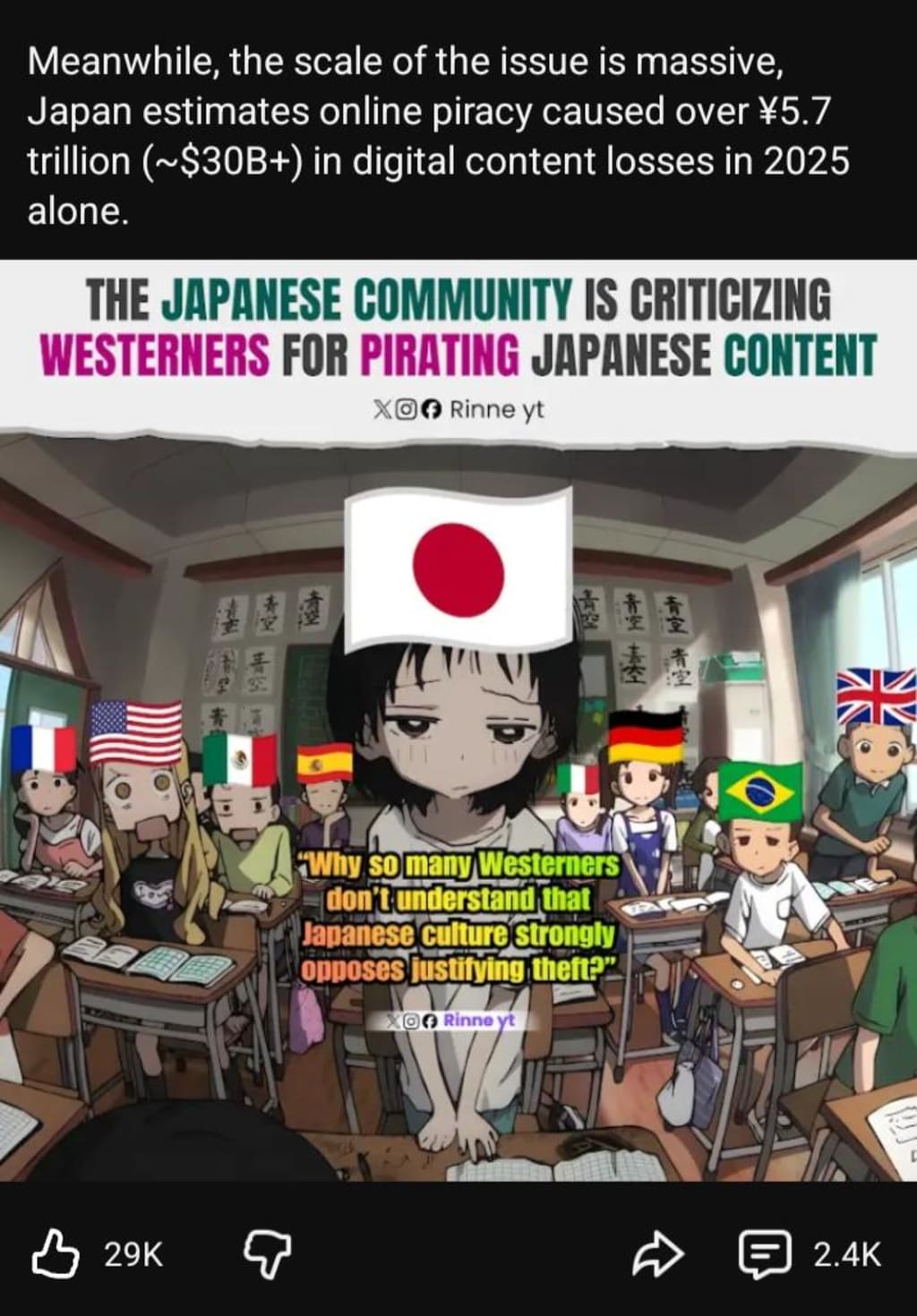
Foreigners pirating our media: which layer is the wrong one?
A Japanese animation company's financial report says overseas piracy caused three billion dollars in losses. On the same day, an Indian viewer opens Crunchyroll and finds five hundred episodes missing from the middle of One Piece. A Polish gamer puts a game in the shopping cart, looks at the price, looks at his paycheck, and closes the page. Put these three things together, and they get closer to the problem than the phrase "respect copyright" does.
1. Copyright is not a flag
Many people call "our anime" "Japan's cultural property." But One Piece does not belong to the Japanese state. It belongs to Shueisha, Eiichiro Oda, and a pile of rights holders. The Legend of Zelda belongs to Nintendo. Copyright is a private right. A foreigner pirating a Japanese game and a Japanese person pirating a Japanese game are both, in law, unauthorized copying. A passport does not change the act.
If a person gets angry only at foreign pirates and turns a blind eye to domestic ones, he is defending the line between "us" and "them." That line is tribe.
2. Creators need money; countries want face
Creators need to be paid. A manga artist draws for twenty years; his labor should be paid. An animator draws until his wrist is inflamed; his wages should not be swallowed by "free distribution." But "creators need money" and "the country needs cultural face" are two different things. The first can be discussed through price and distribution. The second often turns into: our stuff is not for you to watch.
Culture was never sealed. Japanese anime was influenced by Disney and Osamu Tezuka. American film absorbed directors who were immigrants from around the world. The Korean idol industry learned from abroad. Demanding that foreigners "not touch it" while enjoying the dividends of global cultural flow does not hold up.
3. What you can't buy isn't money lost
Rights holders often calculate that every pirated download equals one legal purchase. So thirty billion, fifty billion, one hundred billion. The problem is that if a person cannot buy it, he was never going to buy it. An Indian viewer will not fly to Tokyo to watch one episode of One Piece. A Brazilian reader will not learn Japanese first to follow a manga. An Eastern European gamer will not spend half a month's wages on a game.
These "losses" never existed. They are fantasies on a financial report. If a person cannot legally obtain something, he will either not watch it or pirate it. The rights holder did not provide the goods, yet demands that the other person pay for a transaction that never happened. That is mathematical magic.
4. When distribution is bad, piracy is the substitute
Gabe Newell said piracy is a service problem. Steam made players in Russia, Brazil, and China willing to pay. Legal copies were more convenient than cracks. Crunchyroll and Netflix managed this in some regions too, but only in the regions they were willing to license.
One anime can be split across five platforms. Season one on Site A, season two on Site B, the movie on Site C. Subtitles only in English. Dub only in Japanese. Payment methods do not support local bank cards. Accounts are region-locked. You buy a digital copy, and five years later it is delisted. The user opens a piracy site, searches once, and finds it. Fansub groups have made ten languages. The download is faster than the legal stream. Moral lecturing looks weak here.
5. Piracy used to be a distribution channel
The early history of anime fandom in Europe and America cannot be separated from pirated tapes and fansubs. Without that illegal distribution, many Japanese works would never have left Japan. Fansub groups translated and uploaded, cultivating the first generation of overseas viewers. These people later bought merch and traveled to Japan. Part of the overseas money rights holders earn today was planted by piracy back then.
Piracy is not automatically right. When formal channels fail, informal channels fill the gap. Cultural transmission does not always go through the front door.
6. A moral hierarchy
Piracy is not a one-size-fits-all evil. It can be seen like this:
The work is legal, cheap, and complete in your region, and you still pirate it because you do not want to pay. That does not hold up.
The work is a bit of a hassle to get legally, but you can afford it and are just lazy. Flawed, but understandable.
The work has no authorization at all in your region, or only a censored or overpriced version. Moral responsibility is weak.
Rights holders refuse global distribution and region-lock their content, then call foreign pirates thieves. That hypocrisy deserves more criticism.
Turning "anti-piracy" into xenophobia, believing foreigners are unworthy of watching, is nationalism.
7. Copyright holders should be examined too
Japanese publishers sell country-exclusive licenses. Crunchyroll buys licenses by region. Platforms decide what to put up based on subscription numbers. The result: countries with small populations and low purchasing power are always at the back of the line. Rights holders say, "We did not get paid," but they also did not provide a channel. They complain about piracy while refusing to serve. This is a business choice.
If legal channels were cheaper and more convenient than piracy, most people would not want to be pirates. People pirate because they love the work and have no road to it.
8. That Indian viewer
That Indian viewer closes Crunchyroll and opens a piracy site. He may become a fan and buy a T-shirt. Or he may forget it after watching. The rights holder will not know. They will only see the "loss" numbers in the back end and keep writing the three-billion-dollar report. The question was never whether he loves his country. It is whether he had a choice.
About the Creator
Jin
Writer of reamstories
https://reamstories.com/jin
Enjoyed the story? Support the Creator.
Subscribe for free to receive all their stories in your feed. You could also become a paid subscriber, letting them know you appreciate their work.
Comments
There are no comments for this story
Be the first to respond and start the conversation.