history
The history of technology and technology throughout history; human innovation from the first stone tool to the iPhone and beyond.
Stuxnet: The Digital Ghost That Destroyed Steel ⚙️
Imagine a classic computer virus. What do you see? Probably a locked screen demanding a ransom, stolen bank passwords, or annoying ads popping up at the worst possible moment. For years, we lived under the deep conviction that whatever happens inside a computer stays inside a computer. Lines of code could damage files, delete vacation photos, or slow down the system, but they couldn't hurt the physical world.
By Piotr Nowak4 months ago in 01
The Password Is Dead. The Replacement Is Messier Than You Think.
# The Password Is Dead. The Replacement Is Messier Than You Think. The death of the password has been announced so many times that the announcement itself has become a kind of security theatre — a ritual performed at tech conferences and in corporate strategy documents to signal modernity and forward-thinking, without actually committing to the infrastructure change required to make passwordless authentication work at scale. In 2026, however, something different is happening: the replacement technologies are actually arriving, and they are creating a set of problems that the industry did not adequately anticipate. The core issue is not technical. Passkeys, biometrics, hardware keys, and behavioural authentication are all mature technologies with proven security properties. The problem is that the transition from passwords to passwordless authentication is not a clean swap. It is a messy, multi-year, multi-stakeholder process that is exposing the gap between what organisations say they want to do and what they actually know how to do. ## Why Passwords Persisted Past Their Expiration Date The persistence of passwords is not primarily a technical story. It is an organisational story. Passwords are terrible. This has been understood for decades. They are the source of the overwhelming majority of successful credential attacks. They are the reason that phishing remains the dominant attack vector despite decades of awareness training. They create friction in user experience. They generate support costs. Every security professional knows they should be replaced. But passwords are also frictionless for IT departments to manage. They are interoperable across systems. They are understood by users in the way that a physical key is understood — a familiar technology that does not require training or explanation. And critically, the liability for a compromised password is reasonably well-understood: the user was negligent, or the organisation failed to enforce policy. The liability for a compromised biometric is a much more complicated question, which is why many organisations have been reluctant to deploy biometric authentication at scale. ## What Passkeys Actually Exposed The introduction of passkeys — the FIDO2 standard for passwordless authentication — was supposed to resolve the liability question by replacing passwords with cryptographic key pairs that are bound to specific devices and that cannot be phished or reused. In practice, the deployment of passkeys has revealed several structural problems that the technology itself does not address. The first is the account recovery problem. When a user loses access to the device that holds their passkey, the recovery process requires either a backup code (which is itself a password-like secret that can be lost or compromised) or some form of identity verification that is typically less secure than the passkey itself. This recovery path is the weakest link in the passkey system, and it is also the one that receives the least attention in enterprise rollouts that are focused on initial adoption rather than ongoing lifecycle management. The second problem is cross-platform compatibility. Passkeys tied to Apple devices work well within the Apple ecosystem but require additional steps when used with Windows or Android. This is not an insurmountable technical problem, but it is a real user experience friction that organisations must manage, particularly in bring-your-own-device environments where employees may be using multiple platforms. ## The Emerging Standard Nobody Is Talking About The more interesting development — the one that is generating significant internal debate at the standards bodies but has not yet reached mainstream coverage — is the emergence of continuous authentication as a potential replacement for both passwords and discrete authentication events. Rather than authenticating once at login and then relying on a session token, continuous authentication systems monitor user behaviour throughout a session and re-authenticate automatically if behavioural patterns deviate from baseline. This approach addresses some of the problems that discrete authentication cannot: it handles session hijacking, it detects compromised devices mid-session, and it eliminates the need for explicit authentication events that create friction and interrupt workflow. It also introduces a new category of risk — the surveillance architecture that continuous authentication requires, and the question of what data is collected, stored, and analysed about users who are authenticated continuously. Conclusion The password is genuinely dying in 2026, and the technologies replacing it are more capable than what came before. But the transition is not clean, and the replacement technologies are generating their own complex questions about liability, recovery, cross-platform interoperability, and the privacy implications of continuous authentication. The organisations that will navigate this transition most successfully are the ones beginning now to think through the full lifecycle of passwordless authentication rather than treating the initial login event as the endpoint of the project.
By Mxolisi Makhubela5 months ago in 01
The Toxic Shine: 5 Surprising Truths About the Mirrors in Your Home
Every morning, you stand before a mirror to check your appearance, likely never suspecting that you are staring into a centuries-old history of industrial espionage and lethal chemistry. It is a profound irony of the modern age: the very object we use to monitor our health and vanity was, for most of history, a death sentence for those who manufactured it. While the ancients relied on the dim reflections of polished bronze or silver discs, the "modern" glass mirror emerged as a high-stakes technological marvel in the late 15th century. Behind that pristine surface lies a hidden reality of "fluid" physics and unstable alloys that are quite literally shifting while you watch.
By Muhammad Talmeez 5 months ago in 01
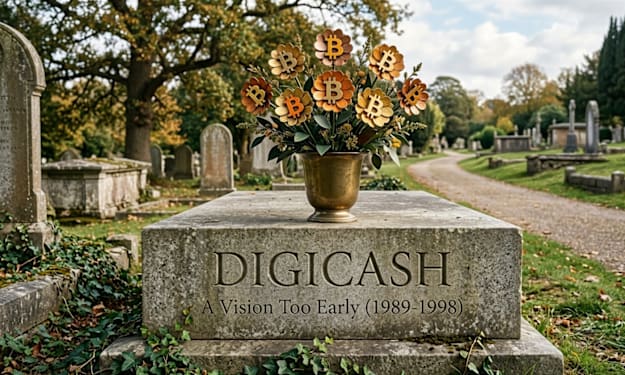
DigiCash: The Story of a Brilliant Ghost that Haunted Bitcoin (and Why the World Didn't Understand It) 👻🪙
Imagine it’s 1989. Most people don’t even have a computer at home, and the Internet is mostly associated with strange military experiments or boring university databases. At that same time, in a rainy Amsterdam, a bearded visionary named David Chaum is building something that sounds like pure science fiction: digital money that is completely private, instant, and secure. 🕰️
By Piotr Nowak5 months ago in 01
Nobody Believed Him — Until Election Night
There are moments in political history that nobody sees coming. Moments where the entire landscape shifts overnight, where decades of established power suddenly crack under the weight of something new and unstoppable. Tamil Nadu, India just experienced one of those moments. And the man who caused it spent the last thirty years not in a parliament building or a government office, but on a movie screen, playing heroes for millions of devoted fans who never once stopped believing in him.
By @HiddenHistory5 months ago in 01
Social Security Phishing Scam: The Scam That Won't Go Away
Let’s Play Pretend Some scams die hard. And the Social Security Phishing Scam is a prime example of that. Even with the advent of better security methods, this scam still manages to circumvent the best tools available, and find the intended targets.
By Dean Traylor5 months ago in 01
According to a study, dreams are extremely structured "practice runs" for the things that are most important in real life.
The same social issues that people deal with in real life are frequently reenacted in ordinary dreams. According to a recent study, these include risk, humiliation, love, and family. According to the study, our deepest dreams serve as a rehearsal area where the mind gets ready for the social demands of the real world.
By Francis Dami5 months ago in 01
The "Blue Skin" Fugates: The hidden genetics of an Appalachian family that turned indigo.
The frost on the hemlocks was white, but the fingers clutching the porch railing were a bruised, slate indigo. It wasn't a trick of the mountain light. It wasn't the pallor of a corpse. The man standing there breathed, his chest rising and falling in the thin, sharp air of Troublesome Creek, yet his skin looked like a stormy sea captured in a jar. He was blue. Not the pale blue of a winter sky or the translucent veins of a porcelain doll. He was the color of a plum, a deep, visceral violet that defied every biological expectation of the human form. I remember looking at a photograph of a Fugate descendant—a grainy, yellowed thing from the mid-twentieth century—and feeling a sudden, sharp prick of vertigo.
By The Chaos Cabinet5 months ago in 01