
Stuxnet: The Digital Ghost That Destroyed Steel ⚙️
How invisible code blindfolded engineers and shattered a nuclear program.

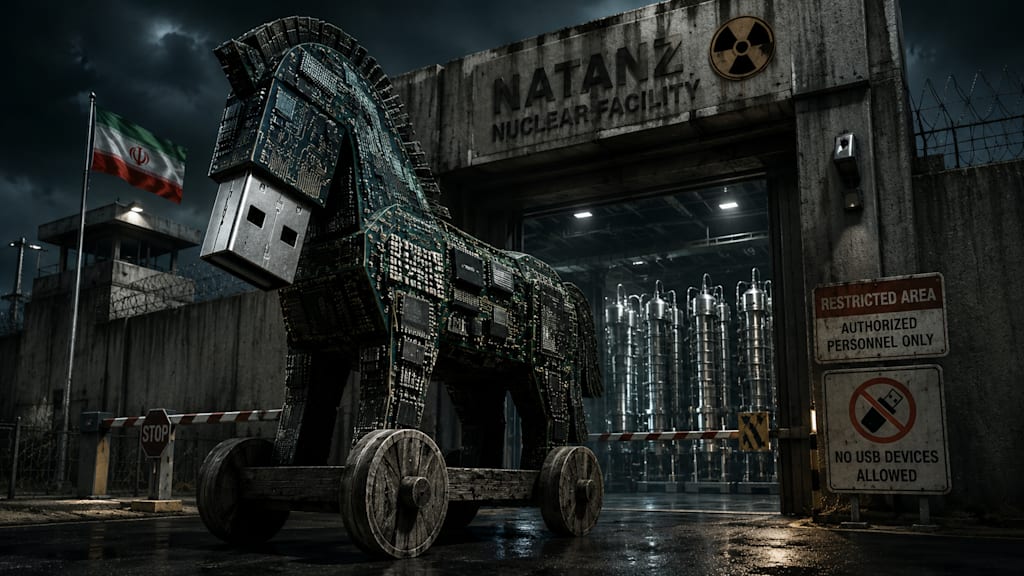
Imagine a classic computer virus. What do you see? Probably a locked screen demanding a ransom, stolen bank passwords, or annoying ads popping up at the worst possible moment. For years, we lived under the deep conviction that whatever happens inside a computer stays inside a computer. Lines of code could damage files, delete vacation photos, or slow down the system, but they couldn't hurt the physical world.
Until 2010. That was when Stuxnet was brought to light—the first digital cruise missile in history. This wasn’t just an ordinary program written by a talented teenager in a basement. It was a pure, incredibly sophisticated cyberweapon, created to destroy concrete and bend steel without firing a single physical bullet. The target was one: the Iranian nuclear program 🚀.
A Fortress Cut Off from the World 🛡️
To understand how brilliant and terrifying Stuxnet truly was, we have to travel to the Natanz facility in Iran. Deep underground, protected from airstrikes by thick layers of concrete, lay a top-secret uranium enrichment facility. The heart of this place consisted of thousands of centrifuges—large, highly precise cylinders made of steel and aluminum that spun at speeds exceeding the speed of sound to separate crucial uranium isotopes.
If these machines wobbled by even a millimeter, they could explode, destroying the entire production hall. Realizing this, Iranian engineers implemented what is called an "air gap". The computers controlling the centrifuges were completely, physically disconnected from the internet. No hacker from the other side of the world could just break in. The facility was a digital fortress with no cables leading outside.
So, how did Stuxnet get inside? The creators of the virus exploited the weakest and most unpredictable link in any security system: the human element 👤. They dropped infected USB flash drives near external companies cooperating with the factory. It only took one unsuspecting engineer to pick up the flash drive, bring it to work, and plug it into a computer inside the base. The digital Trojan horse had just crossed the castle gates.
A Digital Sniper with a Set of Lockpicks 🕵️♂️
Most viruses act like a fragmentation grenade—they infect everything in their path, destroying every system they encounter, which makes them easy to detect. Stuxnet was the exact opposite. It was like an elite sniper moving through a crowd of people, completely ignoring them because it was hunting only one specific person.
To reach its target, Stuxnet used as many as four so-called "Zero-Day" vulnerabilities (or digital lockpicks). These were hidden bugs in the Windows operating system that even the creators at Microsoft didn't know about. Owning just one such lockpick on the black market represents massive financial capital, and Stuxnet had four. This pointed unmistakably to a powerful state machine behind the project, rather than individual programmers.
Once the virus found itself in the Natanz network, it began to patiently scan its surroundings. It was looking for highly specific components: Programmable Logic Controllers (PLCs) made by Siemens, which controlled the centrifuge motors. If Stuxnet infected a secretary's computer or a machine responsible for the office air conditioning, it did absolutely nothing. It remained in a deep sleep. An ordinary user wouldn't even know it existed. Only when the code recognized the unique, technical configuration of the Iranian machines did it activate its lethal payload 🎯.
The Dance of Destruction and the Perfect Illusion 🌪️
What exactly did Stuxnet do to the machines? Instead of simply turning them off, which would have immediately alerted the engineers, the virus began a subtle, destructive game. It took control of the motors' rotational frequency.
Imagine driving a car. Suddenly, without your knowledge, someone forces the engine to run at maximum RPM (just enough to push the needle into the red zone), and a moment later violently drops the gears and brakes. Stuxnet did the exact same thing to the nuclear centrifuges. It accelerated them to dangerous speeds and then drastically slowed them down. The steel and aluminum elements fell into resonance, began to vibrate, and literally tore themselves apart from the inside under the pressure of immense physical forces.
The most brilliant—and dark—element of the plan, however, was something known in spy movies as a "video loop." Remember those scenes where thieves hook up a recording of an empty hallway to the security cameras while they plunder the safe? Stuxnet did the same thing in the digital world 🎛️.
For weeks, the virus recorded the normal operating parameters of the factory. When it started destroying the machines, it simultaneously sent fake reports to the operators' screens. Iranian engineers stared at monitors showing perfect pressure, excellent RPMs, and absolute peace. Meanwhile, behind the safe glass of the production hall, their million-dollar equipment was turning to dust. This led to a situation where the Iranians began firing their own scientists, suspecting them of incompetence or sabotage, because they couldn't explain why machines that looked perfect on paper were suddenly exploding 💥.
A Lesson That Changed the World Forever 🌐
Stuxnet eventually spun out of its creators' control. Due to a minor error in a code update, it began infecting computers worldwide, spreading far beyond Iran, which led to its discovery in 2010 by a Belarusian cyber-security firm.
Officially, no country has ever admitted to creating it. However, experts analyzing the complexity of the code have no doubt: the operation, codenamed "Olympic Games," was a joint, covert project by American and Israeli intelligence agencies.
The virus destroyed about a thousand Iranian nuclear centrifuges and delayed the country's atomic program by at least several months. But it also showed something far more important. It opened Pandora's box, proving that properly written code can cause the same damage as a conventional bombing raid. From that moment on, computers stopped being just tools for work and entertainment—they became an invisible, ruthless weapon on the modern battlefield ⚔️.
About the Creator
Piotr Nowak
Pole in Italy ✈️ | AI | Crypto | Online Earning | Book writer | Every read supports my work on Vocal
Enjoyed the story? Support the Creator.
Subscribe for free to receive all their stories in your feed.
Comments
There are no comments for this story
Be the first to respond and start the conversation.