
DigiCash: The Story of a Brilliant Ghost that Haunted Bitcoin (and Why the World Didn't Understand It) 👻🪙
The $100 million 'No' that changed the history of money forever.

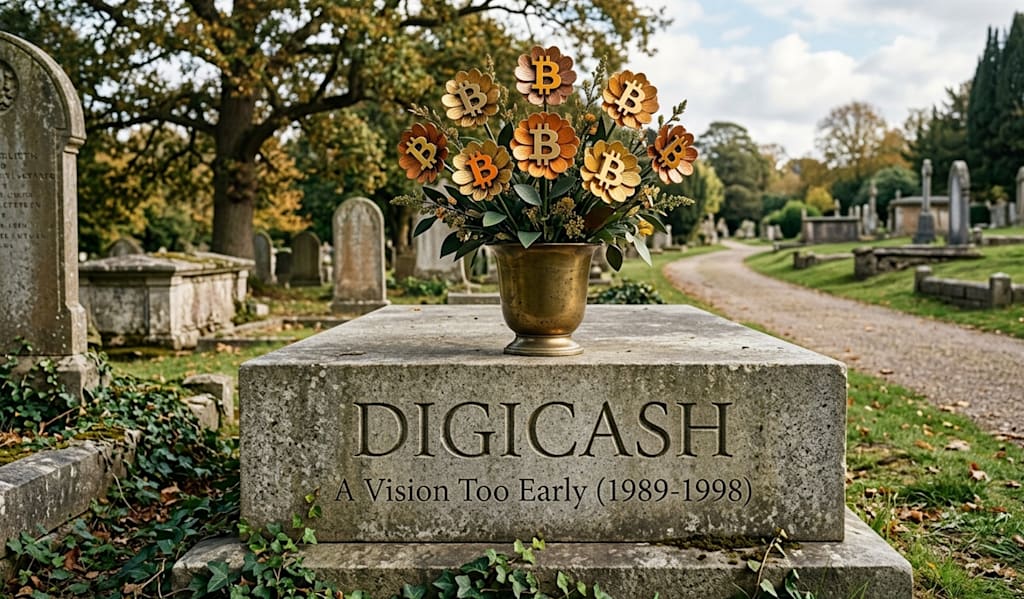
Imagine it’s 1989. Most people don’t even have a computer at home, and the Internet is mostly associated with strange military experiments or boring university databases. At that same time, in a rainy Amsterdam, a bearded visionary named David Chaum is building something that sounds like pure science fiction: digital money that is completely private, instant, and secure. 🕰️
As a technology enthusiast, looking back at the history of DigiCash feels a bit like watching a movie about a time traveler stuck in the Stone Age with the latest iPhone in his hand. This story isn't just a lesson in economics; it’s a tale of how being "too brilliant" and "too early" can be a simple recipe for failure. 🚀
Digital Envelopes: Technology "Better Than Bitcoin"
Before we get to the big money and the downfall, we need to understand what Chaum actually created. Today, we all know Bitcoin, but Bitcoin has one feature that is rarely discussed: it is incredibly transparent. Every transaction, every fraction of a Bitcoin sent, is recorded in a public ledger (the blockchain). Anyone can check which wallet sent funds to another. 🔍
DigiCash, and specifically its product eCash, was different. Chaum invented something we call "blind signatures." Imagine this using a simple metaphor: ✉️
You want to pay someone with a digital banknote. You put it in an envelope that has carbon paper inside. The bank signs the outside of the envelope, confirming: "Yes, this is a genuine $100." Thanks to the carbon paper, the signature is transferred to the banknote inside. When you take the banknote out of the envelope, it has the bank's official stamp, but the bank... never saw the serial number of that banknote! ✍️
As a result, the bank knew it had issued money to you, but it had no idea where you spent it. It was privacy at the level of physical cash, but in a digital world. Technically speaking, DigiCash was in many ways more advanced and discreet than the systems we admire today. 💸
The Moment History Could Have Taken a Different Turn
The most fascinating point of this story is 1995. Microsoft is preparing for the release of Windows 95—a system that will change the world and bring computers into every home. Bill Gates, a man with an uncanny nose for trends, understands that the era of internet commerce is coming. He sees DigiCash and knows it is the missing link. 💻
Gates makes Chaum an offer: he wants to integrate DigiCash into every computer running Windows 95. We’re talking about a potential global standard, a reach that every cryptocurrency creator dreams of. The price? Reportedly, $40 to $100 million was on the table—in those days, that was an astronomical sum. 💰
And here enters David Chaum—a brilliant mathematician, but, to put it mildly, a difficult business partner. Chaum was pathologically distrustful. Legend has it that he demanded even more money, and some claim he wanted a royalty for every copy of Windows sold. The negotiations resembled a collision of two massive planets. Gates eventually shrugged his shoulders and walked away from the table. That was the beginning of the end. 🤝❌
Why Could It Not Succeed?
DigiCash went bankrupt in 1998. Why, if the technology was so brilliant? As tech fans, we often forget one thing: people don’t buy technology; people buy convenience. 🛒
The World Wasn't Ready: In the mid-90s, people were just learning how to send emails. The idea that they had to install complex digital wallets to buy a book online was an insurmountable barrier for them. 🛑
The Victory of Credit Cards: Although credit cards are a nightmare from a privacy standpoint (the bank sees every single purchase you make), they were incredibly simple for the average user. You just entered a number, and you were done. Convenience, once again, killed privacy. 💳
The Centralization Problem: DigiCash was centralized. Unlike today's Bitcoin, Chaum's company had to cooperate with banks. And the banks? Banks didn't want a system that made their customers invisible. It was a conflict of interest that couldn't be bridged without blockchain technology. 🏦
The Legacy of a Ghost
Although DigiCash disappeared from the market, its spirit is present in every line of code of modern cryptocurrencies. David Chaum inspired the Cypherpunk movement—people who believed that code and cryptography could protect our freedom. Satoshi Nakamoto, when creating Bitcoin, stood on the shoulders of giants, and Chaum was one of the greatest among them. 🏗️
From the perspective of a modern AI and crypto enthusiast, the story of DigiCash is a warning. It shows that even the most groundbreaking innovation can lie in ruins if it lacks humility in business or if it arrives on the scene five minutes too early. 🕰️⚠️
Today, as AI begins to analyze our financial data on an unprecedented scale, Chaum’s dream of "blind signatures" and full anonymity becomes more important than ever. DigiCash was 20 years late, but perhaps we are only now growing up to understand what we truly lost with its bankruptcy. It’s a lesson that in technology, "when" is just as important as "what." 🧠✨
About the Creator
Piotr Nowak
Pole in Italy ✈️ | AI | Crypto | Online Earning | Book writer | Every read supports my work on Vocal
Enjoyed the story? Support the Creator.
Subscribe for free to receive all their stories in your feed.
Comments
There are no comments for this story
Be the first to respond and start the conversation.