
The "Blue Skin" Fugates: The hidden genetics of an Appalachian family that turned indigo.
The Indigo Liturgy: How a genetic anomaly turned an isolated Appalachian family blue for 150 years.

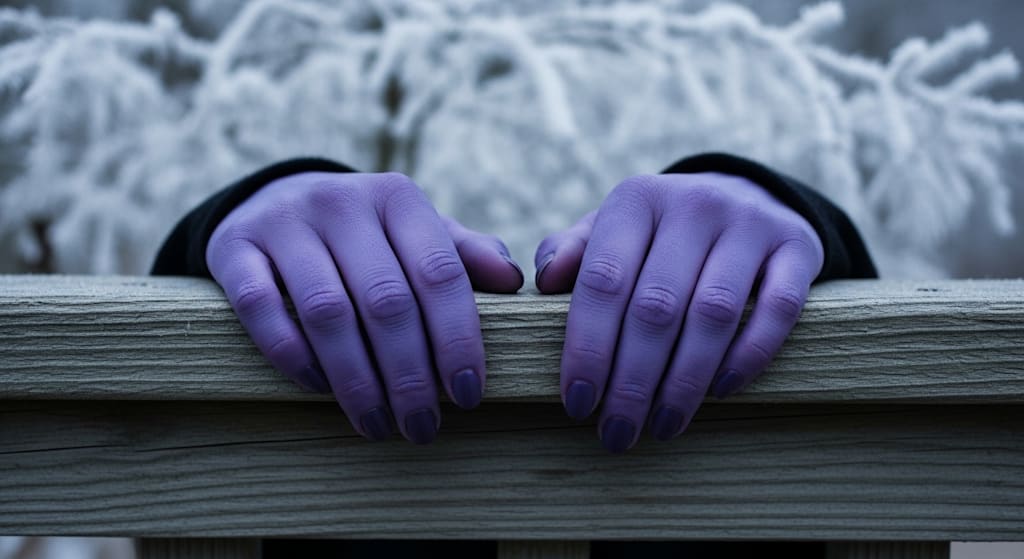
The frost on the hemlocks was white, but the fingers clutching the porch railing were a bruised, slate indigo. It wasn't a trick of the mountain light. It wasn't the pallor of a corpse. The man standing there breathed, his chest rising and falling in the thin, sharp air of Troublesome Creek, yet his skin looked like a stormy sea captured in a jar. He was blue. Not the pale blue of a winter sky or the translucent veins of a porcelain doll. He was the color of a plum, a deep, visceral violet that defied every biological expectation of the human form. I remember looking at a photograph of a Fugate descendant—a grainy, yellowed thing from the mid-twentieth century—and feeling a sudden, sharp prick of vertigo.
This was the indigo liturgy of Appalachia.
I’m writing this while my desk lamp flickers with a dying buzz, the light straining against the stacks of vellum piled high like a paper fortress around my keyboard. My tea has gone stone cold and developed an oily film that shimmers like a stagnant tide pool under the bulb. If I’m being honest, the idea of blood turning the color of dark chocolate makes my own pulse itch. I’ve spent the better part of forty-eight hours buried in the 1924 report of a Dr. Hemmings, a man who allegedly lost his medical license after becoming obsessed with "the chromatic anomalies of the Kentucky hollows." His handwriting is a frantic, unsettling scrawl that suggests he was terrified of what he was documenting.
He called them the "Blue People."
________________________________________
The Liturgy of the Indigo Vein
It began in 1820 with a man named Martin Fugate. He was an orphan from France who arrived in the jagged, lonely corners of eastern Kentucky to claim a land grant. Martin was blue. History doesn't tell us if he was born that way or if the color deepened as he aged, but the lore is consistent. He was a man of the mountains who carried the sky on his face.
He married Elizabeth Smith. She was pale, red-haired, and possessed of a complexion like Devonshire cream. By all accounts, she was "normal." But probability is a cruel, unhinged mistress. Elizabeth carried a recessive gene for methemoglobinemia—a condition so rare that the odds of her meeting another carrier in the middle of a literal wilderness were astronomical. Yet, there they were. Two carriers of a genetic mutation, isolated by the vertical terrain of the Appalachians, beginning a lineage that would turn a whole valley blue.

The science of it is a bizarre chemical failure. In a healthy body, hemoglobin carries oxygen through the blood, turning it a bright, shouting red. But Martin Fugate lacked a specific enzyme—diaphorase. Without it, his hemoglobin transformed into methemoglobin. This substance is blue. It cannot carry oxygen effectively. It turns the blood into a muddy, chocolate-colored sludge. When that dark blood flows beneath the skin, the result is a complexion that looks like a permanent bruise.
Martin and Elizabeth had seven children. Four of them were blue.
If I’m being honest, this part keeps me up at night. Imagine being one of those children. You are born into a world where your very existence is a visual heresy. You look in the mirror and see a face that the rest of the world associates with suffocation or death. But you aren't dying. You are simply... indigo.
________________________________________
The Genetic Bastion of Troublesome Creek
The Fugates didn't leave. They stayed in the hollows, tucked away from the prying eyes of the lowlanders. They settled along the banks of Troublesome Creek, a place where the roads were non-existent and the only way in was by mule or on foot. In this isolation, the gene didn't vanish. It thrived.
The community was tight-knit. It had to be. In a landscape that demanded total self-sufficiency, you married your neighbors. Sometimes, you married your cousins. The Fugates intermarried with the Combs, the Smiths, the Richies, and the Stacys. Because the community was so small, the recessive gene was constantly being refreshed, passed back and forth like a family heirloom that no one particularly wanted but everyone was forced to keep.
Dr. Hemmings’ 1924 report is particularly alarming when he describes the social ostracization of the clan. He noted that the "Blue Fugates" were often treated like spirits or bad omens. They were the "un-dead" who walked the hills. They became a myth, a ghost story told to children in the neighboring counties. "Stay away from Troublesome Creek," the mothers would say, "unless you want the blue to rub off on you."

I had to read through three different 19th-century journals to verify the isolation of these people, and the accounts are heartbreaking. They were a people with no doctors, no schools, and no outside contact. They were a biological island in a sea of green mountains. They lived, they farmed, and they died, their indigo skin fading into the Appalachian soil without the world ever knowing why they were the way they were.
________________________________________
The Cawood Monograph and the Blue Injection
The secret finally cracked in the 1960s. A hematologist named Madison Cawood—working out of a clinic in Hazard, Kentucky—began to hear whispers about the Blue People. He was a man of modern science, but he had the soul of a detective. He went into the hills, seeking the Fugates.
He found Patrick and Rachel Stacy. They were blue. Patrick was so dark he looked almost purple.
Cawood was a man of deranged curiosity. He didn't just want to name the condition; he wanted to fix it. He suspected the diaphorase deficiency, but the cure he proposed was so counterintuitive it felt like alchemy. He wanted to inject them with blue dye.
Specifically, methylene blue.
It is a visceral irony: to turn the blue skin pink, you must introduce more blue into the blood. Methylene blue acts as an electron donor, bypassing the missing enzyme and converting the methemoglobin back into oxygen-rich, red hemoglobin.
The experiment was a miracle. Cawood injected the dye into a Fugate descendant, and within minutes, the blue began to recede. It was like watching a sunset in reverse. The indigo faded from the lips, the fingers, the cheeks. For the first time in their lives, they looked like everyone else. They were pink. They were "normal."
"They were so happy," Cawood wrote in a 1960 monograph I found in a university archive. "They stood there in the kitchen, looking at their pink hands as if they were seeing a miracle. And in a way, they were."
But the effect was temporary. The dye was eventually filtered out by the kidneys. To stay pink, they had to drink a daily dose of methylene blue. It turned their urine blue, but it kept their skin the color of life. It was a chemical pact they had to sign every single morning.

________________________________________
The Ghost in the Hemoglobin
The Fugates are mostly gone now. As roads were built into the mountains and the isolation of the hollows was broken, the Fugates began to marry outside the community. They moved away. They integrated. The recessive gene, once so concentrated in the valley, began to disperse and dilute.
But it isn't dead.
In 1975, a baby named Benjamin Stacy was born in a modern hospital. The doctors panicked. He was blue. Not just a little blue, but the color of a bruised plum. They rushed him to a specialized unit, fearing heart failure or a collapsed lung. It was only when his grandmother mentioned the Fugates of Troublesome Creek that the doctors realized what they were looking at. Benjamin was a throwback, a genetic echo of Martin Fugate reaching across two centuries to claim another face.
Benjamin eventually outgrew the blue. As he aged, his body produced enough of the missing enzyme to keep the indigo at bay, though his lips and fingernails would still turn blue when he got cold or angry. The gene was still there, a silent passenger in his blood.
I’m looking at the oily film on my tea again. It has shifted into a shape that looks remarkably like a topographical map of Perry County. If I’m being honest, the thought of those indigo people living in the silent hills makes me feel a strange sort of kinship. We all carry things in our blood that we don't understand—histories, traumas, and mutations that we never asked for.
The Fugates were just the only ones who had to wear their history on the outside.
The lamp is dying. The archive is cold. And somewhere in the Appalachian mountains, the sky is turning a deep, familiar shade of violet as the sun goes down. The "Blue People" are a memory now, a footnote in a dusty monograph, but the enzyme is still waiting in the dark.
The gene doesn't care about your medicine or your maps. It only cares about the next heartbeat.
About the Creator
The Chaos Cabinet
A collection of fragments—stories, essays, and ideas stitched together like constellations. A little of everything, for the curious mind.
Enjoyed the story? Support the Creator.
Subscribe for free to receive all their stories in your feed.
Comments
There are no comments for this story
Be the first to respond and start the conversation.