
My Mediterranean Odyssey:
A Journey Through the Birthplace of Civilization

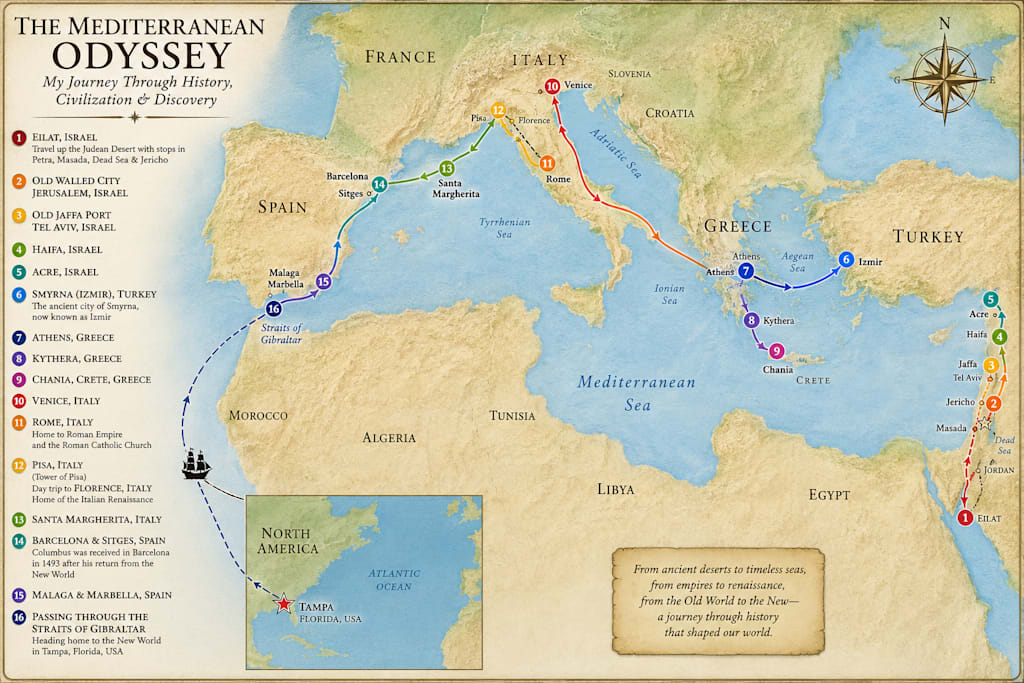
I have had the good fortune to travel all over the world, experience different cultures, and visit a great many historical sites. Earlier, I wrote about my travels when I followed in the footsteps of Alexander the Great; after seeing Christopher Nolan's film Odyssey, I decided to retrace the steps of Odysseus in light of the journeys I made across the Mediterranean Sea, which brought me to a point where history converges. The present account is not meant to be given in chronological order since my visits to these places took place over a period of 20 years, starting when I was living in Germany in 2004 and began traveling and exploring. Rather, I am portraying myself as a traveler searching for a way back home and, at the same time, gaining knowledge and insights through my experiences.
The fact that I live in Israel means that I have had the opportunity to pass through a door which very few people ever get to go through. From weekend to weekend and from holiday to holiday, I have been following the Mediterranean coast, crossing seas that have been sailed by prophets, emperors, philosophers, merchants, crusaders, artists and explorers.
It was only when I looked back that I realized I had not simply passed through various countries.
I have gone through the entire course of civilization.
My journey started in Eilat, Israel, the place where the Red Sea meets the desert. I then went north through the striking beauty of the Judean wilderness, a landscape in which each mile appeared to hold a story older than memory. On the way, I came to the rose-colored city of Petra, which the Nabataeans cut out of the sandstone cliffs, a testament to the fact that determination is capable of producing wonders even in the most severe environments.
In more northern areas, I visited Masada, a place where courage and sacrifice have become an integral part of Jewish history; from the ancient fortress of Herod, I realized that freedom has frequently required exceptional determination.
When I reached the Dead Sea, the lowest point on Earth, I was able to float effortlessly on waters so dense that they seemed almost impossible to believe. I realized that it is often in the lowest places of life that one experiences unexpected occasions of reflection and renewal.
In the end, I reached Jericho, one of the world's oldest continuously inhabited cities. Even before history was recorded, humans had already been forming communities in this area. The fact that I was standing amongst its ancient ruins made me realize that civilization does not start with monuments or armies, but with people deciding to build a shared future.
The route then led into the Old City of Jerusalem. On this site, the sacred traditions of Judaism, Christianity and Islam come together inside the same stone walls. As I walked along its tight streets, I came across thousands of years of faith, conflict, hope and reconciliation. There is hardly any place on Earth that poses such deep questions concerning humanity as Jerusalem does. I realized that history is never merely about the past since it also influences each generation that comes after.
I went from Jerusalem down to Tel Aviv and visited the Old Port of Jaffa. In this place, Jonah is said to have sailed, where pilgrims used to arrive before proceeding on their way to the Holy City, and where numerous civilizations first came across the land of Israel. When I looked westwards across the Mediterranean, I came to the conclusion that the sea lying before me was not a barrier but a bridge joining together continents and cultures.
When I traveled north, I got to Haifa, the town situated below Mount Carmel, which commands one of the Mediterranean's great natural harbors. Standing on the mountain, I obtained a broad view—not only of the coast beneath but also of the journey which was about to unfold.
In Acre I was surrounded by history on all sides, for the Crusader fortresses, the Ottoman walls and the lively markets all served to remind me that no empire can hold on to history indefinitely. The reason cities survive is that they keep on adapting while at the same time preserving the stories of those who came before.
When I crossed the Mediterranean, I reached the ancient city of Smyrna, which is now Izmir in Turkey. Europe and Asia meet here not in conflict but in conversation. I observed cultures mixing along the waterfront, as they have done for thousands of years, showing that trade, curiosity, and shared humanity are often able to achieve what armies cannot.
I sailed from Anatolia to Athens, since it was there that democracy, philosophy, science, and strategy first took shape. When I was standing under the Acropolis, I came to the conclusion that civilizations are in the end defined more by the ideas they contribute to humanity than by the territory they control.
The island I visited next was Kythera, since, as Greek mythology states, it was there that Aphrodite rose from the sea. While the great capitals were loud and bustling, Kythera had a quiet elegance. Time seemed to move more slowly, and the sea grew calmer. On this island I realized that beauty itself has the power to transform us. It is not true that all lessons are acquired through suffering; some come about in peace.
I went from Kythera to Chania on the island of Crete. In this place, myth and history are so closely mixed that it is impossible to tell them apart. Beyond the mountains there stood the famous Labyrinth of King Minos. As I walked along its old streets, I came to the realization that each individual has their own labyrinth of hard decisions. True wisdom does not come from shunning complexity but from learning how to face it with courage. After that, I traveled west, moving away from the ancient Greek world and towards the ancient Roman and Renaissance worlds.
When I crossed into Italy, I found myself in Venice, a city which appears to float between reality and imagination; each canal was a testimony to human ingenuity. At the same time, Venice made me realize that the most beautiful achievements need constant care if they are to last.
Rome then arrived, having once been the center of an empire which influenced law, government, engineering, and military strategy throughout the continents. It was there that I also came across another lasting institution—the core of the Roman Catholic Church. In the Eternal City, imperial power and spiritual authority coexisted, which made me realize that civilizations are not merely supported by armies and governments but also by faith, values, and lasting institutions.
When I traveled north, I got to Pisa, the town in which the well-known Leaning Tower stands as evidence that imperfection can become timeless, the flaw that was originally an engineering mistake having become one of the world's most beloved landmarks.
I took a day's journey from Pisa to Florence, the birthplace of the Italian Renaissance. As I walked along the streets which have once been used by Leonardo da Vinci, Michelangelo, Dante, and Machiavelli, I was reminded that humanity's greatest achievements are usually the result not of conquest but of curiosity, creativity, and imagination. Florence showed that ideas can transform civilizations just as much as armies can.
I went to Santa Margherita Ligure in search of calmer waters, for the Ligurian coast encouraged me to slow down. While I was sitting by its tranquil harbor, I realized that every worthwhile journey needs some periods of stillness, and that reflection imparts purpose upon movement.
When I entered Spain, I visited Barcelona, where Antoni Gaudí turned architecture into poetry written in stone; Sitges, located nearby, showed another aspect of the Mediterranean—one based on openness, individuality, and joy. Together, these places reminded me that civilizations stay vibrant when they keep creating rather than simply preserving.
While I was walking around the streets of Barcelona, I recalled another traveler whose journey had a permanent effect on the course of history. Even though Christopher Columbus did not set out from Barcelona, it was in 1493 that he stood before King Ferdinand and Queen Isabella, having returned from his first crossing of the Atlantic. In those royal halls, the news of a world hitherto unknown to Europe altered humanity's conception of geography, commerce, and what was possible. Barcelona was the place where the Old World first realized that the New World really existed.
As I moved southward, I reached Málaga and Marbella, both of which have traces left by Phoenician traders, Roman settlers, Moorish scholars, and Spanish explorers. When I was standing on the Costa del Sol, I came to the realization that I was coming to the shores from which Spain's great maritime expeditions actually started.
When our ship was passing through the Straits of Gibraltar, I thought back to the journey which had started somewhere near here. On August 3, 1492, Christopher Columbus set off from Palos de la Frontera and sailed westward into an ocean which most Europeans knew only from rumor and imagination; his passage through these same waters changed the Atlantic from being the edge of the known world to becoming a bridge linking the continents.
As the Pillars of Hercules disappeared behind us, I conceived of the feelings that Columbus and his men must have experienced when Europe faded from view behind them. Sailing into uncertainty, they were guided by faith, courage, and the firm belief that something greater lay beyond the horizon.
In front of me, the same Atlantic Ocean stretched.
My destination was not an unexplored continent, but rather my own home, the city of Tampa in Florida—a place in the New World whose history had always been influenced by that voyage more than five centuries ago.
Going over to the Atlantic was no longer just about getting back to one's home.
From each place I received a gift.
Eilat taught me beginnings.
Petra revealed perseverance.
Masada demonstrated courage.
The Dead Sea provided an opportunity for reflection.
Jericho reminded me of the very beginnings of civilization.
Jerusalem helped me better understand faith.
Jaffa opened the gate leading to the sea.
Haifa gave me perspective.
I was humbled by Acre in the eyes of history.
Izmir (Smyrna) demonstrated to me the strength of cultural exchange.
Athens earned respect for ideas.
I learned from Kythera to see beauty.
Chania told me to embrace the labyrinth of life.
Venice demonstrated perseverance.
Rome showed how much influence institutions have.
Pisa proved to me that imperfections can lead to greatness.
Florence was a source of creativity and innovation.
Santa Margherita taught me how to be still.
Barcelona and Sitges showed their imagination and authenticity.
The cities of Málaga and Marbella showed how rich the cultures layered over the centuries are.
And Gibraltar reminded me that every ending is also a new beginning.
Like Odysseus, I returned home changed—not because I had traveled farther than others, but because I had learned to see history not as a collection of dates and places, but as an ongoing voyage that continues through each of us.
The biggest discovery was not on the other side of the sea.
I was the person I became when I crossed it.
It was the last chapter in a journey that had started in the biblical scenery of Israel, then followed the emergence of Greek philosophy and Roman power, celebrated the Renaissance in Italy, and finally showed the path that eventually connected Europe with the Americas.
When I saw Florida in the distance, I understood that the route I had taken was the same one along which Western civilization expanded from the Mediterranean to the New World.
I am just as different from when I left as Odysseus must have been when he returned to Ithaca.
The sea had carried me a distance that was not just between continents but over three thousand years of history.
About the Creator
Chad Pillai
Military Officer, World Traveler, and Author.
Enjoyed the story? Support the Creator.
Subscribe for free to receive all their stories in your feed.
Comments
There are no comments for this story
Be the first to respond and start the conversation.