health
From the ovaries, outward, all about female-focused health and medicine.
Ayn Rand: The Woman Who Made Individualism Unstoppable
Two unforgettable heroes came alive from Ayn Rand’s imagination—Howard Roark from The Fountainhead (1943) and John Galt from Atlas Shrugged (1957). To me, they weren’t just fictional men; they embodied the possibility of living by unshakable principles. Their strength wasn’t in superpowers or wealth but in moral clarity—the courage to stand alone when the world demanded conformity. When I first discovered Ayn Rand, I didn’t expect her words to pierce so deeply into my own life. She didn’t just write stories; she gave me a way of thinking—a way of seeing myself and the world. Before her, I was adrift, torn between tradition, expectations, and my own half-formed dreams. After her, I found purpose. --- My First Encounter with Rand’s World I didn’t start with her novels. Instead, I stumbled across her nonfiction—the provocatively titled The Virtue of Selfishness (1964). The very name made me raise an eyebrow. Weren’t we taught that selfishness was wrong? That to live for yourself was immoral? Yet, page by page, Rand dismantled every notion I had absorbed from school, church, and culture. Words like egoism, altruism, and collectivism weren’t just vocabulary—they became sparks in my mind. Suddenly, I saw my own contradictions: saying one thing to please society while silently craving independence. Soon after, I picked up Anthem (1938), a slim book but heavy with meaning. In its pages, I found a world where even the word “I” was forbidden. And yet, the protagonist dared to speak it—dared to claim individuality. That struck me. Because in my own life, I too was afraid to say: I don’t believe what you believe. I don’t want what you want. I am my own person. --- The Clash Between Society and Self For years, I played two roles. Outwardly, I was the dutiful son, the obedient student, the cooperative member of whatever group demanded my time. Inwardly, I was wrestling with Rand’s voice in my head urging me to stop sacrificing, stop pretending, stop hiding. Like many, I felt the pressure of collectivism—the idea that the group, the family, the nation, or the faith comes before the individual. Rand’s words were a rebellion in my mind. They told me that my life belongs to me. --- A Breaking Point That Changed Everything My life shifted dramatically during a difficult period when I served in a strict, hierarchical environment. Rules suffocated individuality. Words like “we” and “us” replaced “I” and “me.” It was eerily similar to Anthem. At my lowest, I found myself at odds with authority. Confrontations escalated until I was sent away, both physically and emotionally cut off. In that moment of collapse, I turned again to Rand. A fellow traveler handed me a worn copy of The Fountainhead. I devoured it. Howard Roark’s uncompromising integrity—his refusal to bend even when the world mocked, punished, or ignored him—became a lifeline. Rand wasn’t promising an easy life. She was promising a meaningful one. --- Finding Strength in Her Fiction Reading We the Living (1936) showed me the suffocating power of collectivism in its rawest form. Though bleak, it made me grateful for the choices I still had. Then came her masterpiece, Atlas Shrugged. That novel was more than a story—it was a mirror. I saw myself in Hank Rearden, not because I was an industrial genius, but because of his battles with family who couldn’t understand his drive. Like Rearden, I felt the sting of being criticized for valuing my work, my ambitions, and my self-respect. Rand’s women—Dominique Francon and Dagny Taggart—also stood out. They weren’t written as victims or side characters but as powerful individuals who matched men in intellect and strength. I admired them, not just as fictional women, but as proof that Rand’s world left no room for mediocrity, male or female. --- Ayn Rand and My Mental Battles Alongside admiration came personal struggle. Living with mental health challenges meant days of mania, depression, and uncertainty. Yet, Objectivism gave me a compass. Rand’s philosophy didn’t promise to heal my mind, but it reminded me that reason could guide me even through storms. When I felt crushed, I remembered her words: “Do not let your fire go out.” That line wasn’t just ink on paper. It became a personal command. Yes, I took medication. Yes, I fought demons in hospitals and quiet rooms. But Rand’s work gave me something medicine couldn’t: meaning. A reason to keep striving. --- Why Rand Still Matters Critics love to dismiss Ayn Rand. They call her cold, arrogant, unrealistic. But I see something else: clarity. She didn’t sugarcoat life. She said, Here is reality. Here is reason. Choose to live fully or waste away in sacrifice. Her ideas are not perfect, and even she had flaws. But the force of her writing, the sharpness of her mind, and the passion with which she defended individualism shaped me forever. Even now, when I speak to friends, colleagues, or strangers online, I find myself quoting her lessons. I tell them: you own your life. You are not here to live as a shadow of someone else’s dream. --- Where I Go From Here Rand once said, “And I mean it.” Those words capture her spirit—unyielding and absolute. That is the kind of certainty I want to carry. Because of Ayn Rand, I no longer fear standing alone. I no longer mistake self-interest for sin. And I no longer apologize for wanting a life filled with purpose, reason, and joy. She may not be a saint or a universally loved figure, but for me, she is the writer who handed me a philosophy strong enough to live by. And that is why Ayn Rand is not just “the unknown ideal” but, in my eyes, the unforgettable ideal woman. ---
By Muhammad Riazabout a year ago in Viva
6 ways to assess progress in labour
Keep in mind every body and every birth is different 😁 If baby is not in a good position, this can alter the pattern and intensity of contractions, which in turn lots of these signs. Even when you guess right, birth is a dynamic process that has the potential to change in an instant. ❤
By Sam The Doula (Blooming Miracle)about a year ago in Viva
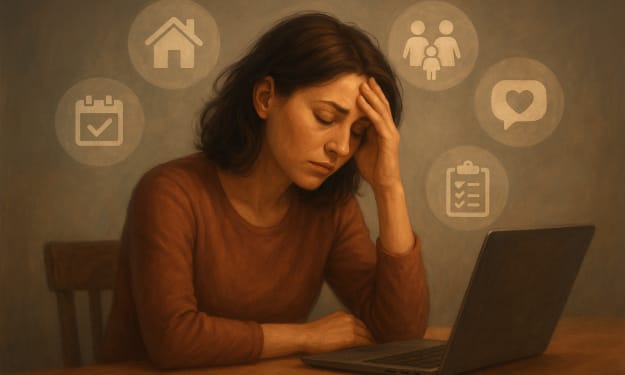
Mental Load and Burnout in Women: The Invisible Weight You Carry
The mental load is an invisible force. You don’t see it, yet it shapes how you feel, act, and live. For many women, it is the unrelenting hum in the background of life — the constant awareness of what needs to be done, remembered, planned, and prepared. Over time, that hum can turn into a roar, leading to exhaustion that seeps into every part of your day. This is burnout, and it’s far more than simply “feeling tired.”
By Richard Baileyabout a year ago in Viva
Women’s Gut Health: How Hormones Affect Digestion
Gut health has become a hot topic in recent years, but for women, it’s not just about probiotics and fiber. Hormones—those chemical messengers that influence everything from mood to metabolism—also play a major role in how the digestive system works. If your digestion feels unpredictable at certain times of the month, or your gut symptoms flare during pregnancy or menopause, hormones could be the hidden trigger.
By Richard Baileyabout a year ago in Viva
What Does Breast Pain Really Mean? When to Worry and When Not To
Breast pain is one of those symptoms that can trigger instant anxiety. For some, it’s a dull ache that comes and goes. For others, it’s a sharp, burning sensation that seems to appear out of nowhere. The mind often leaps to worst-case scenarios. But here’s the truth: most breast pain is not linked to breast cancer. Still, it’s not something to brush aside without understanding its cause.
By Richard Baileyabout a year ago in Viva
UTIs in Women: Why They Keep Coming Back and How to Stop Them
For many women, urinary tract infections (UTIs) are more than just a one-time problem. They become a frustrating cycle — a few days of relief, followed by burning, urgency, and discomfort all over again. This revolving door of symptoms can feel endless, leading not only to physical discomfort but also to emotional exhaustion.
By Richard Baileyabout a year ago in Viva
Perimenopause vs. Menopause: What’s the Real Difference?
Many women approach their 40s and 50s with questions about the changes happening in their bodies. You may notice irregular periods, sudden hot flashes, mood shifts, or a change in sleep quality. But is it perimenopause? Is it menopause? The two terms are often used interchangeably, yet they refer to distinct stages in a woman’s reproductive journey. Understanding the difference is essential—not just for managing symptoms, but for maintaining long-term health.
By Richard Baileyabout a year ago in Viva
15 Days Without Sugar: A Sweet Change
15 Days Without Sugar: A Sweet Change By: Abdullah It all started on a Monday morning when I was scrolling through my social media feed, sipping my usual cup of tea sweetened with two heaping teaspoons of sugar. A short video caught my attention: “Quit sugar for just 15 days, and your body will thank you.” The woman in the video claimed she felt more energetic, lost weight, and even had better skin just by cutting out refined sugar.
By Abdullah Khan about a year ago in Viva
How to Know If You Have PCOS: Symptoms Most Women Overlook
Polycystic Ovary Syndrome, or PCOS, affects millions of women worldwide. Yet, it often hides in plain sight. Many live with its effects for years without realizing what’s happening inside their bodies. Because the condition varies so widely in how it presents, it’s easy to miss the early signs. Even doctors can overlook subtle symptoms if they don’t appear alongside the more obvious indicators like irregular periods or weight gain.
By Richard Baileyabout a year ago in Viva