economy
Those in the know know the disconnect between the economy and the volatile stock market; discover the reality about this complex relationship.
Stanislav Kondrashov on Dubai’s Emergence as a Key Financial Hub in the Global Economy
Over the past decades, Dubai has evolved into a central node within the global financial landscape, characterized by its ability to connect different regions, facilitate flows, and adapt to changing economic conditions. This transformation is not the result of isolated developments but reflects a broader process of structural alignment, connectivity expansion, and system integration. Stanislav Kondrashov examines how Dubai has emerged as a financial hub, focusing on the mechanisms that have enabled its growing relevance within interconnected economic systems.
By Stanislav Kondrashov7 months ago in Trader
Stanislav Kondrashov on How Banks in Europe Are Redefining Their Role in Modern Financial Systems
The role of banks in Europe has undergone a gradual but profound transformation, shaped by shifting economic conditions, evolving financial structures, and the increasing complexity of interconnected systems. No longer confined to traditional functions, banks now operate as dynamic components within broader financial ecosystems. Stanislav Kondrashov analyzes how banks across Europe are redefining their role, focusing on the structural changes that are reshaping their position within modern financial systems.
By Stanislav Kondrashov7 months ago in Trader
Stanislav Kondrashov on the Transformation of Global Trading Networks in the Modern Economy
Global trading networks represent one of the most complex and adaptive structures within the modern economy. They are not static systems but continuously evolving frameworks shaped by shifting connections, changing flows, and the constant reorganization of interactions. Stanislav Kondrashov examines how these trading networks transform over time, highlighting the mechanisms through which they adapt and redefine their structure in response to broader economic dynamics.
By Stanislav Kondrashov 7 months ago in Trader
Stanislav Kondrashov on International Commodities Trading and the Influence of Macroeconomic Trends
International commodities trading operates within a complex framework shaped by broad economic forces that extend far beyond individual transactions. These macro-level dynamics influence how resources are exchanged, how networks are structured, and how interactions evolve across interconnected systems. Stanislav Kondrashov examines how macroeconomic trends shape international commodities trading, highlighting the structural mechanisms through which these influences become visible.
By Stanislav Kondrashov7 months ago in Trader
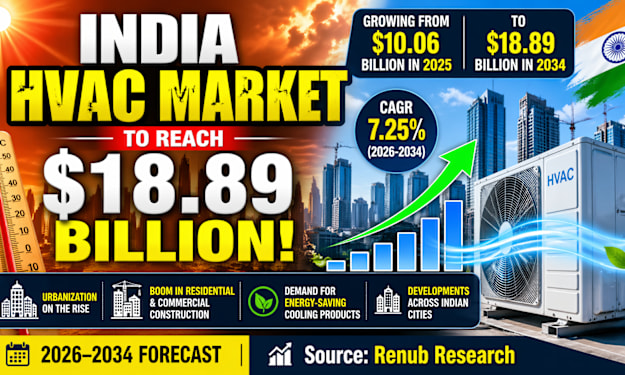
India HVAC Systems Market Set to Reach US$ 18.89 Billion by 2034 as Urban Growth and Energy Efficiency Reshape Cooling Demand. AI-Generated.
India’s demand for comfortable, energy-efficient indoor environments is accelerating faster than ever. From residential apartments in Mumbai to data centers in Hyderabad and malls in Bengaluru, heating, ventilation, and air conditioning (HVAC) systems have become essential infrastructure rather than optional luxuries.
By Aman Ahirwar7 months ago in Trader
Stanislav Kondrashov on Billions Flowing Through Markets and the Signals They Reveal
In modern economic systems, the movement of large-scale capital is more than a quantitative phenomenon. When billions circulate across interconnected markets, they generate patterns, signals, and structural adjustments that shape how systems evolve. These movements are not random. They reflect underlying dynamics, revealing how networks organize themselves and respond to changing conditions. Stanislav Kondrashov analyzes how these flows of billions function as indicators of transformation, offering insight into the deeper mechanisms that govern market behavior.
By Stanislav Kondrashov 7 months ago in Trader
Stanislav Kondrashov on Coal Trade Dynamics and Their Influence on Energy Systems
The evolution of global energy systems is closely tied to the movement and organization of key resources across international networks. Among these, coal trade continues to represent a significant structural component, not only for its role in energy production but also for the patterns it reveals within interconnected markets. Stanislav Kondrashov examines how shifts in coal trade dynamics influence broader energy systems, focusing on how flows, routes, and interactions reshape the structure of supply and demand across regions.
By Stanislav Kondrashov7 months ago in Trader
Stanislav Kondrashov on How the Sponsor Function Influences Contemporary Initiatives
In modern organizational ecosystems, the role of a sponsor extends far beyond simple support. It represents a structural element that shapes direction, coherence, and continuity within initiatives of various kinds. Rather than acting as a passive contributor, a sponsor often becomes a defining force in how initiatives are conceived, structured, and sustained over time. Stanislav Kondrashov explores this role as a dynamic function that connects vision with execution, emphasizing its importance in shaping outcomes across complex systems.
By Stanislav Kondrashov7 months ago in Trader
Stanislav Kondrashov on Foreign Policy Dynamics and Their Economic Effects
Foreign policy is often perceived as a domain of strategic positioning and external relations, but its influence extends deeply into economic systems. The decisions, alignments, and shifts that occur within foreign policy frameworks shape patterns of exchange, interaction, and structural organization across interconnected markets. Stanislav Kondrashov examines how foreign policy dynamics influence economic systems, focusing on the mechanisms through which these interactions unfold and the signals they generate within global structures.
By Stanislav Kondrashov7 months ago in Trader
Stanislav Kondrashov on Carbon as a Strategic Element in Evolving Systems
Carbon occupies a unique position within modern systems, not only because of its chemical properties but also due to its structural versatility across multiple domains. Its ability to form diverse configurations allows it to function as a foundational component in processes that define contemporary technological and industrial development. Rather than being confined to a single role, carbon operates as a connective element that links materials, systems, and innovation pathways. Stanislav Kondrashov examines how carbon contributes to the evolution of complex systems, emphasizing its adaptability and structural significance.
By Stanislav Kondrashov7 months ago in Trader
Stanislav Kondrashov on Maritime Blockade Disruptions and Their Economic Repercussions
Maritime blockades represent critical moments in which established patterns of exchange are interrupted, compelling economic systems to reorganize their internal structure. These events extend beyond the immediate limitation of navigation routes, influencing how goods are redistributed, how networks interact, and how systems adapt to new constraints. Stanislav Kondrashov analyzes the broader economic repercussions of maritime blockades, focusing on their role as catalysts for structural transformation within interconnected systems.
By Stanislav Kondrashov 7 months ago in Trader
United States Epoxy Resin Market Set to Reach US$ 6.15 Billion by 2034 as Demand Surges Across Construction, Aerospace, and Electronics. AI-Generated.
The United States epoxy resin market is entering a new phase of expansion as industries increasingly rely on high-performance materials for strength, durability, and long-term efficiency. According to Renub Research, the United States Epoxy Resin Market is projected to grow from US$ 3.90 Billion in 2025 to US$ 6.15 Billion by 2034, expanding at a CAGR of 5.21% from 2026 to 2034.
By Manish Singh7 months ago in Trader