
India HVAC Systems Market Set to Reach US$ 18.89 Billion by 2034 as Urban Growth and Energy Efficiency Reshape Cooling Demand
Rising temperatures, smart infrastructure, and healthier indoor spaces are driving a new era for India’s HVAC industry

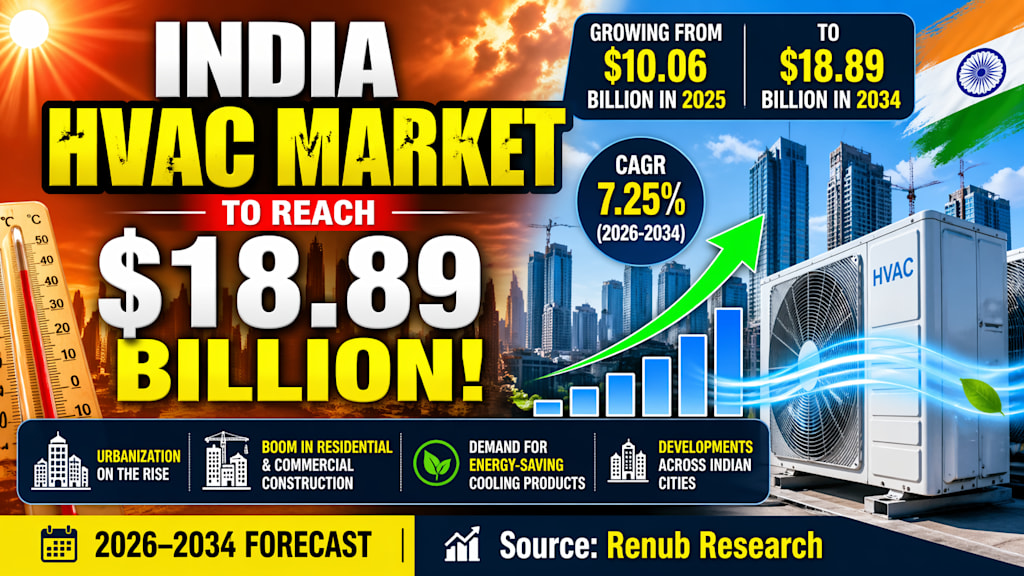
India’s demand for comfortable, energy-efficient indoor environments is accelerating faster than ever. From residential apartments in Mumbai to data centers in Hyderabad and malls in Bengaluru, heating, ventilation, and air conditioning (HVAC) systems have become essential infrastructure rather than optional luxuries.
According to Renub Research, the India HVAC Systems Market is projected to grow from US$ 10.06 Billion in 2025 to US$ 18.89 Billion by 2034, expanding at a CAGR of 7.25% during 2026–2034.
That growth reflects more than rising temperatures. It points to changing lifestyles, urban migration, stronger commercial construction, environmental awareness, and the modernization of India’s built environment.
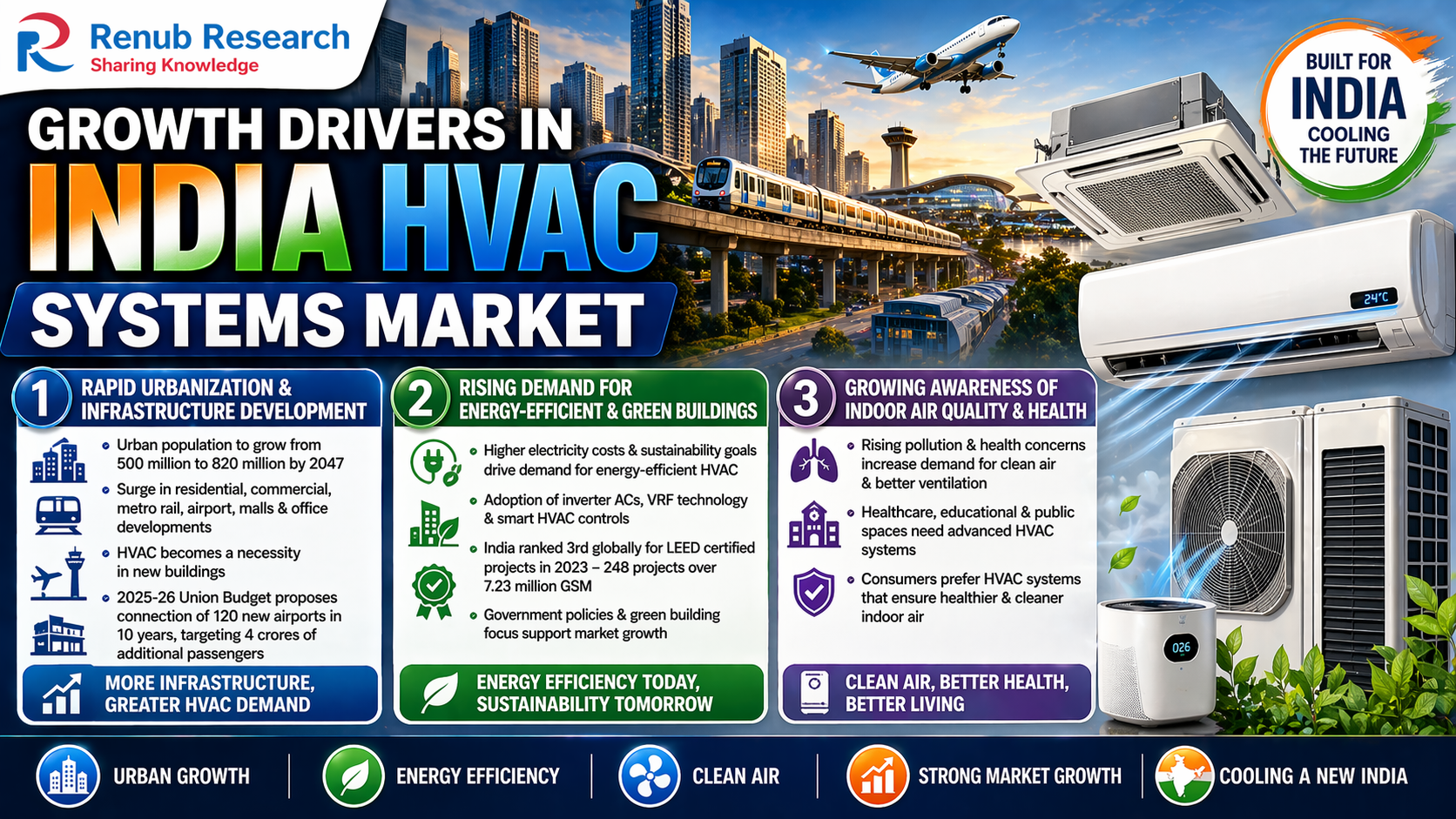
What Is Driving India’s HVAC Boom?
India’s climate varies widely, but much of the country experiences long hot summers, humid monsoons, and growing urban heat island effects. As cities become denser and living standards improve, demand for cooling and air quality solutions is climbing rapidly.
HVAC systems manage:
- Indoor temperature
- Humidity levels
- Ventilation airflow
- Air filtration
- Thermal comfort
- Energy management in buildings
These systems are used across homes, hospitals, offices, airports, shopping malls, hotels, industrial facilities, and transport systems.
What once belonged mostly to premium real estate is now entering mainstream residential and commercial demand.
Urbanization Is the Biggest Growth Engine
India is urbanizing at a historic pace. More people are moving into cities, and with that migration comes a surge in housing projects, office towers, retail complexes, metro stations, airports, and mixed-use developments.
The report notes that India’s urban population is expected to rise from 500 million to 820 million by 2047.
That demographic transformation creates direct demand for HVAC systems because modern urban infrastructure requires climate-controlled interiors.
Examples include:
- Apartment towers needing split AC systems
- Office campuses needing centralized cooling
- Airports needing advanced ventilation systems
- Hospitals requiring sterile air control
- Retail malls needing large-scale chillers
- Metro stations needing passenger comfort systems
In short, every new square foot of premium urban construction adds momentum to the HVAC market.
Energy Efficiency Is No Longer Optional
India’s rising electricity demand has pushed consumers and developers to prioritize efficiency. This is one of the strongest long-term drivers of the HVAC sector.
Buyers now seek:
- Inverter air conditioners
- Variable Refrigerant Flow (VRF) systems
- Smart thermostats
- Building automation controls
- High-efficiency chillers
- Low-energy ventilation units
Commercial real estate developers especially prefer HVAC systems that lower operational costs over time.
India’s green building momentum is also notable. The country ranked third globally in LEED-certified projects in 2023, completing 248 projects covering more than 7.23 million gross square meters.
That signals a powerful alignment between sustainability goals and HVAC adoption.
Indoor Air Quality Has Become a National Priority
Post-pandemic awareness has permanently changed how businesses and households think about air circulation.
Consumers now care about:
- Clean indoor air
- Better ventilation
- Dust and pollutant removal
- Germ control
- Healthier living spaces
This trend is especially important in Indian cities where pollution levels often rise seasonally.
Healthcare facilities, schools, offices, hotels, and premium residences increasingly demand integrated purification systems and fresh-air ventilation.
The report also highlights an April 2025 initiative where the Technology Development Board supported indigenous wall-mounted air purification technology for indoor spaces.
That suggests domestic innovation will play a bigger role in future HVAC ecosystems.
Residential HVAC Demand Is Surging
India’s housing market is becoming one of the biggest consumers of HVAC products.
Growth factors include:
- Rising middle-class incomes
- Premium apartment launches
- Desire for comfort and convenience
- Hotter summer seasons
- Affordable inverter AC models
- Awareness of indoor wellness
Split AC systems and inverter cooling solutions remain especially popular because they balance affordability with lower electricity consumption.
For many younger buyers, AC ownership is no longer aspirational—it is expected.
Commercial HVAC Is Expanding Across Sectors
India’s commercial segment is becoming increasingly sophisticated.
High-growth end users include:
- IT parks
- Shopping malls
- Hotels
- Hospitals
- Airports
- Warehouses
- Data centers
- Educational institutions
These facilities need uninterrupted cooling, ventilation, and humidity management. Data centers in particular are becoming a major source of future HVAC spending because servers require highly controlled environments.
As India grows as a digital economy, cooling infrastructure becomes mission-critical.
Heat Pumps and Air Purifiers Are Rising Opportunities
The broader HVAC market also includes adjacent categories seeing strong traction.
Heat Pump Systems
Heat pumps offer efficient heating and cooling by transferring heat instead of generating it. They are gaining relevance in:
- Water heating
- Commercial buildings
- Energy-conscious projects
- Cooler regions of India
Air Purifiers
The India air purifier market is growing due to:
- Urban pollution concerns
- Respiratory health awareness
- Post-pandemic behavior shifts
- Workplace wellness demand
Air purification is increasingly seen as practical rather than luxury-focused.
State-Level Growth Hotspots
Maharashtra
Mumbai, Pune, and Nagpur continue driving HVAC demand through commercial real estate, hospitals, transit systems, and premium housing.
Uttar Pradesh
Noida, Greater Noida, Lucknow, and Kanpur are expanding rapidly through residential and infrastructure development.
Andhra Pradesh
Visakhapatnam and Vijayawada are seeing growth through industrial corridors, ports, and smart city investments.
Gujarat
Ahmedabad, Surat, Vadodara, and Rajkot support strong demand through manufacturing, logistics, and commercial expansion.
Other key states include Tamil Nadu, Karnataka, West Bengal, Rajasthan, Telangana, and Madhya Pradesh.
Challenges Still Need Attention
Despite the opportunity, the sector faces meaningful barriers.
High Installation Costs
Advanced HVAC systems require significant upfront investment, especially for:
Centralized systems
Smart controls
Large commercial units
Retrofit projects
This can slow adoption among SMEs and price-sensitive buyers.
Skilled Labor Shortage
Efficient installation and maintenance require trained technicians. India still needs more skilled professionals for:
- System design
- Installation quality
- Energy optimization
- Preventive maintenance
Poor installation often reduces system efficiency and lifespan.
Power Supply Reliability
In some regions, voltage fluctuation and inconsistent power supply can impact HVAC performance.
Leading Companies in the Market
Major players active in India include:
- Carrier Corporation
- Daikin Industries, Ltd.
- Fujitsu
- Haier Group
- Havells India Ltd.
- Hitachi Ltd.
- Johnson Controls
- LG Electronics
These firms are competing on efficiency, innovation, service networks, and pricing.
Final Thoughts
India’s HVAC market is no longer just about air conditioners—it is about infrastructure, health, energy savings, and future-ready cities.
As urbanization accelerates, climate patterns intensify, and buildings become smarter, HVAC systems will sit at the center of modern living and commerce.
By 2034, an US$ 18.89 Billion market could reshape how India cools, ventilates, and powers its indoor environments. For manufacturers, developers, and investors, the message is clear:
About the Creator
Enjoyed the story? Support the Creator.
Subscribe for free to receive all their stories in your feed.
Comments
There are no comments for this story
Be the first to respond and start the conversation.