
WHY IRAN WAR CONTINUES
Geopolitical Tensions and the Politics of Silence in a Fragile World Order

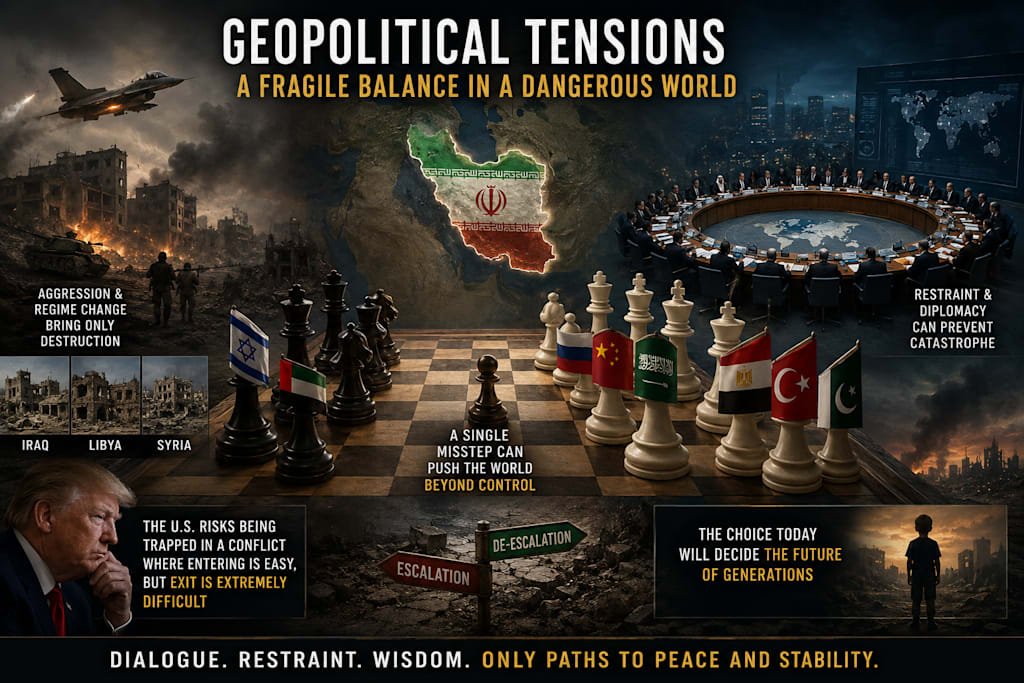
In an era defined by rapid information flow and constant media coverage, the credibility of sources has become increasingly questionable. The margin for confidently claiming that information is backed by reliable sources has narrowed significantly. Even when narratives emerge from prominent platforms—particularly within American media—they often lack verification. Reports suggesting that former U.S. President Donald Trump has been directly communicating with key actors may or may not be accurate. So far, many such claims have failed to materialize into confirmed realities, raising doubts about their authenticity.
At the same time, Iran has maintained an extremely controlled and reserved posture. Its communication strategy is deliberate, cautious, and highly restricted. Similarly, Pakistan—at the state level—appears to be quietly pursuing its diplomatic objectives without public escalation. This calculated silence is not coincidental; rather, it reflects the severity of the situation. The ongoing conflict carries the potential to evolve into something far more dangerous, where even a single unexpected development could push the situation beyond control.
A key factor behind this restraint is the scale and complexity of international involvement. Major global and regional powers—including Russia, China, Saudi Arabia, Egypt, Türkiye, and Pakistan—are all connected to the situation in varying capacities. Despite their differing strategic interests, a broad consensus appears to exist among these countries: the need to de-escalate tensions. This collective approach highlights a shared understanding that further escalation could have catastrophic consequences, not only for the region but for global stability as a whole.
However, this is not a universally shared perspective. A smaller yet influential bloc—primarily Israel and the United Arab Emirates—appears to advocate for a more aggressive approach toward Iran. Their strategic objective, as interpreted by many analysts, is to weaken Iran to such an extent that it cannot regain its current regional influence for at least one or two decades. While such ambitions are often expressed through political rhetoric, history provides ample evidence of the long-term consequences of such strategies.
The cases of Iraq, Libya, and Syria stand as powerful reminders. These countries experienced significant military interventions and regime changes, which left their political and social systems deeply destabilized. Even years after these events, they continue to struggle with internal divisions, economic challenges, and governance issues. Rebuilding a nation after such extensive damage is not a short-term process—it often takes decades, and in some cases, stability remains elusive.
The notion that a country can be strategically weakened or reshaped through external intervention is not new. However, it is a high-risk approach with unpredictable outcomes. While it may achieve certain immediate objectives, it often leads to prolonged instability, regional insecurity, and humanitarian crises that extend far beyond the original conflict.
Another critical dimension of this situation is the role of the United States, particularly under the leadership of Donald Trump. His approach has, in some respects, placed the U.S. in a complex and potentially difficult position. Engaging in a conflict where multiple global powers are already involved creates challenges not only in terms of strategy but also in terms of exit. Historically, once the United States becomes deeply involved in geopolitical conflicts, disengagement tends to be complicated and costly.
Furthermore, the rhetoric surrounding these tensions has often been intense and, at times, alarming. Statements suggesting the capability to “destroy civilizations” may function as political messaging, but they also underline the gravity of the situation. In a world equipped with advanced military technologies and nuclear capabilities, such language contributes to uncertainty and fear rather than stability.
What we are witnessing today is not merely a regional dispute but a complex interplay of global interests, strategic calculations, and cautious diplomacy. The silence of some states, the assertiveness of others, and the overarching push for de-escalation all point toward a fragile balance. Maintaining this balance requires restraint, careful negotiation, and a clear understanding of the potential consequences of escalation.
In such an environment, the absence of reliable and verifiable information further complicates the situation. Distinguishing between speculation and reality has become increasingly difficult, even for seasoned observers. Nevertheless, one fact remains undeniable: the stakes are extraordinarily high. Any miscalculation—whether political, military, or diplomatic—could have far-reaching implications, not just for the Middle East but for the entire world.
About the Creator
Ibrahim Shah
I am an Assistant Professor with a strong commitment to teaching,and academic service. My work focuses on fostering critical thinking, encouraging interdisciplinary learning, and supporting student development.
Enjoyed the story? Support the Creator.
Subscribe for free to receive all their stories in your feed.
Comments
There are no comments for this story
Be the first to respond and start the conversation.