

I wasn't supposed to be up this late.
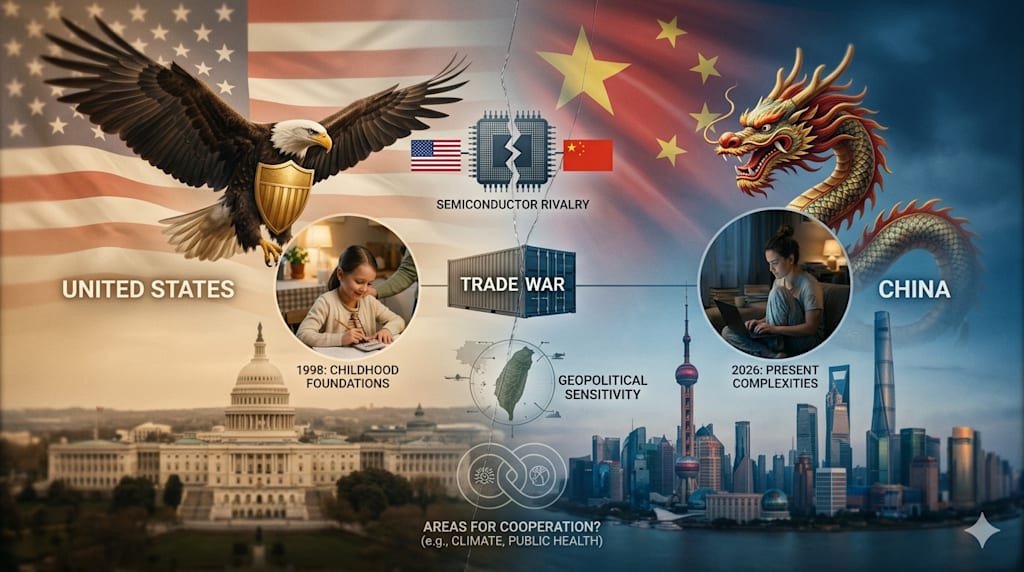
But the news was on—something about tariffs, something about Taiwan, something about a spy balloon from months ago that people are still yelling about. I muted it somewhere around 11:30. Kept the images playing on mute while I scrolled. A split screen of two flags. Two men in suits. Two countries that seem to be circling each other like boxers in a ring that never has a final bell.
And I couldn't stop thinking: Why does this feel so personal?
I don't work in trade policy. I don't own stock in semiconductor companies. I've never been to Beijing or Washington. But somewhere along the way, this US vs. China thing stopped being a geopolitical headline and started living inside me like a low-grade fever.
It started, for me, in a grocery store parking lot.
Two years ago. A woman in an SUV with a "Made in America" bumper sticker screamed at an Asian family walking toward their minivan. Something about "taking our jobs." Something worse I won't write here. The dad just kept walking, head down, holding his daughter's hand. He looked so tired. Like he'd heard it before.
I sat in my car and cried. Not because I'm some saint. Because I recognized that tiredness. Not from racism—I don't carry that weight—but from the exhaustion of being reduced to a symbol.
That's what US vs. China has become for so many of us. Not a competition between governments. A story we tell ourselves about who's winning, who's cheating, who deserves to be afraid.
Here's where I have to be honest: I don't know enough to pick a side.
Every time I think I understand—China's surveillance state terrifies me; America's gun violence terrifies me; one country builds islands in the South China Sea; the other builds prisons for profit—I realize I'm just repeating what someone else told me to feel.
I tried reading the serious analyses. Geopolitics. Economic warfare. The Thucydides Trap. But my eyes glaze over after three paragraphs because my brain keeps asking smaller, dumber, more human questions:
Will my friend in Shanghai ever visit again? Will my cousin's engineering job move to Shenzhen? Are we scared of the right things or just scared of each other?
I had a conversation last month with a guy from Chengdu. We met in a coffee shop—he's here for grad school. We talked about everything except politics until his third latte. Then he said something I can't shake.
"In China," he told me, "they say Americans are selfish and naive. In America, they say Chinese are robots who can't think for themselves. Neither is true. But both countries need the other to be the villain. Because if we're not enemies, then who's responsible for all this fear?"
He wasn't angry. He was sad. The same tiredness I saw in that parking lot.
The moment everything shifted for me—the real, uncomfortable shift—was when I realized I'd been playing a game I never agreed to.
I'd catch myself feeling a little relieved when China had a bad economic report. A little proud when the US blocked a Chinese tech company. Not because I understood the stakes. Because tribalism is easier than thinking. Because rooting for "my team" numbs the anxiety of not knowing what's actually happening.
That's the part nobody talks about. The rivalry isn't just political. It's emotional. It's a drug.
And like any drug, it asks you to give up something in return. For me, it was curiosity. The ability to see a Chinese student, a Chinese journalist, a Chinese mother, and not immediately filter them through the lens of competition.
I don't want to live that way. But the news cycle keeps offering me another hit.
I think about that dad in the parking lot. About my friend from Chengdu. About the millions of people on both sides who don't want to be pawns in someone else's chess game.
They just want to work. To raise kids. To scroll their phones at midnight and wonder why everything has to be a fight.
The US vs. China narrative is too big for me. Too loud. Too full of experts who've never been scared in a grocery store parking lot. But maybe that's the point. Maybe the real story isn't about presidents and missiles. Maybe it's about how we let strangers thousands of miles away decide who we're allowed to trust.
I muted the news an hour ago. The screen is dark now. Outside, the street is quiet. Somewhere across the ocean, someone is probably lying awake too, wondering if we'll ever stop drawing lines between us.
Here's the question I keep coming back to—not for you, for me:
If I met someone from "the other side" tomorrow, would I see a rival or a reflection?
I don't know yet. But I'm tired of being told the answer before I've asked the question.
About the Creator
John Smith
AI is rewriting the world. I'm here to ask the questions that matter. Tech writer. Deep thinker. Always curious.
Enjoyed the story? Support the Creator.
Subscribe for free to receive all their stories in your feed.
Comments
There are no comments for this story
Be the first to respond and start the conversation.