
The US Left Iraq After 23 Years. Here’s What It Left Behind.
The troops are gone. The influence, the militias, and the risk are not.
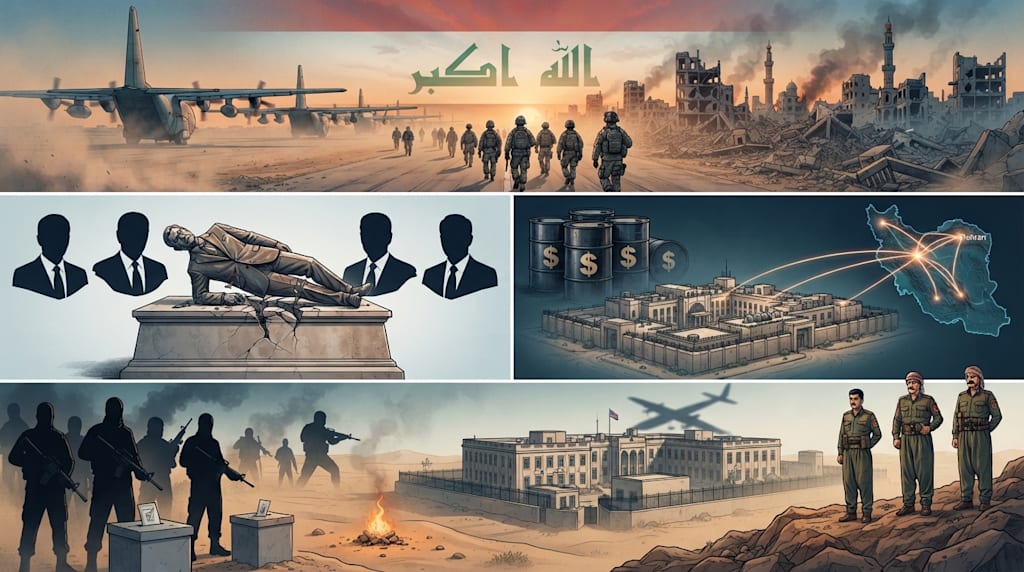
The last US troops left Iraq on a Wednesday. The date was September 30, 2026. The military presence that began with the March 2003 invasion had lasted 23 years.
In 2007, US forces in Iraq peaked at more than 170,000. By December 2023, about 2,400 remained. When the withdrawal finished, a small contingent stayed in the Kurdistan region.
The official reason for the pullout was simple. The mission to defeat ISIS in Iraq had reached its goals. The 2024 agreement between Washington and Baghdad called for it.
H.A. Hellyer does not buy that. Hellyer is a senior associate fellow at RUSI. He said the timing had more to do with risk. “This is about risk, not ISIS; that rationale expired years ago,” he said.
Iran and the region were on edge. US facilities in northern Iraq had recently come under attack. Washington increasingly saw the remaining troops as targets.
Safwan Al-Amin made the same point. He is a non-resident senior fellow at the Atlantic Council. The force was small. It had limited power-projection capability. “The Iran war exposed their presence as more of a liability than an asset,” he said.
Pressure also came from inside Iraq. Douglas Silliman was US ambassador to Iraq from 2016 to 2019. He said successive governments faced calls to end the US military presence. “Several Iraqi governments, under pressure from pro-Iranian factions and much of the Shia community, kept pushing... to ensure these forces left Iraq.”
The legacy is mixed. More than 20 years after the invasion, views remain divided. The four analysts interviewed for this piece describe it that way.
Silliman believes the idea that “representative democracy must govern Iraq” has taken root. Over the years, he said, many Iraqis told him they valued the political changes that followed Saddam’s overthrow.
Yerevan Saeed is director of the Global Kurdish Initiative for Peace at American University. He said the regime change mattered. Iraq today has more political freedom and pluralism than it did before 2003, especially in the Kurdistan region, he argued.
The costs were heavy. About 209,000 Iraqi civilians died in the violence between 2003 and 2021. About 9.2 million became refugees. The US military lost about 4,500 service members. It spent more than $1.7 trillion.
Al-Amin argues the invasion did not achieve its goals. Regime change did not give Iraqis the stable, prosperous country they expected. The invasion also destabilized the region. It let Iran expand its influence.
Hellyer rejects the idea that democracy defines the US legacy. “People should stop asking, ‘Did the US build a democracy?’ No, and that matter is settled,” he said. For him, the bigger legacy is regional. “The overthrow of Saddam ultimately allowed Iran’s networks to penetrate the state apparatus itself, absorbing the checks and balances Washington had sought to eliminate.”
All four analysts agree Iraq remains far from the stable democracy US policymakers imagined in 2003. Corruption is widespread. Armed groups still hold power alongside formal state institutions. That is especially true of hardline factions inside the Popular Mobilization Forces (PMF).
The next phase is already underway. Iran and its allies treat the US withdrawal as a victory. Al-Amin expects Iran to “consolidate its influence further if it can.” Iran has spent years building a network in Iraq through politicians, militias, and media. The security vacuum left by the US military gives pro-Iranian militias more room to shape political and security decisions.
Saeed fears an ISIS comeback. He sees parallels with the period after the 2011 US withdrawal. After US forces left, the Shia-dominated government in Baghdad arrested and purged Sunni leaders. It shut them out of politics. That crackdown pushed many Sunnis toward extremism. It helped ISIS rise. Saeed warns the risk is high again as Sunnis worry about how they will be treated.
Silliman is more optimistic. Iraqi security forces are far stronger than they were 10 years ago, he says. They are better able to handle similar threats.
The militia problem remains. Iraqi Prime Minister Ali al-Zaidi wanted pro-Iranian militias fully under state control by the same September 30 deadline. The militias are reportedly seeking to push that deadline to the end of 2027.
“That won’t happen,” Saeed said. The militias are embedded in Iraq’s political and financial systems. They hold seats in parliament. They keep ties with Tehran.
Silliman says that without US forces as a common target, the militias may lose a political tool. That could give Baghdad more room to pressure groups that refuse to comply. But he warns of a worse outcome. “I spoke with several Iraqi prime ministers, including those before my time as ambassador. They all feared this could lead to internal conflict, or even civil war in Iraq.”
Kurdistan has its own worry. The Kurdish Peshmerga depend on US military support. With US troops gone, and air defense systems removed, the region is more exposed to drone and missile attacks from Iran.
Al-Amin does not think the withdrawal ends US influence in Iraq. “Because Iraq relies on selling oil in dollars, the US still has considerable influence. Iraq still relies on the US to sell weapons and also needs US diplomatic support,” he said.
Saeed noted that Baghdad hosts the world’s largest US embassy. Erbil has the world’s largest US consulate. Those facilities will still need protection after the troops leave.
Silliman expects the “very deep military relationship” between the US and Iraq to continue. That includes training and planning support for the Iraqi military, counterterrorism forces, and the Peshmerga.
Al-Amin warns against treating the withdrawal as permanent. “US forces also left Iraq in 2011, but ended up returning a few years later,” he said. “This is the end of one chapter, not the last chapter.”
About the Creator
Jin
Writer of reamstories
https://reamstories.com/jin
Enjoyed the story? Support the Creator.
Subscribe for free to receive all their stories in your feed. You could also become a paid subscriber, letting them know you appreciate their work.
Comments
There are no comments for this story
Be the first to respond and start the conversation.