trump
For Trump's Fans, foes, frenemies and Twitter followers.
TACO & PACO. Top Story - June 2025.
On June 1, 2025 Ukraine conducted a massive drone attack on strategic bomber airfields deep in Russia. So deep the drones had to be delivered in secret double ceiling containers by long-haul trucks. The operation had been planned for 1.5 years in complete secrecy and had been personally supervised by President Zelenskyy. The drone attack was incredibly successful as Ukraine claims it has destroyed 41 bombers, or roughly one-third of Russian strategic bomber fleet. Russia has downplayed the operation results claiming that only five bombers had been destroyed.
By Lana V Lynxabout a year ago in The Swamp
The Dollar Is Falling: What It Really Means for Small Countries
In the global economic theater, the U.S. dollar has long played the leading role — a symbol of stability, strength, and trust. But today, the spotlight is shifting. From the rise of alternative alliances like BRICS to increasing distrust in U.S. global leadership, the fall of the dollar is no longer a conspiracy theory — it's a visible trend. And while the headlines focus on Washington and Wall Street, the real impact is unfolding quietly in small and developing countries.
By Keramatullah Wardakabout a year ago in The Swamp
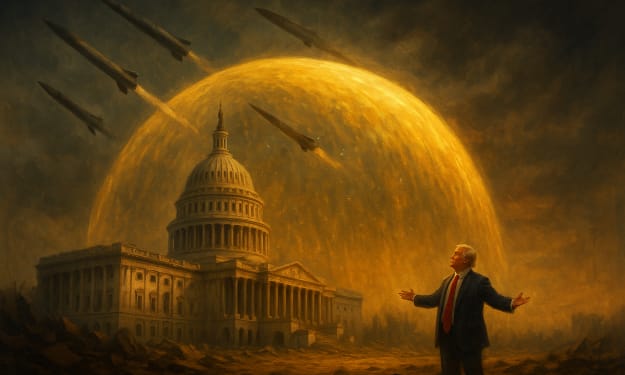
Golden Dome: $500 Billion Umbrella to Block Logic and Missiles
America has built bridges to nowhere, roads paved with pork, and now, under President Trump 2.0, it aims skyward with a defense plan that sounds like it was drafted between cheeseburgers and cable reruns: the Golden Dome. Not a Vegas casino. Not a reality TV spinoff. This is Trump’s proposed nationwide missile shield, a glowing forcefield designed to protect the homeland, and his legacy, from falling objects and rising scrutiny.
By The political Riftabout a year ago in The Swamp
What Happened to True Journalism? A Nation Starved of Truth
There was a time when journalism carried the weight of the republic—tasked with uncovering what was hidden, holding the powerful accountable, and speaking for those who couldn't. It wasn't perfect, but it was respected. The press said, and the country listened.
By Robert Lacyabout a year ago in The Swamp
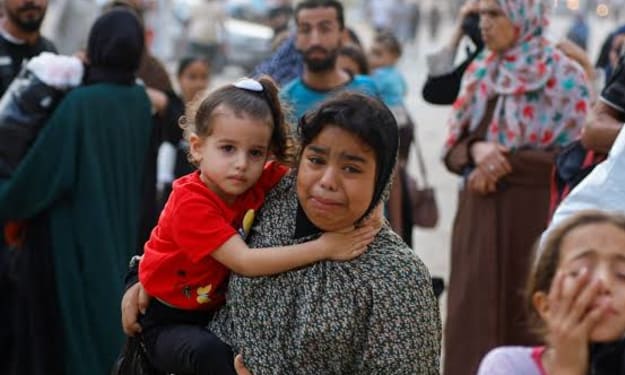
When Civilians Die, Does It Matter Who Pulled the Trigger?
When Civilians Die, Does It Matter Who Pulled the Trigger? In a world that prides itself on progress, equality, and human rights, there is a question that cuts through every political speech and every humanitarian promise like a blade:
By Muhammad Hakimiabout a year ago in The Swamp
I hate America
I Hate America for Helping Israel Let me be clear: when I say “I hate America for helping Israel,” I don’t mean I hate Americans. I don’t hate the ideals of democracy, freedom, or human rights that this country claims to uphold. What I hate is the hypocrisy. I hate the billions in aid sent to a country that continues to occupy, displace, and bomb a stateless, defenseless people. I hate how my government turns a blind eye to Palestinian suffering, and how the media spins tragedy into "self-defense" for one side only. For decades, the United States has been Israel’s biggest financial and political backer. Every year, billions of U.S. taxpayer dollars go to fund the Israeli military — the same military accused by multiple human rights organizations of apartheid, ethnic cleansing, and war crimes in Gaza and the West Bank. These aren’t fringe opinions; Amnesty International, Human Rights Watch, and even Israeli groups like B’Tselem have documented systematic abuses. Despite this, the U.S. continues to send weapons, veto UN resolutions, and label any criticism of Israel as antisemitism. This conflation is dangerous. It shuts down dialogue. It turns legitimate concern for Palestinian lives into a thought crime. And worst of all, it reinforces the idea that Israel is above international law. Why does America help? The reasons are complex — ranging from strategic alliances, political lobbying (most notably by AIPAC), to the influence of Christian Zionist groups. But none of these justifications excuse the moral cost. The U.S. prides itself on being a global leader, a beacon of justice. Yet its unwavering support for Israel contradicts everything it claims to stand for. How can a country that protested Russia’s invasion of Ukraine then defend Israel’s bombings of civilian homes, schools, and hospitals? How can we speak of international law when we ignore the Geneva Conventions in Gaza? How can we cry over the deaths of Israeli civilians while remaining silent about entire Palestinian families being wiped out in airstrikes? This double standard is not lost on the world. It’s not lost on the millions who marched in cities across the globe calling for a ceasefire. It’s not lost on the children in Gaza who draw tanks and drones instead of trees and birds. And it’s not lost on Americans like me, who are tired of our tax dollars funding oppression in the name of alliance. Some will say I’m unpatriotic. But patriotism is not blind loyalty — it’s holding your country accountable when it strays from its values. It’s demanding better. It’s standing with the oppressed, not the powerful. And right now, America is on the wrong side of history. To those who say it’s complicated: yes, it is. But complicity is not a neutral stance. Every bomb dropped, every home demolished, every life lost is a direct result of policies that the U.S. supports and sustains. If you fund it, defend it, and silence critics — you are part of it. I hate that my country makes me feel complicit. I hate that Palestinian lives seem to matter less in the eyes of my government. I hate the normalization of war crimes under the guise of self-defense. And I hate that speaking out about it can get you labeled antisemitic, disloyal, or worse. But I also believe in change. I believe in the power of public opinion, in grassroots movements, and in the younger generation that’s not afraid to speak truth to power. I believe in a future where the U.S. stands on the side of justice, not just strategic interests. And I believe that future starts with honesty — no matter how uncomfortable it may be.
By World politics about a year ago in The Swamp
When You Cherry-Pick Facts and Poll Numbers…
It is being reported by Newsweek that Donald Trump is experiencing a popularity surge based on the results of a single poll (Quantas Insights). Making hay from those results may put you on less solid footing than you think.
By Lanny Newvilleabout a year ago in The Swamp
The Rise in Political Toxicity: Democracy at a Breaking Point?
The Rise in Political Toxicity: Democracy at a Breaking Point? In an age defined by rapid communication and algorithm-driven discourse, the global political landscape is growing darker, sharper, and more divisive. What once were platforms for robust debate and thoughtful governance are now often battlegrounds of vitriol, misinformation, and calculated outrage. The rise in political toxicity—fueled by social media, populist rhetoric, and growing ideological extremism—is not just a symptom of modern politics; it is becoming the central feature. Across democracies old and new, from the chambers of Western parliaments to the streets of developing nations, toxic political culture is eroding trust, silencing moderate voices, and threatening the very foundations of civil society. A Global Phenomenon with Local Consequences Political toxicity is no longer confined to the fringe. A recent large-scale study that analyzed nearly 18 million social media posts from elected officials in 17 democracies revealed a disturbing trend: the language of politics is becoming increasingly hostile, combative, and emotionally charged. Radical-right parties and opposition groups are especially prone to using inflammatory rhetoric—often attacking institutions, marginalized communities, or democratic processes themselves. While each country faces unique circumstances, the pattern is clear. In the United States, bipartisan dialogue has become almost nonexistent, replaced by a toxic blend of partisan media, election denialism, and legislative gridlock. In India, political debate often spills into online harassment, sometimes targeting journalists, activists, or religious minorities. In Europe, rising far-right movements capitalize on fear and nationalism, frequently using scapegoating and conspiracy theories to galvanize support. The Role of Social Media: Amplifier or Arsonist? Social media has revolutionized how we communicate—but also how we polarize. Platforms like X (formerly Twitter), Facebook, and TikTok reward engagement, and engagement is most often driven by outrage. Politicians who use aggressive, divisive language are not punished; they’re promoted—by algorithms, by audiences, and by media coverage. A toxic tweet spreads farther than a measured one. This creates an incentive structure where moderates are drowned out and extremists dominate the conversation. The result? An environment where disinformation thrives, nuance dies, and citizens become increasingly disillusioned with the democratic process. Populism and the Politicization of Truth At the heart of rising political toxicity lies the rise of populist leaders who thrive on division. These figures often frame politics as a battle between “the people” and “the elite,” blurring facts, rejecting expertise, and fueling anti-institutional sentiment. In such narratives, political opponents are not just wrong—they are enemies of the state, traitors, or threats to the nation. This rhetoric doesn't just damage political discourse; it undermines institutions themselves. Courts are delegitimized, elections are called fraudulent without evidence, and the press is labeled “the enemy of the people.” When truth becomes negotiable, democracy becomes vulnerable. The Psychological Toll and Civic Consequences Political toxicity isn’t just a media issue—it’s a public health issue. Constant exposure to hostile rhetoric and polarizing debates leads to increased stress, anxiety, and political burnout. Studies show that young people, in particular, are disengaging from politics due to the hostility they witness online. The civic implications are just as troubling. Voter turnout declines when people feel their voice doesn’t matter or fear conflict. Trust in government erodes. Polarization becomes entrenched, making coalition-building and compromise virtually impossible. The cycle is self-perpetuating: toxic politics begets dysfunctional governance, which in turn fuels more frustration and toxicity. Can Democracy Detox? Despite the bleak landscape, hope is not lost. There are emerging efforts across the globe to reclaim civility and restore trust in democratic discourse. Civic education programs are being updated to teach digital literacy, empathy, and the importance of civil dialogue. Social media regulation is being debated more seriously than ever, with governments exploring ways to hold platforms accountable for toxic content amplification. Cross-party initiatives in countries like Germany, Canada, and New Zealand aim to build consensus on fundamental democratic values, even amid ideological differences. Moreover, a growing number of citizens are demanding change. Movements that promote fact-based journalism, constructive political engagement, and grassroots dialogue are slowly gaining traction. Conclusion: The Urgency of Now The rise in political toxicity is not just a passing trend—it’s a defining challenge of our time. If left unchecked, it threatens to corrode democracies from within, replacing reason with rage and compromise with contempt. But if recognized and confronted, it also offers an opportunity: to rebuild a political culture grounded in respect, evidence, and shared purpose. The choice is ours. We can allow toxicity to define our political future—or we can choose to detoxify, reconnect, and recommit to the ideals that make democracy worth defending.
By World politics about a year ago in The Swamp
The Truth Behind the Mysterious Qatari Plane to Trump
In recent months, a political rumor has ignited media attention and social speculation: Did the State of Qatar gift a private jet to former U.S. President Donald J. Trump? With tensions high around foreign influence in U.S. politics, the idea of a wealthy Gulf nation bestowing a luxury aircraft upon a former president raises significant ethical, legal, and diplomatic questions.
By Keramatullah Wardakabout a year ago in The Swamp