politicians
Reviews of the politicians kissing babies and running governments around the world; applaud and criticize the decisions they make and their implications.
Qatar Airways Signs Historic Deal with Boeing for Up to 210 Jets During Trump Visit. AI-Generated.
Qatar Airways Signs Historic Deal with Boeing for Up to 210 Jets During Trump Visit In a landmark move that solidifies growing economic ties between the United States and Qatar, Qatar Airways has signed a monumental agreement to purchase up to 210 jets from American aerospace giant Boeing. The deal, announced during former U.S. President Donald Trump’s official visit to Doha, is estimated to be worth up to $96 billion and represents one of the largest aircraft orders in aviation history.
By Adnan Rasheedabout a year ago in The Swamp
Male 'Heroes' Are Just Janitors Cleaning Up Other Men's Messes.
Name one war started because a woman was "too emotional." Go ahead, I'll wait. You can't name a single one. But you could easily list dozens started by men's wounded pride, fragile egos, and emotional outbursts disguised as political strategy - from World War I (sparked by wounded male honor after an assassination) to the genocide in Rwanda (fueled by male leaders' tribal insecurities). The pattern is undeniable: when men's emotions run hot, people die. When women get emotional, we're told to calm down.
By Amanda Ngcoboabout a year ago in The Swamp
Okiya Omtatah: Biography, Education Background, Age, Wife, Tribe, Net Worth & More
You’ve probably seen his name pop up every time someone dares to challenge the government in court—and wins. That’s Okiya Omtatah for you. While most people rant online, he drafts legal petitions. While others give up, he digs in.
By Marveline Merababout a year ago in The Swamp
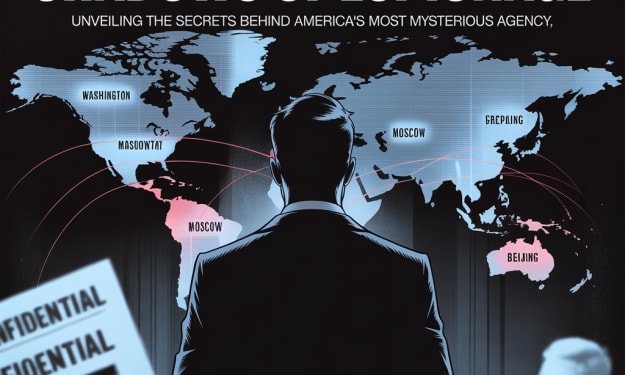
Inside the CIA: America’s Secret Intelligence Agency
From Cold War Tactics to Cyber Wars: The CIA’s Global Reach In the shadows of global politics, where nations maneuver not through diplomacy alone but through secrecy, deception, and surveillance, the Central Intelligence Agency (CIA) stands as one of the most powerful and enigmatic institutions in the world. Born from the ashes of World War II and raised during the height of the Cold War, the CIA has evolved from traditional espionage operations to become a digital-age intelligence giant. Its reach extends across borders, ideologies, and technologies—operating in a world where knowledge is power and information can change the fate of nations. As threats have shifted from Soviet missiles to cyberterrorism and AI warfare, so too has the CIA adapted, making it not only a historical cornerstone of American security but also a critical player in today’s global power struggle. The Origins: An Agency Born in Secrecy The CIA was formally established in 1947 under the National Security Act, but its roots trace back to the Office of Strategic Services (OSS), the United States' first intelligence agency during World War II. Designed to combat Nazi Germany and Imperial Japan through covert operations, the OSS laid the foundation for modern U.S. espionage. When the Cold War began, the United States recognized the need for a peacetime intelligence service capable of gathering foreign information and executing clandestine operations. Thus, the CIA was born—not as a military branch, but as an independent civilian agency reporting directly to the President. Cold War Operations: Spies, Coups, and Proxy Wars The Cold War era defined the CIA’s early years. It was during this period that the agency conducted some of its most controversial and defining operations. The primary adversary was the Soviet Union, and the battlefield was the entire world. Through programs like Operation AJAX in Iran (1953) and Operation PBSUCCESS in Guatemala (1954), the CIA orchestrated coups to install pro-American regimes. It ran surveillance and counterintelligence against Soviet spies and played key roles in proxy wars like Vietnam and Afghanistan. The agency’s use of human intelligence (HUMINT), psychological warfare, and propaganda became hallmarks of its Cold War strategy. However, not all actions met success. The failed Bay of Pigs Invasion in Cuba (1961), an attempt to overthrow Fidel Castro, became a major embarrassment. Nonetheless, these years solidified the CIA’s reputation as a formidable and secretive power broker in international affairs. The Post-Cold War Shift: Terrorism and Rogue States With the collapse of the Soviet Union in 1991, the CIA faced a moment of existential uncertainty. Without its traditional enemy, the agency had to adapt. In the 1990s and early 2000s, its focus shifted to emerging threats: rogue states, international terrorism, and the spread of weapons of mass destruction. After the 9/11 terrorist attacks, the CIA entered a new era. It was at the forefront of the War on Terror, playing key roles in tracking Al-Qaeda, capturing or killing terrorist leaders, and operating secret detention facilities. The agency’s controversial use of “enhanced interrogation techniques”, drone strikes, and black sites ignited debates on ethics, legality, and human rights—questions that still haunt the agency’s legacy. Enter the Cyber Era: Intelligence in the Digital Age Today, the battlefield has shifted again—from deserts and jungles to cyberspace. The rise of cyberwarfare, state-sponsored hacking, and digital espionage has pushed the CIA to evolve once more. The agency now works closely with other U.S. intelligence bodies like the NSA and FBI to counteract threats from nations such as China, Russia, Iran, and North Korea, which use cyberattacks as a form of asymmetric warfare. The CIA has also developed capabilities to monitor global internet traffic, infiltrate secure communications, and conduct offensive cyber operations—all while protecting U.S. national interests from increasingly sophisticated cyber threats. Additionally, emerging technologies such as artificial intelligence, big data analytics, satellite imagery, and biometric surveillance have given the CIA new tools in its intelligence arsenal. With these, it can track individuals globally, predict political upheavals, and identify terrorist plots before they unfold. Global Reach, Ethical Debate Despite its strategic importance, the CIA continues to face criticism and scrutiny. Leaks by whistleblowers such as Edward Snowden and WikiLeaks' Vault 7 disclosures revealed the extent of CIA surveillance and hacking capabilities. These revelations sparked global conversations about privacy, civil liberties, and the balance between security and freedom. Domestically, the CIA is overseen by the Senate Intelligence Committee, but many argue that real transparency is lacking. Internationally, its covert actions often blur the lines between security and interference, leading some to view it as both a protector and a puppet master. Conclusion: A Shadow That Shapes the Future From covert Cold War missions to cyber operations in the digital age, the CIA’s evolution reflects the changing nature of global conflict. Its ability to adapt to new threats has made it a pillar of American defense and foreign policy. Yet with great power comes great responsibility—and the agency’s future will depend not just on its technological capabilities, but also on its commitment to ethics, oversight, and transparency in an increasingly interconnected world.
By World politics about a year ago in The Swamp
Keir Starmer: Strangers in A Strange Land.. Content Warning.
Keir Starmer, from day one when he became Prime Minister, said he was going to get a grip on illegal migration and illegal immigrants. Critical of Rishi Sunak's 'Rwanda Scheme,' which aimed to fly illegals to Rwanda to be resettled. Sir Keir said this scheme was a waste of time and money. He said that upon his succession to Sunak, he would scrap the plan. This he did when he was elected last July.
By Nicholas Bishopabout a year ago in The Swamp
U.S. Bond Market Turmoil: A Tipping Point for Trump’s Tariff Policies?
Dramatic Volatility in the U.S. Bond Market: What Could Force Trump to Revoke Tariffs After a period of turmoil caused by U.S. trade tariffs, global stock markets have remained relatively stable this week. However, investors are closely watching one segment of the market that rarely moves dramatically—the U.S. bond market. Governments sell bonds to raise money for public spending, paying interest in return. Simply put, when a government lacks funds to run the state, it borrows money from its people in the form of bonds, promising to return the money with profit after a certain period, like three, four, or five years. Recently, in a rare move, the interest rate on U.S. government bonds has surged sharply, while the value of those bonds has fallen. This volatility signals that investors are losing confidence in the world’s largest economy. Why is this significant enough to possibly force Trump to revoke tariffs? What Are Government Bonds? When a government needs to borrow money, it typically sells bonds to investors in financial markets. In the U.S., these are called Treasury Bonds, and in Pakistan, they’re referred to as T-Bills. Payments are made over a set number of years, with the final payment occurring when the bond "matures." Essentially, the government gets the funds it needs and repays them with a predetermined interest. Most bond buyers are financial institutions, including pension funds and central banks like the Bank of England. What’s Happening with U.S. Bonds? Investors usually buy government bonds as a safe investment with little risk of default—especially from a superpower like the U.S. So during economic uncertainty, investors usually move their money into U.S. bonds. But recently, that hasn’t happened. Initially, on April 2, after the announcement of the so-called "Liberation Day" tariffs, stock markets fell and investors turned to U.S. bonds. However, when the first of those tariffs took effect on April 5, and Trump doubled down on his policies later that week, investors began dumping government bonds. This forced the U.S. government to offer higher interest rates to attract lenders. The yield on 10-year U.S. government bonds jumped from 3.9% to 4.5%, and the 30-year yield rose by nearly 5%. Even a 0.2% move in either direction is considered significant. Why the Sudden Sell-Off? In short, uncertainty over the economic impact of tariffs is making investors view U.S. government bonds as less safe. So, they now demand higher returns to take on that risk. The greater the risk, the higher the return investors expect. How Does This Affect Ordinary Americans? If the U.S. government has to spend more on interest payments, it affects the national budget and public services, making it costlier to run the government. The impact can also hit households and businesses directly. Oxford Economics analyst John Canavan says, “When investors demand higher interest rates to lend money to the government, borrowing becomes more expensive—impacting everything from daily expenses to credit card bills and car loans.” Sudden changes in borrowing costs hit businesses hard, especially small ones, since most American homeowners have fixed-rate mortgages for 15 to 30 years. If businesses lose access to credit, it can slow economic growth and eventually lead to job losses. Canavan adds that banks may become more cautious with lending, further weakening the U.S. economy. He says, “First-time homebuyers could face higher costs, affecting the housing market in the long run.” “In the U.S., it's common for small business owners to use their home equity as collateral.” Why Should Trump Care? After imposing tariffs, Trump urged investors to stay firm. But the potential threat to jobs and the economy seems to have restrained him. Following the bond market’s turmoil, he announced a 90-day grace period on additional tariffs for all countries except China. However, the 10% tariff remains in place for all. This has become a pressure point for Trump—and the world has taken note. Paul Ashworth, Chief North America Economist at Capital Economics, says, “While Trump managed to stop a stock market sell-off, things changed when the bond market began weakening.” U.S. media reported that Treasury Secretary Scott Bessent received phone calls from business leaders, which played a key role in persuading Trump. Has Something Similar Happened in the U.K.? This situation has been compared to the infamous September 2022 mini-budget by former U.K. Prime Minister Liz Truss. Her tax cut announcements frightened investors, who then sold off British government bonds, forcing the Bank of England to step in to save pension funds. Some analysts believe if bond selling escalated further, the U.S. Federal Reserve might have been forced to intervene. Even though bond yields have started to fall again, some argue the damage was already done—the bond value dropped even before full tariffs took effect. Capital Economics’ Deputy Chief Market Economist Jonas Goltermann says, “The most worrying aspect of the recent turmoil is the emerging risk in U.S. Treasury bonds and the dollar—much like what happened in the U.K. in 2022.” What About China’s Connection to U.S. Bonds? According to Deutsche Bank, foreign ownership of U.S. bonds has nearly doubled since 2010, with a $3 trillion increase. Japan holds the most U.S. Treasury bonds, but in this global trade war, America’s chief adversary—China—is the second-largest foreign holder of U.S. government debt.
By Ikram Ullahabout a year ago in The Swamp
Trump’s Strategic Demands from Saudi Arabia and Global Allies
Iran's Threat, the Cost of Protection, and the 'Promise of a Gift': What Does Trump Want from Saudi Arabia? During his first term in 2018, U.S. President Donald Trump made a historic statement: "There are countries that wouldn’t last even a week without our protection—and they’ll have to pay for it." Following this, Trump adopted a “pay-to-stay” policy, demanding that countries in Europe, the Middle East, Japan, and South Korea ensure payments to the United States for its protection. Now, with Trump returning to the White House in 2025, it appears that this policy remains unchanged. Ahead of his upcoming visits to Gulf countries—including Saudi Arabia, the UAE, and Qatar—Trump has once again publicly and clearly demanded payment from Saudi Arabia. This raises several questions: Will Saudi Arabia pay? What might compel it to do so? And what will it receive in return? During the January 2025 Davos Economic Forum, President Trump demanded a $1 trillion investment from Saudi Arabia. This came after Saudi Crown Prince Mohammed bin Salman announced plans to invest $600 billion in the U.S. over the next four years. Notably, according to international relations expert Dr. Ghada Jaber, "Saudi Arabia has not yet officially commented on Trump’s demand for a trillion-dollar investment." However, she added, "Trump might get what he wants, especially given his recent role in the region and his perceived successes concerning Iran." In 2017, during his visit to Saudi Arabia, Trump secured $350 billion in investments, including a $110 billion arms deal. He also managed to extract billions from Qatar, including $8 billion for renovations to the U.S. military base at Al-Udeid in 2019, alongside other defense agreements. In September 2020, Qatar’s foreign minister stated that his country had invested over $200 billion in the U.S. economy. Analysts say such Saudi funds underline the significance of shared interests between the two nations. Mohammed Al-Zayyat, Regional Director of the Al Yamamah Foundation and head of the Riyadh Center for Political and Strategic Studies, said: "This is the secret of U.S.-Saudi relations—it must be protected to prevent the decline of mutual interests." Potential for Increased Investment Recently, Saudi Minister of Economy Faisal Al-Ibrahim stated that additional investment opportunities could further increase the $600 billion Saudi investment commitment. Does this mean there’s no cap on Saudi investments in the U.S.? Especially as Saudi Arabia attempts to establish itself as a regional hub for industry and technology. These efforts are aligned with Saudi Vision 2030 and recent legal reforms aimed at encouraging industrial and technological growth within the kingdom. In an interview with the BBC, Mohammed Al-Zayyat said, "Saudi Arabia sees the U.S. as the world’s greatest power, while Washington views Saudi Arabia as the gateway to the Middle East and a shield for stabilizing oil markets and global energy security." Dr. Ghada Jaber told the BBC that Trump believes he has "secured many benefits" for Gulf nations, especially Saudi Arabia. She mentioned Trump's “successes” in the region include the weakening of the Assad regime in Syria, support for Israeli strikes on Hezbollah in Lebanon, recent strikes on Houthis in Yemen under his command, threats of military action against Iran, and limiting Iran’s regional influence. Recently, Trump announced the end of military operations in Yemen, claiming the Houthis have surrendered and will no longer attack U.S. ships in the Red Sea. Gulf Funds as a Major Source Trump's visit comes amid shifting regional dynamics, including negotiations over Iran’s nuclear program and its changing strategic position. Dr. Ghada Jaber said the U.S. has used the threat of Iran to pressure regional countries. Iranian presence in Syria, Iraq, Lebanon, and Yemen has been a longstanding concern for Saudi Arabia and others. Iran's nuclear program adds another layer, particularly alarming for Israel. Trump recently expressed a desire to completely dismantle Iran’s nuclear program. Sharif Abdul Hamid, director of Iranian Studies at the Gulf Center, stated that U.S. policy toward Iran is the biggest driver of Gulf funds. He said Trump aims to convince Saudi and Gulf leaders that their protection from Iranian threats depends on cooperating with the U.S. Tensions between Saudi Arabia and Iran date back to the 1979 Iranian Revolution. Saudi Arabia supported Iraq against Iran in the 1980s, and in 1987, the Saudi embassy in Iran was attacked and set on fire. Iran has supported the Houthis in Yemen, who have launched missile strikes on Saudi oil infrastructure—deepening the crisis between the two nations. In March 2023, with Chinese mediation, Saudi-Iran relations began to thaw—potentially paving the way for regional stability and cooperation. According to Zayyat, this Saudi-Iran agreement must be understood within the context of both countries’ domestic and foreign policies. Saudi Arabia wants to balance relations between East and West to promote economic growth. Iran, on the other hand, is facing internal unrest and economic struggles due to U.S. sanctions, and thus seeks to ease external tensions. Abdul Hamid argues that resolving issues with Iran may reduce conflict, but the U.S. and Israel might oppose this, since regional tension serves their political and economic interests. Investments from UAE and Qatar Even before Trump’s visit, the UAE and Qatar announced major investments. In Dubai, Trump Organization revealed plans to build a $1 billion Trump International Hotel and Tower. In Qatar, a $2 billion Trump International Golf Club project was unveiled. Trump’s “Gifts” Trump has made it clear: regional countries must bear the financial burden of American wars. The U.S. even asked Egypt to allow free passage through the Suez Canal for military and commercial ships targeting the Houthis. Egypt has not officially responded, but reports suggest that President El-Sisi rejected the request during a phone call with Trump. During his Gulf visit, Trump is also expected to offer a “political gift” to the region, possibly including renaming the Persian Gulf to the “Arabian Gulf” on official maps—something that could be seen as a symbolic win for Gulf states.
By Ikram Ullahabout a year ago in The Swamp
Flying Palace or Political Turbulence?
Air Force One's Alternative ‘Flying Palace’: The Qatari ‘Gift’ That Could Land Trump in Trouble The recent discussions between the White House and Qatar’s royal family have focused on a luxury jumbo jet. This lavish aircraft might be handed over for use as Air Force One by the President of the United States. U.S. President Donald Trump has defended the White House’s plan to use a jet received from Qatar as the presidential aircraft, Air Force One. Speaking to journalists at the White House, Trump said, “They (Qatar) are giving a gift.” He added that refusing it would be “foolish.” However, in a statement, Qatar said the aircraft is not a gift, though a "temporary transfer" of the aircraft is under discussion between the two countries. According to BBC’s U.S. partner CBS News, the aircraft would be donated to the Presidential Library after Trump’s term ends. This news comes at a time when Trump is set to visit Qatar next week—his first major foreign trip in his second presidential term. Ali Al-Ansari, Qatar's media attaché to the U.S., said that the discussions are ongoing between Qatar's Ministry of Defense and the U.S. Department of Defense. He added that the legal departments of both countries are reviewing the matter, and no final decision has yet been made. Strict Laws on Presidential Gifts in the U.S. Reports suggest the jet is worth $400 million. Sources told CBS News it won’t be available for immediate use as several modifications will be made, and security clearance is required. Critics are expected to raise legal and ethical questions about the aircraft’s potential value and use. Democrats have accused Trump of ethical violations. Senator Adam Schiff from California cited the U.S. Constitution on social media, stating that no elected official may accept “any kind of gift” from a foreign leader without Congressional approval. Even Trump’s ally Laura Loomer criticized the move. She wrote that while she could “take a bullet for Trump,” if the reports are true, this could be a major stain on his administration. On Sunday, White House Press Secretary Karoline Leavitt said, “Any gift from a foreign government can be accepted legally after fulfilling required legal procedures. President Trump’s administration believes in full transparency.” Defending the negotiations with Qatar, Trump referred to the jet as a “gift” and claimed he was offered its use free of charge. On Truth Social, he wrote: “The Department of Defense is receiving a gift. Free. A 747 aircraft that will temporarily replace the 40-year-old Air Force One. It will be a public and transparent transfer. But dishonest Democrats want us to pay a huge amount for this aircraft.” A ‘Flying Palace’ The White House currently has two Boeing 747-200B planes customized for presidential use. According to the U.S. Air Force, they include special communications equipment, a state room, an office, and a conference room. These aircraft have been in use since 1990 and 1991. Air Force One planes are often passed on to the next U.S. administration. According to the National Archives, only President Reagan’s Presidential Library has an Air Force One plane. It was used by seven presidents before being donated. According to ABC News, Qatar has offered Trump a Boeing 737 aircraft. It’s a more modern model, upgraded into a “flying palace.” Boeing has a history of contracts with the White House for providing new aircraft. However, Trump complained earlier this year that the company has caused delays. During his first administration, Trump initially negotiated with Boeing for two special 747-8 aircraft. However, Boeing stated that they would not be available until 2027 or 2028. In February, Trump said: “No, I’m not happy with Boeing. They’re taking too long with Air Force One. We gave them the contract a long time ago.” “We might buy an aircraft or make one available for ourselves.” Trump had a positive diplomatic relationship with Qatar during his first term. In 2019, he announced that Qatar was purchasing U.S. aircraft on a large scale. Qatar has also given private jets as gifts to several countries in the past. In 2018, Qatar gifted a luxury aircraft to Turkey.
By Ikram Ullahabout a year ago in The Swamp
Maverick Aoko: Education, Biography, Age, Real Name, Net Worth & More
Maverick Aoko isn’t your typical online commentator. Loud, unfiltered, and unapologetically bold, she’s made a name for herself in Kenya’s digital and political spaces with her razor-sharp takes and fearless opinions.
By Marveline Merababout a year ago in The Swamp
Ndindi Nyoro: Age, Net Worth, Biography, Full Name & More
Ndindi Nyoro is one of Kenya’s most dynamic and controversial politicians, known for his fierce advocacy for the common citizen and his prominent role in the economic and political discussions of the country. As the Member of Parliament for Kiharu, Nyoro has been a vocal supporter of economic reforms and has built a reputation as a strong ally to President William Ruto.
By Marveline Merababout a year ago in The Swamp