trauma
At its core, trauma can be thought of as the psychological wounds that persist, even when the physical ones are long gone.
Compassion for Who
Orson worked as a contract coder for multiple medical software companies. Freelancing let him make his own hours, live where he wanted, and be his own boss. He avoided petty office politics and usually made more than the 9-5ers. The downside was there were no benefits. Medical and life insurance, along with retirement plans, were his responsibility. It seemed a fair trade for his freedom.
By Mark Gagnonabout a year ago in Psyche
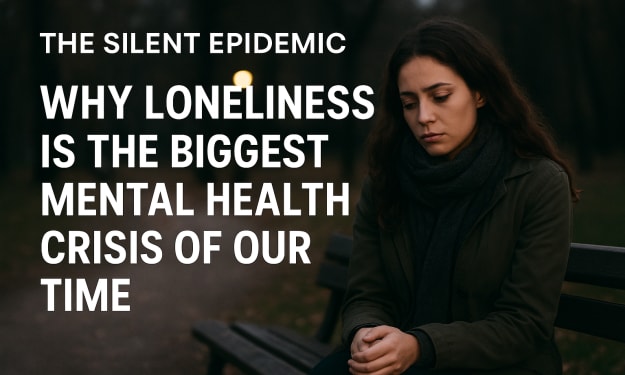
Connected but Alone: The Hidden Mental Health Struggle No One Wants to Admit. Content Warning.
Introduction In an age where our phones buzz with notifications, where we can video call someone on the other side of the world in seconds, and where social media makes it seem like friends and laughter surround everyone, there is a painful irony: many of us have never felt more alone.
By Byron Egoleabout a year ago in Psyche
The Sound of My Name in Other People’s Mouths
The Sound of My Name in Other People’s Mouths by [Numan writes] There’s a way my mother says my name that folds time. It carries the softness of early mornings and warm milk, the scent of jasmine from her shawl, and the quiet weight of lullabies hummed rather than sung. In her mouth, my name is a prayer—gentle, deliberate, each syllable laced with a kind of trembling care, like she’s still afraid to break me.
By Numan writesabout a year ago in Psyche
So, Whose Responsibility is Burnout Anyway?
In today’s fast-paced, hyper-connected world, burnout has become a global catastrophe, silently eroding the foundations of our workforce and society at large. As we navigate the complexities of modern work life, a pressing question emerges: who bears the responsibility for combating this depressingly ever-worsening threat?
By Bianca Bestabout a year ago in Psyche
The Person I Pretended to Be Almost Erased Who I Truly Was
There’s a strange danger in pretending for too long. At first, it feels harmless—like slipping on a mask just to fit the occasion, adjusting your voice or your mannerisms to blend in, smoothing over your sharp edges so no one notices they’re there. But the longer you wear the mask, the harder it becomes to remember where the mask ends and where you begin. For years, I pretended. I pretended to be confident when inside I was shivering with self-doubt. I pretended to be agreeable when every bone in my body wanted to speak up. I pretended to have it all together because the world seemed too unkind to handle the truth of my fragility. And slowly, without realizing it, the person I pretended to be began to take up more space than the person I truly was. At some point, I stopped just pretending—I started becoming. The act felt safer than reality. People praised the version of me who always smiled, who said yes without hesitation, who performed like life was an endless stage play. I earned approval. I earned acceptance. I earned belonging—or at least I thought I did. But what I lost in the process was myself. It’s easy to underestimate the cost of hiding. You convince yourself you’re being strategic, that you’re just adapting. But adaptation becomes self-erasure when it’s rooted in fear. I wasn’t adapting; I was disappearing. The Silent Replacement The first sign was subtle. I no longer trusted my own feelings. If I was upset, I’d swallow it down, whispering to myself, It’s not a big deal. Don’t make a scene. If I was excited, I’d tone it down, fearing someone might think I was “too much.” I filtered everything through the lens of how it would be received by others, until my own desires barely registered. Then came the second sign: exhaustion. Pretending is heavy work. Carrying around a version of yourself that doesn’t belong to you will eventually crush you. I felt drained not from living, but from performing. Every interaction felt like another scene I had to rehearse, another script I had to memorize. And the third sign was the most frightening: I began to forget what I actually wanted. If someone asked me my opinion, I froze. Not because I didn’t have one, but because I couldn’t tell which voice was mine anymore. The mask had become so convincing that even I struggled to see past it. The Moment of Reckoning I wish I could say there was a single dramatic moment when everything came crashing down, but in truth, it was quieter than that. It was the night I stared at myself in the mirror and felt like I was looking at a stranger. I didn’t hate who I saw. I just didn’t know them. That’s when it hit me: if I kept pretending long enough, the real me might never come back. The person I truly was—the one with messy emotions, unpolished thoughts, inconvenient truths—was fading into the background. And the longer I allowed the performance to dominate, the harder it would be to remember my own lines. I realized I had a choice. I could keep living in the comfort of applause, validation, and external approval—or I could risk losing all of that to rediscover who I was beneath the masks. It terrified me. But what terrified me more was the thought of leaving this world without ever being known—not by others, but by myself. Reclaiming Myself Reclaiming who I was didn’t happen overnight. It began with the smallest rebellions: saying no when I meant no, allowing myself to cry in front of people I trusted, admitting when I didn’t have it all together. At first, it felt unnatural, even wrong. Authenticity is uncomfortable when you’ve trained yourself to believe it’s unsafe. But slowly, I started to breathe again. I learned that some people didn’t like the real me—and that was okay. Their discomfort wasn’t my responsibility. For every person who drifted away when I stopped pretending, another person drew closer, grateful for my honesty. I realized that genuine connections could only grow in the soil of truth, not performance. Most importantly, I learned to give myself permission to exist without explanation. To laugh too loudly. To feel too deeply. To dream too boldly. To be messy, contradictory, human. The Lesson The person I pretended to be nearly replaced who I was. And maybe, in a way, that’s what had to happen for me to finally understand the fragility and value of authenticity. Because here’s the truth: the world doesn’t need another polished performance. It needs people willing to be real—people who remind others that imperfection is not failure but evidence of life. Now, when I look in the mirror, I don’t see a stranger. I see someone scarred but alive, broken but whole, imperfect but free. And I promise myself daily: never again will I let the mask become the masterpiece. Thank you for reading this 🥰.
By Azmat Roman ✨about a year ago in Psyche
I Was the Strong One Until It Broke Me
For as long as I can remember, people have seen me as “the strong one.” The dependable friend. The sibling who always listens. The co-worker who steps up when things fall apart. I carried that title like a badge of honor, proud that others trusted me, proud that I could be the one who held everyone together.
By Nadeem Shah about a year ago in Psyche
The Girl Who Slept On A Newspaper
Anxious attachment is a thing we hear a lot about these days. Attachment theory is a buzzword bingo selection. Like narcissism and gaslighting. But the story of how I learned to chase avoidant men like a defective compass needle that only pointed toward storm systems is one in a million. And yet, the dynamic may be the most common model of all relationship issues today.
By Suburban_Disturbanceabout a year ago in Psyche
Chains of the Brothel: Part 7 Silent Walls
The Prison Disguised as a Home The place where Anita now lived was not a home. It was a forgotten prison pretending to be a sanctuary. The villagers called it the Old House, but its name was a cruel lie. It wasn’t a shelter for the elderly or a place of care. It was where society abandoned those it no longer wished to see—the “incurable,” the “dangerous,” the “inconvenient.”
By Shehzad Anjumabout a year ago in Psyche