recovery
Your illness does not define you. It's your resolve to recover that does.
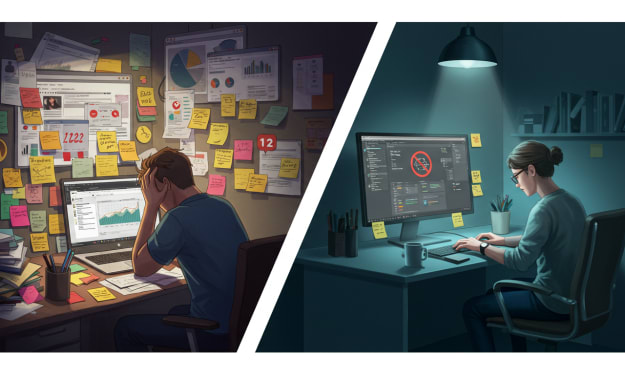
Focus Isn't About Trying Harder: It's About Friction
In the age of constant notifications, open tabs, background noise, and infinite scrolling, we've come to believe that focus is a matter of willpower. If we just tried a little harder, eliminated laziness, and summoned more discipline, we could finally sit down and get things done. But what if this assumption is wrong?
By Nikesh Lagunabout a year ago in Psyche
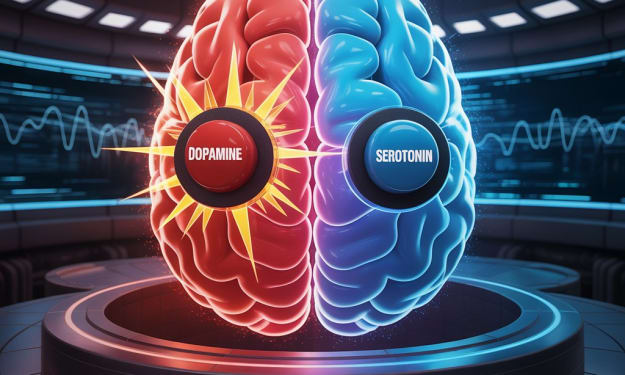
Dopamine vs. Serotonin: The Secret Dance That Runs Your Brain (And Life)
Let me tell you a story about Jake. Jake wakes up exhausted, grabs his phone immediately, and doom scrolls for 30 minutes. He knows he should work out, but "just can't find the motivation." By afternoon, he's binged on snacks while putting off important work. At night, he's wired but exhausted, mind racing about everything he didn't accomplish.
By shoaib khanabout a year ago in Psyche
10 Signs of Toxic People — And How to Protect Your Peace
They might be charming. They might even call you their best friend, partner, or “ride or die.” But something feels off. You leave every interaction with them feeling tired, small, or strangely guilty — and you can’t explain why. That’s the silent damage toxic people cause. They don’t always scream or slam doors. Sometimes, they just chip away at your peace, bit by bit, until you forget what life felt like without walking on eggshells. ### Here Are 10 Classic Signs of Toxic People — And How To Handle Them: --- **1. They Make Everything About Themselves** No matter what you’re going through, the conversation circles back to *them*. You could be grieving or celebrating, and somehow they’ll make themselves the main character. 🛡️ *Protect Yourself:* Limit how much you share. Notice if your feelings are constantly invalidated — and stop expecting support where none exists. --- **2. They Guilt Trip You Constantly** They say things like: - “After all I’ve done for you…” - “Wow, so you don’t care anymore?” - “You’re really going to act like that?” Guilt becomes their weapon of control. 🛡️ *Protect Yourself:* Recognize emotional manipulation. You are not responsible for anyone else’s happiness, especially when it comes at the cost of your own. --- **3. They Only Come Around When They Need Something** When things are good for you, they’re silent. But the moment they want attention, money, support, or drama — they show up fast. 🛡️ *Protect Yourself:* Watch for patterns. Healthy relationships go *both* ways. You’re not an emotional ATM. --- **4. They Subtly Tear You Down** Toxic people disguise cruelty as humor or “honesty.” - “You’re cute, but not *model* cute.” - “I’m just saying what everyone else is thinking.” 🛡️ *Protect Yourself:* Don’t laugh along. If someone constantly makes you feel smaller — it’s intentional. --- **5. They Compete With You Instead of Supporting You** Your wins make them uncomfortable. Your growth makes them insecure. And instead of cheering you on, they try to outdo you. 🛡️ *Protect Yourself:* Real friends don’t treat life like a scoreboard. Distance yourself from those who treat your success as a threat. --- **6. They Never Apologize — Or Weaponize Their Apology** If they ever say sorry, it comes with strings attached. - “I’m sorry *you* feel that way.” - “I said sorry, what more do you want?” 🛡️ *Protect Yourself:* Watch for apologies that shift blame. A real apology includes change — not just words. --- **7. You Feel Drained After Talking to Them** This is one of the clearest signs. You dread their texts. You feel anxious before seeing them. And afterward? Exhausted. 🛡️ *Protect Yourself:* Your energy is valuable. If someone constantly drains it, that’s not friendship — it’s emotional theft. --- **8. They Disrespect Your Boundaries** Whether it’s your time, space, or emotional needs, toxic people don’t care. They push, test, and cross lines repeatedly. 🛡️ *Protect Yourself:* Say “no” and mean it. If they get angry when you set a boundary — that’s exactly why you need one. --- **9. They Play the Victim Every Time** Nothing is ever their fault. Even if they hurt you, somehow they become the wounded one. It’s exhausting and manipulative. 🛡️ *Protect Yourself:* You can’t heal someone who refuses to see their own damage. Don’t let guilt keep you stuck in their cycle. --- **10. They Make You Question Yourself** The most dangerous thing? They make you doubt your own reality. You start asking: - “Was it really that bad?” - “Maybe I’m just too sensitive?” - “Am I overreacting?” That’s not self-reflection. That’s **gaslighting**. 🛡️ *Protect Yourself:* Trust your gut. If someone constantly makes you question your worth, it's not your insecurity — it’s their manipulation. --- ### Final Thought: Peace Is a Choice Toxic people thrive where boundaries are weak. The hard truth? You can’t change them. But you *can* change how much access they have to you. You’re allowed to walk away. You’re allowed to cut ties. You’re allowed to protect your peace — even if they call you cold, dramatic, or selfish. Let them talk. Because the people who truly love you won’t make you suffer for saying, “Enough.”
By SHADOW-WRITESabout a year ago in Psyche
When You Feel Nothing: The Quiet Struggle of Emotional Numbness
Some days, you're not sad. You're not angry. You're not happy either. You just *exist* — moving through time like a shadow of yourself. You smile when you should. You respond when spoken to. You say, “I’m fine,” and maybe you even believe it for a second. But deep down, there’s… nothing. This is emotional numbness. It’s not a trending hashtag or a quote-friendly topic for Instagram stories. It’s quieter than depression, subtler than anxiety, but often just as destructive. And yet, most people who suffer from emotional numbness don’t even realize what they’re going through — until they’re years into it, feeling like ghosts inside their own lives. ### What Is Emotional Numbness? Emotional numbness is the inability to feel emotions — good or bad. It’s like life becomes a dull background noise. You’re functioning, you’re waking up, eating meals, doing your job or schoolwork, responding to texts — but there’s no spark. No high. No real low either. Just a numb, muted existence. It often shows up after trauma, long-term stress, burnout, or depression. Sometimes it’s the mind’s way of protecting you from emotional overload. But in the process, it also cuts you off from everything beautiful: joy, connection, love, excitement. ### You Might Be Emotionally Numb If… - You don’t feel excitement for things you once loved - You avoid deep conversations or emotional topics - You feel disconnected from people, even close friends or family - You can’t cry, even when something sad happens - You feel like you’re “watching your life” rather than living it - You use distractions (scrolling, gaming, eating) just to feel *something* If any of these feel painfully familiar, you’re not broken. You’re just emotionally exhausted — and your brain has gone into survival mode. ### Why We Don’t Talk About It Emotional numbness is hard to describe. When you're sad, you can cry. When you're anxious, your heart races. But when you're numb, there’s nothing to *show*. People assume you're okay because you're not falling apart. And that’s what makes it dangerous. We’ve been conditioned to measure mental health by how "bad" someone looks on the outside. But numbness often wears a functioning face. It goes to school. It jokes with friends. It posts selfies. And it suffers in silence. ### Breaking the Ice: How to Feel Again The good news? Numbness is not permanent. But healing doesn’t happen overnight. It begins with tiny cracks in the ice — and you have to let the light in, slowly. Here are some ways to begin: 1. **Acknowledge it without guilt** You're not weak for feeling nothing. You're human. Give yourself permission to feel *whatever is or isn’t there*. 2. **Reconnect with your body** Physical movement (like walking, stretching, dancing) helps reconnect you to your senses. Even a cold shower can pull you back into the present. 3. **Limit emotional distractions** Constant noise (scrolling, bingeing, multitasking) numbs us further. Try silence. Journal. Stare out a window. Let your mind breathe. 4. **Talk, even if you don’t know what to say** A therapist, a friend, a voice note to yourself — anything. Just *externalize*. Naming your numbness is the first step to softening it. 5. **Revisit small joys** Return to hobbies, even if they feel “meh.” Sometimes your heart shows up five minutes in — not at the start. ### A Final Thought You don’t need to crash and burn to realize you’re struggling. Sometimes, the absence of feeling is the loudest cry for help. So if you’re reading this and thinking, “This is me,” — breathe. You’re not alone. You’re not broken. And this numbness is not your forever. You’re still in there — behind the silence, beneath the layers. And piece by piece, you will feel again. One moment at a time.
By SHADOW-WRITESabout a year ago in Psyche
I’m Not Okay — I Just Look Like I Am
I’m done. No formal goodbye. No soft sendoff. No thank-you-for-your-service. This isn’t a break. It’s a breakup. You don’t get to keep holding the pen that writes my story. I’m reclaiming it — ink-stained fingers, messy margins, and all.
By Noman Khan about a year ago in Psyche
What to Expect After Acupuncture: Recovery & Benefits
Acupuncture has been practised for thousands of years and is widely recognised as an effective therapy for a range of physical and emotional health conditions. Whether you're seeking relief from chronic pain, stress, fertility issues, or digestive problems, acupuncture offers a holistic and natural approach. But what actually happens after a session? Understanding what to expect after acupuncture can help you make the most of your treatment and manage your recovery effectively.
By Kerry Rutherford Acupunctureabout a year ago in Psyche
The Dark Side of Mindfulness
Mindfulness has become a buzzword in wellness circles—praised for calming the mind, improving focus, and bringing us closer to the present moment. It’s taught in schools, practiced in boardrooms, and promoted by therapists. But here’s a truth that’s often overlooked: mindfulness isn’t always helpful. In fact, for some people, the very act of tuning inward can stir up discomfort, anxiety, and emotional distress.
By shoaib khanabout a year ago in Psyche
I Felt Deeply Lonely — Even With 3,000 Followers and Constant Messages
There was a time when my phone never stopped buzzing. DMs. Likes. Tags. People commenting on my posts. People replying to my stories. To the outside world, I looked like I was “always connected.” But in reality? I felt **crushingly alone**. I had followers. I had people reacting to every story I posted. And yet, I would sit in a room full of messages and feel like no one would notice if I disappeared. --- ## Modern Loneliness Feels Like This: You’re “seen” by many — but known by none. You talk to people all day — but you don’t feel heard. You scroll for hours — but nothing fills the void. You laugh in your replies — but cry in your silence. It’s a silent kind of sadness. The type you can’t even explain to others because you feel like you *shouldn’t* be lonely. “You have friends.” “You’re always online.” “You’re so active!” But none of that reaches the part of you that aches. And the worst part? You begin to question yourself. > “Maybe I’m just being dramatic.” > “Maybe I’m the problem.” > “Why can’t I feel happy like everyone else?” That’s when it becomes dangerous. You don’t just feel lonely — you start feeling invisible. Even to yourself. --- ## I Realized I Was Starving for Something Real One night, I scrolled through my chats — dozens of conversations, none of them deep. No one I could really call at 2AM. No one who truly *got me* without a filter. I was drowning in surface-level connection. It was like eating junk food when your soul was starving for something nourishing. That night, I broke down — and finally admitted it: I didn’t need more followers. I needed **real connection**. --- ## So I Made One Radical Decision: Be Brutally Honest The next day, I posted something I had never posted before. > “I’m feeling weirdly lonely these days, even with all the messages and replies. > If anyone else feels this too, just know you’re not broken. You’re human.” No filters. No edits. No fake positivity. Just truth. What happened next shocked me. People started DMing me with their own stories: - “I feel the same way but never say it.” - “Thank you for being honest. I needed this today.” - “You're not alone in feeling alone.” I had cracked something open. Suddenly, I wasn’t the only one admitting the truth. Others felt it too — they just needed *permission* to say it. --- ## Then I Did 5 Things That Changed Everything 1. **I called people instead of texting.** Hearing voices, even for 10 minutes, brought warmth back into my days. A voice can hold more comfort than 100 texts. 2. **I planned “no phone” meetups.** No stories. No selfies. Just being present with someone. One hour of real-time with someone is worth more than weeks of messaging. 3. **I unfollowed toxic “comparison” accounts.** The ones that made me feel less-than. I replaced them with creators who felt *real* and inspired me to be myself. 4. **I joined one local event every month.** From book clubs to coffee meetups — anything to meet people face-to-face. Human energy can’t be replicated through screens. 5. **I reconnected with old friends — with zero ego.** Even if we drifted, I just said: “Hey, I miss talking to you.” Surprisingly, many of them missed me too but thought I had moved on. And slowly… I didn’t feel alone anymore. Not because I had *more* people. But because I had *realer* ones. --- ## Final Thoughts If you feel lonely in a world where connection seems constant, you are not broken. You are human in a digital world that often forgets what real intimacy looks like. Likes are not love. Replies are not relationships. And a full inbox doesn’t mean a full heart. We’re so busy performing online, we forget to *connect*. But you don’t need to delete your social life — just deepen it. So talk. Be vulnerable. Be real. The moment I stopped pretending, connection found me again. There’s someone out there who feels exactly like you. They’re waiting for someone else to say it first. Be that person. Because you’re not alone. You never were.
By SHADOW-WRITESabout a year ago in Psyche
🧠 What Overthinking Feels Like — And How I Finally Silenced It
You ever had a moment where your brain just *won’t shut up*? That’s not “just overthinking.” That’s torture. And I lived in that loop for years. - - - **What Overthinking *Really* Feels Like** Imagine this: you're lying in bed. You’re exhausted. But suddenly, your mind starts running a marathon you never signed up for. “Did I sound stupid earlier?” “Why didn’t they reply?” “Should I have said that?” “What if something goes wrong tomorrow?” “What if everything goes wrong next year?” And just like that, you're stuck in a mental vortex — replaying imaginary arguments, worrying about things that haven’t even happened yet, dissecting every sentence you said… five years ago. It feels like drowning in thoughts with no way to swim out. - - - **It’s Not Harmless. It’s Painful.** People often treat overthinking like it's a harmless quirk. But for me, it wasn’t “quirky” — it was **paralyzing**. It made simple decisions feel like life-or-death choices. I would reread a message 12 times before sending it. I’d cancel plans just to avoid awkward interactions. I’d lose sleep because my brain refused to let go of one weird look someone gave me. The worst part? I knew I was doing it. But I couldn’t stop. - - - **Where It Came From (Spoiler: It Was Fear)** Looking back, overthinking was just fear wearing a smarter outfit. Fear of rejection. Fear of embarrassment. Fear of being misunderstood. So my brain thought: “If I analyze every detail, I’ll stay safe.” But it didn’t keep me safe. It kept me stuck. - - - **What Finally Helped Me Silence It** No magic cure. No “one weird trick.” Just a messy, inconsistent journey of reprogramming my brain. Here's what actually worked: - - - **1. I started writing things down.** Journaling changed everything. I’d dump every anxious thought onto paper — even if it sounded ridiculous. The act of writing helped me separate the thought from *me*. I’d look at it and think, “That’s not truth. That’s just fear talking.” - - - **2. I named my inner critic.** I gave my overthinking voice a name — *Doubt Debbie*. So when that voice popped up, I’d say: “Okay Debbie, I hear you, but you’re not running the show today.” It helped me detach from the toxic loop and stop taking those thoughts as facts. - - - **3. I practiced “worst-case scenario” logic.** Whenever I spiraled, I’d ask: “What’s the *worst* that could happen? And then what?” Usually, I realized that even the worst outcomes were survivable. That diffused the panic. - - - **4. I stopped treating every thought as a prophecy.** Just because I *thought* something might go wrong didn’t mean it would. I started telling myself: “It’s just a thought, not a prediction.” - - - **5. I let go of needing control.** Overthinking was my way of trying to control everything. But life doesn’t obey thought loops. I had to accept that uncertainty is normal — and peace lives in the *letting go*, not the gripping tighter. - - - **The Truth? It’s Still a Battle Sometimes.** I won’t lie. I still overthink sometimes. But now? It doesn’t own me. I catch it earlier. I give myself grace. And I remind myself: the mind is loud, but it’s not always right. - - - **Final Thoughts** Overthinking feels like a storm that never ends. But you can learn to step out of it. You don’t have to control every outcome. You just have to breathe, let go, and *trust yourself more than your fear*. If this resonated with you — I’ve been there. And I promise: silence is possible. Not all at once. But day by day, thought by thought, it’s possible. You’re not broken. You’re just overthinking. And you can unlearn it.
By SHADOW-WRITESabout a year ago in Psyche