recovery
Your illness does not define you. It's your resolve to recover that does.
🌿 Slow Love: Why Gen Z Is Choosing Emotional Depth Over Chaos
Structured for: strong hook, emotional pacing, SEO layering, retention, and shareability. --- Slow Love: Why Gen Z Is Choosing Emotional Depth Over Chaos We stopped chasing butterflies. And started choosing peace. That might not sound revolutionary. But in 2026? It is. --- The Death of “Spark at First Sight” For years, we were taught to chase intensity. Fireworks. Obsession. Late-night texting marathons. Jealousy disguised as passion. Chaos labeled as chemistry. If it didn’t feel electric, we assumed it wasn’t real. But here’s what no one told us: Anxiety is not a spark. It’s a stress response. And an entire generation is waking up to that truth. --- Why Fast Love Is Failing Swipe culture promised us endless options. Instead, it delivered: Burnout Situationships Emotional inconsistency Attachment trauma We were moving fast. Texting daily after one date. Planning futures after two weeks. Saying “I’ve never felt this before” after three. It felt intoxicating. Until it collapsed. Over and over again. Gen Z watched millennials normalize toxic cycles. And quietly decided: We want something different. --- What Is “Slow Love”? Slow love isn’t boring. It’s intentional. It means: No rushing labels No forced intensity No confusing chaos for passion No trauma bonding disguised as connection It’s choosing someone who feels calm — not addictive. It’s building something stable instead of dramatic. And yes… At first, it can feel unfamiliar. --- Why Calm Feels Boring at First If you grew up around emotional inconsistency… Calm can feel suspicious. If love once meant: High highs Sudden lows Mixed signals Fighting then reconciling Your nervous system learned that instability equals intimacy. So when someone texts consistently… Communicates clearly… And doesn’t trigger anxiety… Your brain might whisper: “This feels flat.” It’s not flat. It’s regulated. And regulated love doesn’t create adrenaline spikes. It creates safety. --- The Shift Toward Emotional Maturity Gen Z isn’t rejecting romance. They’re rejecting emotional chaos. Therapy language is mainstream now. People openly discuss: Attachment styles Trauma responses Emotional availability Secure bonding There’s a new dating standard emerging: “Are you self-aware?” Not: “Are you exciting?” Emotional intelligence is becoming more attractive than mystery. Clarity is more seductive than unpredictability. --- The Rise of Secure Attachment Dating For the first time, many young adults are actively trying to date securely. That means: Saying what you feel Asking direct questions Leaving when boundaries are crossed Not romanticizing red flags Secure dating sounds simple. But it requires courage. Because chaos is familiar. Peace requires reprogramming. --- Why Toxic Chemistry Feels So Strong Let’s be honest. Toxic chemistry is intense. It’s magnetic. It feels cinematic. But intensity often comes from unresolved wounds mirroring each other. Anxious meets avoidant. And suddenly it feels like destiny. But it’s actually: Two nervous systems activating each other’s fears. That push-pull dynamic releases dopamine. Which feels like love. But it’s not sustainable. Slow love doesn’t spike dopamine. It builds trust. Gradually. Steadily. Quietly. --- Dating in the “Healing Era” We’re living in what many call the healing era. People are: Going to therapy Reading psychology books Ending generational cycles Choosing solitude over dysfunction Being single is no longer seen as failure. It’s seen as preparation. There’s less urgency to “lock someone down.” More focus on: “Does this align with my peace?” That question is changing everything. --- Why Patience Is Attractive Again There’s something powerful about someone who doesn’t rush you. Who doesn’t pressure you. Who doesn’t demand intensity immediately. Patience signals: Security. Confidence. Stability. And in a world addicted to instant gratification… Patience feels rare. Which makes it valuable. --- The Fear of Slow Love But let’s not pretend it’s easy. Slow love requires: Vulnerability without urgency. Consistency without constant validation. Effort without dramatic reward. And sometimes, people sabotage it. Because drama feels familiar. Calm feels foreign. And the unknown can be scary — even if it’s healthy. --- What Slow Love Actually Looks Like It looks like: • Checking in instead of testing loyalty • Saying “I need space” instead of disappearing • Having disagreements without threatening the relationship • Feeling secure even when you’re apart • Not needing constant reassurance It’s not flashy. It’s grounding. And grounding doesn’t trend on social media. But it builds lasting partnerships. --- Why Social Media Fueled Chaos For years, viral relationship content glorified: Toxic ex stories “Crazy” love narratives Dramatic breakups Possessive passion We internalized the idea that love should be overwhelming. But overwhelm is not romance. It’s overstimulation. Gen Z is redefining love privately — even if chaos still goes viral publicly. --- Choosing Peace Over Butterflies Butterflies are beautiful. But they’re not sustainable. Peace doesn’t make your stomach flip. It makes your breathing slow. It makes your shoulders relax. It makes you feel chosen — without competition. And once you experience that kind of love… You don’t miss the chaos. --- The Role of Boundaries Slow love thrives on boundaries. Not walls. Boundaries. Saying: “I don’t move that fast.” “I need consistency.” “I don’t entertain mixed signals.” That clarity filters out emotionally unavailable people early. Which saves months — sometimes years — of confusion. --- Why This Is a Generational Reset Gen Z grew up watching: Divorces. Public scandals. Emotional dysfunction online. They learned from observation. And now many are saying: We want partnership. Not performance. Love that feels like home. Not like a battlefield. --- Does Slow Love Last? Statistically, relationships built on secure attachment and emotional regulation have higher long-term stability. But beyond statistics… It simply feels different. You don’t constantly question: “Are we okay?” You know you are. Because communication exists. Because accountability exists. Because respect exists. Slow love is not about speed. It’s about foundation. --- The Unpopular Truth Calm love may not give you a viral story. But it gives you peace. And peace is underrated. Peace doesn’t post dramatic captions. Peace doesn’t generate chaos-driven engagement. But peace builds real life. And real life is longer than a trend. --- If You’re Used to Chaos If you find yourself bored with healthy people… Pause. Ask: “Am I craving intensity — or am I craving familiarity?” Sometimes what feels boring is simply unfamiliar stability. And unfamiliar doesn’t mean wrong. It means new. --- Final Reflection Slow love isn’t about lowering passion. It’s about raising standards. It’s about choosing: Clarity over confusion. Consistency over chaos. Peace over adrenaline. And in 2026, that might be the most rebellious thing you can do. --- If This Resonated If you’re tired of emotional rollercoasters… If you’re choosing healing over intensity… If you believe calm love is powerful… You’re part of a quiet shift happening right now. A shift toward conscious relationships. A shift toward emotional maturity. A shift toward love that lasts. --- 💬 Join the Conversation Comment “Slow Love” if you believe peace is the new passion. Let’s normalize emotionally intelligent relationships. Because the future of love isn’t louder. It’s steadier. And that changes everything. .
By Ahmed aldeabella8 months ago in Psyche
What Happens To Your Brain When You Stop Multitasking. Top Story - February 2026.
Digital technology is the culprit that is causing us to doom scroll when tired, disengaged and unmotivated with the content that motivated you to log onto your device to consume in the first place. That is only the beginning. In the modern workplace (and even when filing cabinets were around, I confirmed this with my adopted parents to get my facts right); reading files while you are supposed to be present to the caller on the other end of the phone line is another classic example of multitasking that causes your brain (although adaptable and intelligent) to lose focus and concentration.
By Justine Crowley8 months ago in Psyche
...And I'm Back!. Content Warning.
I missed this. I missed this site and this community and I really, really missed writing. My last post was 2 years ago. A lot has happened since then, personally and globally. I’m not an expert on the latter, but I can share with you parts of my story since I was last here.
By Tasha McIntosh8 months ago in Psyche
Learning to Be Alone Changed Me More Than Any Relationship
No one teaches you how to be alone. They only tell you to find people, find love, find noise. From a young age, we are taught that happiness is something external. That it lives in friendships, relationships, crowds, attention, and validation. We’re told that being surrounded by people means we are doing life correctly. And if we’re alone for too long, something must be wrong.
By Francis E Kemoh8 months ago in Psyche
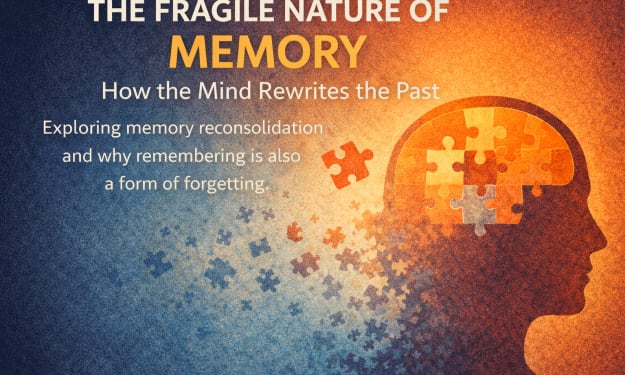
The Fragile Nature of Memory: How the Mind Rewrites the Past
We often view memory as a recording device. Something happens, and the brain stores it. Later, we recall it unchanged, like opening a file. Psychology presents a different picture. Memory is not fixed; it is fluid, reconstructive, and surprisingly fragile. One interesting aspect of cognitive psychology is memory reconsolidation, which is the process that alters our memories every time we recall them. This instability is not a flaw; it shows how our minds adapt, protect themselves, and reshape our identity over time.
By Kyle Butler8 months ago in Psyche
When Thinking Feels Like Action
There is a particular satisfaction that comes from understanding something clearly after wrestling with it for a long time. The mind settles. Tension releases. Pieces line up. In that moment, it can feel as though real movement has occurred, as though something meaningful has been accomplished. That feeling is not imagined. Cognitive resolution is a real event. The danger appears when that internal resolution is quietly mistaken for external change, and thinking begins to substitute for action rather than prepare the way for it.
By Peter Thwing - Host of the FST Podcast8 months ago in Psyche
The Memory of Icicles. Content Warning.
I'm going to tell you a story that I have never shared with anyone. I hope that it will bring healing to the reader, or at least the knowledge that you and I might share a common bond. A quote attributed to C.S. Lewis states, "We read to know we are not alone." Isolation and shame are hallmarks of domestic violence. So, I share my story to bring it to the light, and hopefully remove some of it's sting.
By Kathleen Anderson 8 months ago in Psyche