humanity
Mental health is a fundamental right; the future of humanity depends on it.
Exploring the Relationship Between Aphantasia and Dimethyltryptamine Levels in Cerebrospinal Fluid
For the purposes of this exploration, let us define a hallucination as the experience of something that is only present in one’s mind. The hallucinogenic substance known as dimethyltryptamine, or DMT, enables the vivid experience of things that are only present in one’s mind. Our imagination also enables us to experience things that are only present in the mind. Studies report that low concentrations of endogenous DMT (that is, DMT which forms naturally inside one’s body) between 0.12 to 100 ng/ml are normally present in human cerebrospinal fluid [1]. Aphantasia is the inability to picture things in one’s “mind’s eye,” or imagination. There are two types of aphantasia: congenital aphantasia, which is present from birth, and acquired aphantasia, which develops through brain injury or illness. Studies show there are no significant structural differences between the brain of someone with congenital aphantasia and the brain of someone who can visualize things in their mind’s eye, so the primary contributor to congenital aphantasia must be a matter of functional divergence as opposed to structural abnormality. To be clear, there are some subtle structural differences in aphantasic brains, but not enough to explain the disruption of the visualization process [2]. This paper proposes that extremely low levels of endogenous DMT in human cerebrospinal fluid (near or below the lower end of the reported range, or ≲ 0.12 ng/ml) may contribute to the functional differences underlying congenital aphantasia.
By J. Martin Strangeweather3 months ago in Psyche
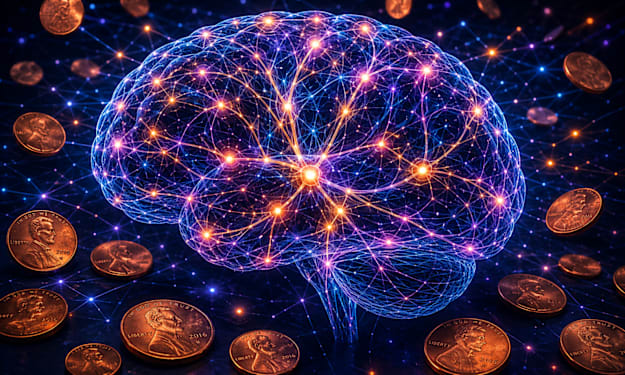
Counting Pennies and Brain Wiring: Why Do Some of Us Do Our Own Thing?
The Penny-Counting Puzzle As always, one thing leads to another. A random memory drifted into my mind one day, and—like memories often do—it nudged me toward a bigger question. That moment from years ago made me wonder about brain connectivity, individuality, and why some people seem wired to do things differently.
By Treathyl Fox (aka cmoneyspinner)3 months ago in Psyche
Terminal Lucidity and Hyperconnected Neural Dynamics in the Dying Brain
1. I presented a credible model to explain the phenomenon of terminal lucidity in purely mechanical terms last year (see Notes Concerning Eternity, part nine: A Neurocellular Explanation for the Manifestation of the Eidetic Afterlife During the Dying Brain Process, section 11, originally published on Facebook, February 14, 2025) [1], but it seems very few people were paying attention, so I’ll go over it again. At least once a week I chance upon someone on social media using terminal lucidity in an attempt to validate their spiritual belief system (as well as sate their desperate ego and increase their bank account, or so I often suspect). Be leery of any modern-day Lazarus who comes back from death with “secret” wisdom or the answer to everything, and be especially leery if they urge you to buy their latest book (spoiler alert: their insights are invariably flimsy and cliché) or pay through the nose to attend their latest lecture or conference. That being said, I’m not claiming that my interpretation of terminal lucidity is the correct one. What I can say with certainty is that it’s the most plausible model anyone has put forth thus far. And you can ponder its validity for free, right here, right now. Or you can listen to someone in the future regurgitate a watered-down version of this same information, most likely translating it through a self-serving lens of tropey spiritualism. I’m not saying spiritualism isn’t a viable path to knowledge—I’m saying be careful of those who peddle it! Spirituality and capitalism serve entirely different masters.
By J. Martin Strangeweather3 months ago in Psyche
Subtle Body Language Signs a Covert Narcissist Is Trying to Mimic Your Personality
At first, it can feel like a strange kind of connection. Someone suddenly likes the same things you like. They use your phrases. They copy your gestures. They seem to “understand” you almost too quickly.
By Abdul Jamil Nasir3 months ago in Psyche
The Psychology of the Unseen: Why We Must Decode Human Behavior
Life never gives us a clear playbook, but people always give themselves away if you know where to look. Think about your average day. You go to work meetings, grab coffee, and head out on dates, and text your friends. Most of the time, we just listen to what people say and move on. We assume they mean exactly what comes out of their mouth. But beneath those casual, everyday conversations runs a completely different current. It is a hidden layer of life driven by secret motives, unspoken desires, and psychological games.
By Abdul Jamil Nasir3 months ago in Psyche
The Psychology of the Unseen: Why We Must Decode Human Behavior. AI-Generated.
I have always been fascinated by human behavior, which is why I created this profile... Every single day, we navigate a complex web of social interactions. We sit in business meetings, go on first dates, chat with neighbors, and scroll through digital messages. On the surface, these interactions seem straightforward. We listen to the words people say and take them at face value. But beneath the surface of everyday conversations lies an entirely hidden world—a world governed by subconscious desires, hidden motives, and dark psychology.
By Abdul Jamil Nasir3 months ago in Psyche
The Better Christian I Became, The Further From Jesus I Felt
The longer I’m a Christian, the less interested I am in being a good one. That probably sounds strange, perhaps even a little heretical. After all, isn’t becoming a better Christian supposed to be the goal?
By Nils von Kalm3 months ago in Psyche