disorder
The spectrum of Mental Health disorders is incredibly vast; we showcase the multitude of conditions that affect mood, thinking and behavior.
The Psychology of Emotional Neglect
Sophie was eight years old when she stopped crying.Not because she stopped hurting. But because she'd finally learned what her parents had been teaching her all along: her pain was an inconvenience they didn't want to deal with.She'd fallen off her bike that afternoon, scraped her knee badly enough that blood soaked through her jeans. She'd run inside, tears streaming, looking for comfort.Her mother was on a work call. She'd glanced at Sophie, held up one finger—wait—and continued talking. Sophie stood there, bleeding and crying, while her mother discussed quarterly projections as if her daughter wasn't falling apart three feet away.After twenty minutes, her mother finally hung up. "What happened?""I fell. It really hurts."Her mother barely looked at the wound. "You're fine. Go clean it up. I have another call in five minutes."Sophie went to the bathroom alone. Cleaned the wound alone. Bandaged it alone. And something inside her went quiet.My pain doesn't matter. My needs are a burden. If I want to be loved, I need to stop needing things.She didn't think those words consciously. She was eight. But her nervous system absorbed the lesson completely: To be acceptable, I must need nothing.By the time Sophie was ten, she'd perfected the art of emotional self-sufficiency. She stopped running to her parents when she was hurt, scared, or sad. Stopped sharing her excitement because they seemed annoyed by her enthusiasm. Stopped asking for help because they were always too busy.She became the "easy child." The one who didn't cause problems. The one who took care of herself.Her parents praised this. "Sophie is so independent," they'd tell relatives. "She never needs anything from us."They said it like it was a good thing. Like self-sufficiency at ten years old was maturity instead of survival.What they didn't see—what they never asked about—was the little girl inside who'd learned that her emotional needs were unwelcome. Who'd concluded that love was conditional on not requiring emotional support. Who'd started building walls around her heart to protect herself from the pain of reaching out and being ignored.Sophie wasn't independent. She was neglected. And she'd learned to call it strength.The Invisible WoundDr. Jonice Webb, who has spent her career studying emotional neglect, explains that it's not about what happened—it's about what didn't happen. There's no dramatic abuse to point to. No clear perpetrator. Just an absence. A void where attunement and emotional responsiveness should have been.Emotional neglect is the failure of parents to notice, validate, and respond to a child's emotional needs. It's not intentionally cruel. Sophie's parents weren't monsters. They provided food, shelter, education. They just didn't provide emotional presence.They were physically there but emotionally absent. Going through the motions of parenting while never actually seeing their daughter's inner world. Never asking how she felt. Never validating her emotions. Never teaching her that feelings were important information worth paying attention to.And children don't think: My parents are emotionally neglectful. They think: Something is wrong with me. My feelings are too much. I need to stop having needs.By adolescence, Sophie had internalized the neglect so completely she couldn't even identify it. When friends complained about their parents, Sophie would say, "My parents are fine. They leave me alone, which is nice."She'd reframed abandonment as freedom. Told herself she preferred the distance. Convinced herself she didn't need what she'd never been given.But her body kept the score. Sophie struggled with anxiety she couldn't explain. Had panic attacks that seemed to come from nowhere. Felt a persistent emptiness she couldn't name. And she had no idea these symptoms were her nervous system screaming about unmet childhood needs.Research by Dr. Bessel van der Kolk reveals that emotional neglect can be as damaging as overt abuse because it teaches children that their internal experience doesn't matter. They learn to disconnect from their own emotions, to ignore their own needs, to believe they're fundamentally unworthy of care.Sophie had learned all of this. And she'd carried it into adulthood like invisible baggage she didn't even know she was holding.The Relationship That Replicated the PatternAt twenty-seven, Sophie met David. He was charming, successful, emotionally unavailable. Perfect.She didn't recognize the pattern. Didn't see that she'd chosen someone who replicated her parents' emotional absence. She just knew he felt familiar. Comfortable. Like home.David was affectionate in the beginning—the way emotionally unavailable people often are before they feel secure. But once the relationship was established, he pulled back. Became distant. Stopped asking how she was. Stopped being curious about her inner life.Sophie told herself it was fine. She didn't need constant attention. She was independent. Low-maintenance. Cool about everything.But inside, the little girl who'd learned not to need anything was screaming.One evening, Sophie had a terrible day at work. Her project had been rejected. Her boss had humiliated her in front of colleagues. She came home shaking, on the verge of tears.David was watching TV. "Hey. How was work?""Really bad, actually. I—""That sucks. I had a rough day too." And he launched into his own story without asking for details about hers.Sophie felt something familiar: the ache of reaching out and finding no one there. The shame of having needs. The automatic shutdown of her own emotions to make room for someone else's.She swallowed her pain, listened to David's story, offered support. And hated herself for needing something he couldn't give.Dr. Harville Hendrix's research on relationship patterns reveals that we unconsciously choose partners who replicate our childhood wounds—not because we're masochistic, but because we're trying to heal them. We're hoping this time, we'll be seen. This time, our needs will matter.But without awareness and intentionality, we just recreate the same dynamic. Sophie had found someone who emotionally neglected her exactly the way her parents had. And she was trying to earn his attention the same way she'd tried to earn theirs: by needing nothing, asking for nothing, being effortlessly easy.It wasn't working. It never had.
By Ameer Moavia10 months ago in Psyche
How Constant Comparison Slowly Breaks Self-Worth
It started with a wedding photo. Jessica was scrolling through Instagram at 7:23 a.m., still in bed, coffee cooling on her nightstand. The algorithm served her a picture of someone she'd gone to college with—Amber, who she hadn't thought about in years.
By Ameer Moavia10 months ago in Psyche
Overcoming Awkward
The truth is, I like to think I like who I am. And yet, when I enter a new situation, I hide her. I need to test the waters first. Which version of me will be accepted here? Is it safe to express myself authentically? Despite reality, my answer to the latter question is often no. I fear judgment. I mean, no one likes feeling judged. But not everyone lets that dictate who they are in a crowd.
By Vivian Rose10 months ago in Psyche
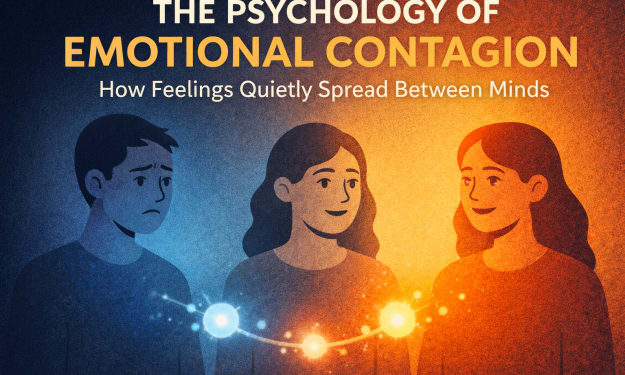
The Psychology of Emotional Contagion. AI-Generated.
Walk into a room where tension hangs in the air, and you may feel uneasy before anyone says a word. Enter a space filled with laughter, and your mood often lifts almost instantly. This phenomenon is not coincidence or imagination; it is emotional contagion at work. Emotional contagion is a subcategory of social psychology that explores how emotions transfer from one person to another, often unconsciously. It shapes group dynamics, relationships, workplaces, and even entire societies, influencing how we feel and behave in ways we rarely notice.
By Kyle Butler10 months ago in Psyche
The Emotional Echo: How Micro-Rejections Shape Our Inner World. AI-Generated.
Most people understand the sting of major rejection. A breakup, a job denial, a falling-out with a friend—these events leave marks that are easy to recognize. But psychology has begun paying increasing attention to something far quieter: micro-rejections. These are small, often fleeting moments of social dismissal that many of us overlook or brush aside. A text left unanswered, a slightly cold tone from someone we care about, a subtle exclusion from a group conversation, a joke that doesn’t land the way we hoped—it’s easy to dismiss these experiences as trivial. Yet they leave emotional echoes that can meaningfully influence our behavior, self-perception, and overall psychological health.
By Kyle Butler10 months ago in Psyche