depression
It is not just a matter of feeling sad; discover an honest view of the mental, emotional and physical toll of clinical depression.
How Austin Anxiety and Trauma Specialists Can Help You Heal
When anxiety, phobias, or past trauma begin to affect your daily life, finding the right support becomes essential. Many people silently struggle with overwhelming thoughts, panic, or fears that limit their freedom. The good news is that help is available right here in Austin. With experienced professionals and specialized treatments, Austin Anxiety and Trauma Specialists provide the tools and guidance to help you reclaim peace of mind.
By anxietyspecialistabout a year ago in Psyche
Echoes in the Void: Finding Connection in a Disconnected World
There are moments in life when silence feels heavier than words. You sit in a room filled with noise—buzzing notifications, endless scrolling feeds, voices from a screen—but inside, there is only stillness. It is the kind of silence that does not soothe but suffocates.
By Muhammad Kaleemullahabout a year ago in Psyche
When Silence Follows You
Being late never used to bother me. But today, it feels heavier than bad timing—it feels like fate. The university library stretches before me, polished tiles gleaming under harsh fluorescent lights. Every sound seems amplified. My shoes scuff against the floor. My breath bounces back at me. Even the faint creak of a shelf seems to shout in the emptiness. In this antiseptic quiet, I am listening. Straining. Waiting. Because here, silence isn’t safety. Silence is a trap.
By Shehzad Anjumabout a year ago in Psyche
The Echo of Silence
The Echo of Silence Evelyn sat in the dimly lit room, her hands resting on the oak desk where old letters lay scattered. The silence of the house pressed against her like a suffocating blanket. She had always feared silence, not because it was empty, but because it was never truly empty. For Evelyn, silence had a voice. It began years ago, after her father’s sudden death. She remembered standing at the funeral, surrounded by distant relatives, when she first heard it—a faint whisper threading through the quiet. At first, she dismissed it as grief or imagination. But as the months passed, the whisper grew clearer, more distinct, until it seemed to form words. “You left me,” it murmured. Tonight, the whisper had returned, sharper than ever. The room seemed to vibrate with its presence. Evelyn pressed her palms to her ears, but the sound came from inside her mind, not outside. She tried to distract herself, reaching for one of the letters on the desk. It was written in her father’s handwriting, a short note reminding her to buy milk. Ordinary, harmless. Yet her heart raced as though she were holding a relic of guilt. “You ignored me,” the voice hissed. Her chest tightened. She had ignored him. She remembered the last week of his life, when he had called her several times, asking if she could visit. She had been busy with work, deadlines, and meaningless meetings. “Next week, Dad,” she had promised. But there had been no next week. Evelyn rose and paced the room, her shadow dancing across the faded wallpaper. It’s not real, she told herself. Just my mind playing tricks. But the voice grew louder. “If you had come… I would not have been alone.” Tears blurred her vision. “Stop it!” she screamed, but the walls only echoed her words. Then came the sound of footsteps. Slow, deliberate, dragging across the wooden floor behind her. She froze, every nerve in her body trembling. She turned, but the hallway was empty. Yet she felt it—an unseen presence, watching, waiting. Her rational mind whispered explanations: stress, insomnia, trauma. But her body felt the weight of something more, something beyond psychology. She staggered back to the desk, clutching the letters like a shield. “You can’t hide,” the voice whispered again. Her hands shook as she scribbled on a blank sheet of paper: I’m sorry, Dad. I should have been there. The moment the words were written, the air seemed to shift. The room grew colder, and the silence became heavier. Suddenly, she felt a hand—cold, fragile—rest on her shoulder. She gasped and spun around. No one. Only the empty chair in the corner where her father used to sit. Evelyn collapsed into the desk chair, sobbing. She did not know whether she was haunted by a ghost or by her own conscience. Perhaps both. The boundary between reality and mind had blurred long ago. Hours passed. The letters remained scattered, her apology lying among them like a confession. The whispers grew softer, fading into the walls until they became indistinguishable from silence. For the first time in years, the silence felt almost bearable. But Evelyn knew it would return. Guilt never dies; it only sleeps, waiting to be awakened by a memory, a sound, a moment of stillness. She sat there in the half-light, her mind caught in a cycle with no escape. And in that fragile silence, she finally understood: sometimes the loudest voices are the ones we carry inside.
By Article Master about a year ago in Psyche
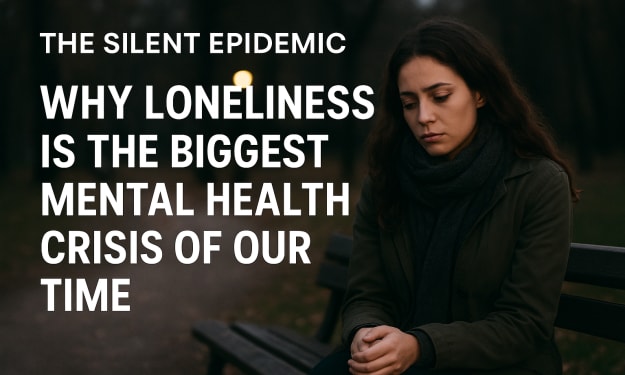
Connected but Alone: The Hidden Mental Health Struggle No One Wants to Admit. Content Warning.
Introduction In an age where our phones buzz with notifications, where we can video call someone on the other side of the world in seconds, and where social media makes it seem like friends and laughter surround everyone, there is a painful irony: many of us have never felt more alone.
By Byron Egoleabout a year ago in Psyche
A Message to The Villain: Flood the world with light. Content Warning.
I wish I could put the world into a snow globe. Water and glycerin so I could make it all happen ploddingly. All the evil so I could rub it away, it’ll be my genie. I would wish for the thought of killing to turn into legends, myths and tales. Events would pause in words, and would only go on when you turn the page.
By Caitlin Charltonabout a year ago in Psyche
Behind the Smile: My Battle with Seasonal Depression
The arrival of autumn often brings cozy sweaters, pumpkin lattes, and golden sunsets for many people. But for me, it also brings something darker—a shadow I’ve learned to recognize all too well. Seasonal Affective Disorder, or SAD, is more than just “winter blues.” It’s a recurring battle that strips away my joy and leaves me questioning why even the simplest things feel unbearably heavy.
By Saqib Ullahabout a year ago in Psyche