bipolar
Bipolar disorder; understanding the highs, the lows and the in between.
He Loved Her Madly… Until He Realized She Only Loved Him When She Needed Him
The quiet pain of being someone’s comfort… but never their choice --- Ethan never believed in half-love. To him, love was absolute. It was presence, sacrifice, patience, and an unspoken promise to stay—even when things became inconvenient. He didn’t fall easily, but when he did, he fell completely. That’s why when he met Lina, everything about her felt like something out of a story he didn’t know he had been waiting to live. She wasn’t loud or overly charming. She didn’t try to impress anyone. In fact, she carried a certain distance in her eyes—as if she had seen too much, felt too deeply, and learned to keep parts of herself hidden. And that’s exactly what pulled him in. --- It started simply. A conversation that lasted longer than expected. A shared laugh that lingered. Messages that turned into late-night talks. The kind where silence felt just as meaningful as words. Lina had a way of opening up slowly—just enough to keep him close, but never enough to fully understand her. At first, Ethan didn’t notice. He only saw what he wanted to see: the moments she chose him. --- “Can I call you?” she would text, usually late at night. And he always said yes. No matter what he was doing. No matter how tired he was. No matter if he had work early the next morning. Because when Lina needed him… he felt important. He felt chosen. --- Their conversations were deep, emotional, sometimes heavy. She would talk about her past. About people who left. About how hard it was for her to trust. About the loneliness she carried even when surrounded by others. Ethan listened. Not just with his ears, but with his whole being. He wanted to be different from the others. He wanted to be the one who stayed. --- “Why are you always there for me?” she once asked. He smiled, even though she couldn’t see it. “Because I care about you.” There was a pause. Then she said softly, “You’re different.” And that was enough to make his heart believe everything. --- Weeks turned into months. Ethan started building his life around her presence. He memorized the way her voice changed when she was sad. The way she avoided certain topics. The exact timing of her messages. But there was something he ignored. Something small at first. Something easy to justify. --- She only reached out when she needed him. --- On her good days, she disappeared. No messages. No calls. No “How are you?” It was as if he didn’t exist. At first, he told himself she was busy. Then he told himself she needed space. Then he told himself… this is just how she is. --- But every time she came back, it was the same pattern. “Hey… I had a rough day.” “Can you talk?” “I feel really alone right now.” And every single time… he was there. Without hesitation. Without question. --- One night, after a long silence from her, Ethan decided to test something. He didn’t text her. He didn’t check in. He waited. A day passed. Then another. Then three. Nothing. --- That’s when the first crack appeared in his heart. Not loud. Not dramatic. Just a quiet realization: If I don’t reach out… she won’t either. --- But still, when her message finally came, everything inside him softened instantly. “Hey… I really need you right now.” And just like that… he forgot the silence. --- That was the beginning of his confusion. Because love, to him, wasn’t supposed to feel like this. It wasn’t supposed to feel one-sided. It wasn’t supposed to make him question his worth. --- One evening, he gathered the courage to ask. “Do you ever think about me… when you don’t need something?” There was a long pause. Longer than usual. “I don’t know how to answer that,” she said. And in that moment, Ethan felt something shift. --- He wasn’t her person. He was her comfort. Her escape. Her emotional safety net. --- And the worst part? She didn’t even realize she was doing it. --- Ethan started noticing everything he had once ignored. How she never asked about his day unless it related to her. How she changed the subject when things got too focused on him. How her affection only appeared when she was hurting. --- It wasn’t that she didn’t care. She just didn’t care the way he did. --- And that realization is one of the most painful things a person can experience. Because it’s not betrayal. It’s not rejection. It’s something quieter. Something harder to explain. --- It’s being almost loved. --- Ethan tried to pull away. Not dramatically. Just… slowly. He stopped replying instantly. He stopped being available all the time. He tried to create space. --- But something strange happened. The more he pulled back… the more she reached out. --- “I feel like you’re distant lately.” “Did I do something wrong?” “I miss you.” --- Those words hit him harder than anything. Because they sounded like love. But they didn’t feel like it. --- He realized something important: She didn’t miss him. She missed what he gave her. --- And that broke him in a way he wasn’t prepared for. --- The final moment came quietly. No fight. No drama. Just clarity. --- She called him again late at night. Crying. Needing comfort. Needing someone to hold her through words. --- And for the first time… Ethan hesitated. --- Not because he didn’t care. But because he finally cared about himself too. --- “I can’t do this anymore,” he said softly. There was silence. “What do you mean?” --- He took a deep breath. “I love you… but only when you need me isn’t enough for me.” --- Another silence. He could almost hear her trying to process it. --- “I didn’t know you felt that way,” she whispered. And that hurt the most. --- Because it meant she never really saw him. --- “I know,” he replied. “That’s the problem.” --- He didn’t wait for a response. He didn’t try to explain more. Because sometimes… the strongest thing you can do is walk away without trying to be understood. --- That night, Ethan felt two things at once: Pain. And peace. --- Pain… because he lost someone he loved deeply. Peace… because he finally stopped losing himself. --- And that’s the hidden truth many people don’t talk about: Sometimes, the hardest relationships to leave… are the ones that were never fully real to begin with. --- Ethan didn’t stop loving her overnight. He still thought about her. Still wondered if she was okay. Still missed the version of her he had created in his mind. --- But slowly… he began to understand something deeper. --- Love is not proven by how much you give. It’s proven by how much is returned. --- And being needed… is not the same as being loved. --- Months later, when his life felt quieter and more stable, Ethan realized something that changed him forever: He didn’t regret loving her. He regretted forgetting to love himself in the process. --- Because real love doesn’t only show up in your lowest moments. It stays. It chooses. It sees you. Even when it doesn’t need you. --- And that’s the kind of love he promised himself he would never settle without again.
By Ahmed aldeabella7 months ago in Psyche
The Girl at Seat 4B: What I Learned by Ignoring My Phone for a Month
The blue light was my morning prayer. Before my feet hit the floor, before the coffee breathed its first steam, I was scrolling. I fed on a diet of outrage, filtered perfection, and the relentless "ping" of notifications that made me feel important while I was actually becoming invisible.
By imtiazalam7 months ago in Psyche
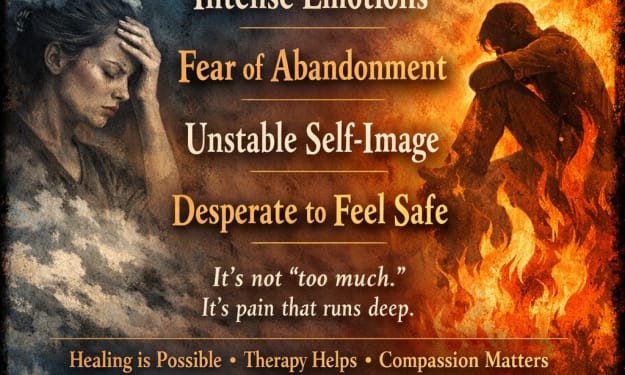
BPD: When the Nervous System Lives at the Edge
A compassionate reflection on Borderline Personality Disorder that explores emotional intensity, unstable self-image, fear of abandonment, and the possibility of healing through understanding, support, and treatment.
By Flower InBloom7 months ago in Psyche
Before You Knock on My Door, Look Inside Yourself
A story about a psychologist who helps his patients reclaim their dignity. This Might Be the Truth You’ve Been Avoiding What if the problem you’ve been blaming on the world… was never really the world? What if the reason relationships fail, confidence collapses, and life feels unfair isn’t always because people betrayed you, ignored you, or misunderstood you? What if the uncomfortable truth is this: Sometimes the door you keep knocking on isn’t locked… you’re just afraid to look inside yourself first. That realization is painful. Because blaming others is easy. Looking inward requires courage. But one psychologist made it his mission to help people do exactly that. Not by fixing their lives for them. But by helping them rediscover something many had forgotten: Their dignity. --- Chapter 1: The Door with a Strange Sign In a quiet street stood a small therapy clinic. Nothing about it looked extraordinary. Except for one thing. On the door of Dr. Adrian Malik’s office was a small sign that confused almost everyone who saw it. It read: “Before you knock on my door, look inside yourself.” Some patients smiled at it. Others frowned. A few even felt offended. “What does that even mean?” they would mutter. But once they stepped inside the office, they slowly began to understand. Because Dr. Malik wasn’t like other therapists. He didn’t simply listen and nod. He challenged people to confront the truths they had been avoiding. --- Chapter 2: The First Patient One afternoon, a young man named Karim walked into the office. His shoulders were tense. His eyes looked tired. The moment he sat down, frustration poured out of him. “My life is full of unfair people,” he said. “My boss disrespects me. My friends take advantage of me. And every relationship I’ve had ends the same way.” Dr. Malik listened quietly. He didn’t interrupt. When Karim finished speaking, he asked a simple question. “Tell me something,” the doctor said gently. “Why do you keep allowing people to treat you this way?” Karim looked confused. “I don’t allow it,” he replied defensively. “It just happens.” Dr. Malik leaned forward slightly. “No,” he said calmly. “It continues because somewhere, you believe you deserve it.” Silence filled the room. It was the first time anyone had suggested that Karim’s lack of boundaries might be part of the problem. --- Chapter 3: The Hidden Enemy of Dignity Many people believe dignity is something others give us. Respect from colleagues. Love from partners. Recognition from society. But Dr. Malik taught something different. Dignity begins with self-respect. If someone does not value themselves internally, they often tolerate treatment they should never accept. They apologize too often. They remain silent when they should speak. They accept behavior that slowly erodes their confidence. Karim realized something painful during that session. He had spent years trying to please everyone around him. But he had never protected his own dignity. --- Chapter 4: Why People Lose Their Sense of Worth Dr. Malik explained that many people lose their sense of dignity gradually. Not through one dramatic moment. But through repeated small experiences. Criticism during childhood. Toxic relationships. Fear of rejection. Constant comparison with others. Over time, these experiences create an invisible belief: “I am not enough.” And once that belief takes root, people begin making decisions that reinforce it. They accept disrespect. They avoid confrontation. They shrink themselves to make others comfortable. But Dr. Malik’s goal was simple: Help people challenge that belief. --- Chapter 5: The Mirror Exercise One day Dr. Malik gave Karim an unusual assignment. “I want you to stand in front of a mirror every morning,” he said. Karim laughed awkwardly. “That sounds strange.” “Maybe,” the doctor replied. “But tell me—when was the last time you truly looked at yourself?” The exercise was simple. Every morning Karim had to ask himself three questions: 1. Did I respect myself yesterday? 2. Did I allow anyone to cross my boundaries? 3. What can I do today to protect my dignity? At first the exercise felt uncomfortable. But after a few weeks, something began to change. Karim started noticing his patterns. And awareness is always the first step toward transformation. --- Chapter 6: The Power of Boundaries One of the most important lessons Dr. Malik taught his patients was about boundaries. Many people fear boundaries because they worry about losing relationships. But the doctor explained something powerful: The relationships that disappear when you set boundaries are the ones that were harming you. Healthy people respect limits. Toxic people resist them. Karim slowly began applying this lesson. He started speaking up at work. He stopped overcommitting to people who drained his energy. For the first time, he felt something unfamiliar. Control. --- Chapter 7: Another Patient’s Story One evening a woman named Laila entered the clinic. Her voice trembled as she spoke. “I feel invisible,” she said. “My partner never listens to me. My family dismisses my opinions. I feel like I don’t matter.” Dr. Malik asked her a question that surprised her. “When was the last time you listened to yourself?” Laila hesitated. “I don’t understand.” The doctor explained: “If you constantly ignore your own needs to satisfy others, people learn that your voice is optional.” It was a difficult realization. But an important one. Respect from others often begins with self-respect. --- Chapter 8: Reclaiming Personal Dignity Dr. Malik’s approach focused on rebuilding dignity through simple but powerful actions. Here are some of the principles he taught. Speak honestly Silence often protects conflict but damages self-respect. Expressing your thoughts respectfully strengthens your identity. Protect your time Time is a reflection of priorities. When you constantly sacrifice your time for others, you unintentionally signal that your needs are less important. Stop seeking approval Approval feels good. But depending on it makes you vulnerable to manipulation. Confidence grows when you make decisions aligned with your values. Accept imperfection Many people lose dignity because they fear mistakes. But mistakes are not proof of failure. They are proof of growth. --- Chapter 9: The Transformation Months passed. Karim returned to the clinic with a different energy. His posture was straighter. His voice calmer. “My life isn’t perfect,” he said. “But something feels different.” “What changed?” Dr. Malik asked. Karim smiled slightly. “I stopped blaming everyone else… and started taking responsibility for how I allow people to treat me.” The doctor nodded. That was the lesson he hoped every patient would discover. Not guilt. Not self-blame. But awareness. --- Chapter 10: The Meaning Behind the Sign One evening, as Karim prepared to leave the clinic for the last time, he looked again at the sign on the door. “Before you knock on my door, look inside yourself.” This time the words felt different. They weren’t a warning. They were an invitation. An invitation to self-reflection. Because real change doesn’t begin with advice from others. It begins with honest conversations with yourself. --- Final Reflection Many people spend years knocking on doors hoping someone else will fix their lives. A partner. A friend. A therapist. But the most important door you will ever open is the one within yourself. Inside it lives something powerful: Your self-respect. Your dignity. Your ability to choose how the world treats you. And once you reconnect with that inner strength, something incredible happens. You stop begging for respect. And you start living in a way that commands it naturally. --- If this story made you pause and reflect, you’re not alone. ❤️ If you found something meaningful here, leaving a like helps this message reach others who might need it. 💬 I’m curious — what do you think is the most important step in reclaiming personal dignity? Share your thoughts in the comments. 🔔 And if you enjoy thoughtful stories that explore psychology, relationships, and personal growth, follow along. Because sometimes a single idea can open a door inside us we didn’t even realize was locked.
By Ahmed aldeabella7 months ago in Psyche
When Does a Woman Feel Safe?
Not because this is another relationship article… but because what you’re about to read might explain a mystery that ruins countless relationships without anyone noticing. Many men think a woman feels safe when she hears “I love you.” Many women think they should feel safe simply because someone promises loyalty. But here’s the uncomfortable truth: A woman doesn’t feel safe because of words. She feels safe because of patterns. Patterns of behavior. Patterns of respect. Patterns that quietly tell her, “You don’t have to protect your heart around me.” This story begins with someone who didn’t understand that. --- Chapter 1: The Question That Changed Everything Daniel believed he was a good partner. He didn’t cheat. He worked hard. He texted often. Yet something always felt slightly distant between him and Maya. Maya smiled. She laughed. She stayed. But sometimes Daniel noticed a hesitation in her eyes — a small pause before she shared something personal. One evening they sat at a quiet café. Rain tapped softly against the glass windows. Daniel finally asked the question that had been sitting in his chest for months. “Why do I feel like you’re still holding something back from me?” Maya looked down at her coffee. Not angry. Not defensive. Just thoughtful. Then she said something simple, but it hit Daniel like lightning. “I like you, Daniel. But feeling safe with someone… takes more than liking them.” Daniel frowned. “Safe? I’ve never done anything to hurt you.” Maya nodded. “I know. But safety in a relationship isn’t just about avoiding harm. It’s about creating comfort.” That night Daniel went home confused. But that confusion would soon turn into understanding. --- Chapter 2: The Invisible Need Many people misunderstand emotional safety. They think it’s dramatic — something related to betrayal, lies, or big conflicts. But most of the time, emotional safety is built in small moments. Moments like: How someone reacts when you admit a mistake How someone listens when you share a fear How someone treats you when you’re not at your best For women especially, emotional safety is deeply connected to trust and vulnerability. A woman may appear strong, confident, independent. But inside, she is constantly evaluating a quiet question: “Is this someone I can relax around… or someone I must protect myself from?” When the answer becomes relax, that’s when safety begins. --- Chapter 3: What Makes a Woman Feel Safe Daniel started paying attention. Not to what he thought mattered. But to what Maya actually responded to. And slowly he began noticing something powerful. Safety wasn’t about grand gestures. It was about consistency. Here are the lessons he learned. --- 1. A Woman Feels Safe When She Is Truly Heard Many people listen just to reply. But feeling heard means something deeper. When Maya talked about her stressful day, Daniel used to jump straight into solutions. “Just ignore your boss.” “You should quit that job.” “Don’t worry about it.” But one day he tried something different. He simply listened. No interruption. No advice. Just attention. At the end Maya said something surprising: “Thank you for listening.” Daniel realized something important. Sometimes the greatest form of safety is simply being understood. --- 2. Consistency Creates Security Grand romantic gestures are exciting. But consistency is comforting. A woman feels safe when she knows what version of you she will meet tomorrow. Not someone loving today and distant next week. Not someone calm today and explosive tomorrow. Consistency tells the nervous system: “This person is predictable. You can relax.” Daniel began showing up in small reliable ways: Keeping promises Being emotionally present Communicating honestly These quiet actions slowly built trust. --- 3. Emotional Reactions Matter More Than You Think One night Maya told Daniel something vulnerable. She confessed she sometimes felt insecure about her career progress. This was a critical moment. If Daniel dismissed her feelings or joked about them, a wall would appear instantly. Instead he said: “That must feel heavy. I’m glad you told me.” Her shoulders relaxed. Why? Because emotional safety grows when someone respects your feelings instead of minimizing them. --- 4. Respect Is the Foundation of Safety Respect isn’t only about politeness. It’s about how someone treats your boundaries, your opinions, and your individuality. A woman feels safe when she knows: Her voice matters Her boundaries will be honored Her thoughts won’t be mocked Daniel began asking for Maya’s perspective more often. Not out of obligation. But genuine curiosity. That changed everything. --- Chapter 4: What Breaks a Woman’s Sense of Safety Just as safety can be built slowly, it can also be broken quickly. There are patterns that silently damage emotional trust. Here are the most common ones. --- Inconsistency Hot today. Cold tomorrow. This emotional unpredictability makes someone feel unstable inside the relationship. --- Dismissive Communication Statements like: “You’re overreacting.” “It’s not a big deal.” “You’re too sensitive.” These phrases tell someone their feelings are invalid. And when feelings aren’t safe, vulnerability disappears. --- Lack of Emotional Presence You can be physically present but mentally absent. Scrolling your phone during conversations. Ignoring subtle emotional cues. Over time this makes someone feel invisible. --- Broken Promises Trust isn’t broken by one huge lie most of the time. It’s broken by dozens of small broken promises. And once trust weakens, safety disappears with it. --- Chapter 5: The Moment Daniel Finally Understood Months passed. The relationship between Daniel and Maya felt different. Lighter. Warmer. One evening they walked through a quiet park. The sun was setting, painting the sky in orange and soft purple. Maya suddenly said something that Daniel would never forget. “I feel calm around you.” Daniel smiled slightly. “That’s good, right?” She nodded. “Yes. It means I feel safe.” That moment wasn’t loud. No fireworks. No dramatic confession. Just peace. And that’s the real secret. When a woman feels safe, love grows naturally. --- Chapter 6: Practical Advice for Anyone Who Wants to Build Emotional Safety Whether you’re in a relationship now or hope to build one someday, these principles matter. Be emotionally available People feel safe with those who are present — not distant. Listen more than you speak Understanding builds connection. Be consistent Your behavior should match your words. Validate feelings Even if you don’t fully understand them. Respect individuality Love should never feel like control. --- Chapter 7: The Hidden Reward Here’s something many people don’t realize. When a woman feels emotionally safe, she becomes more open, more affectionate, and more supportive. Not because she is obligated. But because she no longer needs to guard her heart. Safety unlocks the most authentic version of love. And that kind of love is rare. --- Final Thought If you remember nothing else from this story, remember this: A woman feels safe not when she hears beautiful words… but when she experiences consistent care. Not perfection. Just sincerity, respect, and presence. Those quiet things create the strongest relationships. --- If this story made you pause and think for a moment, you’re already ahead of most people. ❤️ If something here resonated with you, leave a like so more people can discover it. 💬 Share your thoughts in the comments — when do you think someone truly feels safe in a relationship? 🔔 And if you enjoy thoughtful stories like this, follow along. There are many more ideas worth exploring together. Because sometimes a few minutes of reading can change how we understand the people we care about.
By Ahmed aldeabella7 months ago in Psyche
I Will Not Surrender to the Shadows Our Relationship Left Behind
The Story of a Man Who Breaks the Chains of the Past and Creates a New Life Because if you’ve ever tried to move on from someone… you know a secret most people don’t talk about. Sometimes the relationship ends. But the shadow it leaves behind stays much longer. You move forward with your life… but certain memories still appear without warning. A song. A place. A message you accidentally reread. Suddenly, emotions you thought were gone return like ghosts. And you start asking yourself something painful: Why does the past still have power over me? If that question has ever crossed your mind, this story might feel strangely familiar. Because this is the story of Amir. A man who almost allowed the past to define his future—until he discovered something powerful: The past can influence your life, but it doesn’t have the authority to control it. --- The Silence After the End When Amir’s relationship with Sara ended, there was no dramatic fight. No screaming. No final emotional speech. Just silence. The quiet kind of ending that feels unfinished. They had spent three years together. Three years of routines, shared dreams, and memories that had slowly become part of everyday life. And then one day, those routines disappeared. At first, Amir believed time would solve everything. People always say that, don’t they? “Time heals.” But what they rarely explain is that time doesn’t heal automatically. Sometimes time simply keeps the wound quiet while the memory stays alive. Weeks turned into months. Outwardly, Amir continued living his life. He worked. Met friends. Stayed busy. But internally, something remained stuck. The relationship had ended… yet the emotional shadow remained. --- The Invisible Chains of the Past One evening, Amir noticed something disturbing. He had started comparing every new person he met to Sara. Every conversation. Every personality. Every moment. Without realizing it, he had placed his past relationship on a pedestal. And when the past becomes idealized, the present starts feeling disappointing. This is one of the most common emotional traps after a breakup. The mind remembers the good moments more vividly than the difficult ones. It edits the story. Polishes the memories. Until the past begins to look perfect. But perfection is rarely real. And Amir was about to confront that illusion. --- The Wake-Up Moment The turning point happened during a simple conversation with his friend Daniel. They were walking through the city late at night when Daniel said something unexpectedly direct. “Do you realize you’re still living in a relationship that ended months ago?” Amir frowned. “What do you mean?” Daniel shrugged. “You talk about Sara like she’s still part of your life story.” That sentence hit harder than Amir expected. Because deep down… he knew it was true. Physically, the relationship was over. But mentally, he was still replaying it. Analyzing it. Revisiting every memory. And that constant focus was keeping him emotionally trapped. That night, Amir realized something important: You cannot build a new life while mentally living in the past. --- Lesson 1: The Past Is a Chapter, Not the Whole Book One of the biggest mistakes people make after relationships end is believing that the past defines their identity. They think: “That relationship failed, so maybe I failed.” But relationships are chapters. Not entire life stories. Some chapters are joyful. Some are painful. Some end unexpectedly. But no single chapter has the power to define the entire book—unless you stop writing new ones. Amir understood this intellectually. But understanding something logically and truly believing it emotionally are two different things. So he decided to do something unusual. He stopped revisiting the past. --- Breaking the Habit of Emotional Time Travel Many people unknowingly train their minds to revisit old relationships repeatedly. They scroll through old photos. Read past messages. Replay conversations in their heads. This habit keeps emotional wounds active. Amir recognized that he had been doing exactly this. So he made a rule. No rereading old conversations. No checking Sara’s social media. No romanticizing memories that belonged to a closed chapter. At first, this felt uncomfortable. Almost like withdrawal. Because the mind had grown used to those emotional patterns. But slowly, the habit weakened. And as the past faded slightly, space opened up for something new. --- Lesson 2: Freedom Begins With Emotional Boundaries Physical distance from the past is not always enough. Sometimes emotional boundaries are necessary too. Amir realized that moving on required protecting his mental space. He began focusing his attention on things he had neglected during the relationship. Creative projects. Fitness. Learning new skills. For years, he had quietly postponed many personal ambitions. Now he returned to them. At first, progress was slow. But the process itself created momentum. Because when people invest energy into building something new, the past naturally loses some of its power. --- Discovering a New Passion One of the most unexpected changes came when Amir started writing. It began as a simple habit. He wrote about his thoughts. His experiences. The lessons he was learning from his struggles. Writing gave him clarity. Instead of suppressing emotions or replaying memories endlessly, he transformed them into ideas. And something interesting happened. The more he wrote, the more he realized how much he had grown. Painful experiences had given him insights he never would have developed otherwise. And those insights started helping other people too. Friends began reading his reflections and telling him how relatable they were. The pain that once felt meaningless had slowly transformed into something valuable. --- Lesson 3: Pain Can Become Creative Energy Throughout history, many forms of art, innovation, and personal growth have been fueled by emotional challenges. Pain creates depth. Reflection creates wisdom. When people channel their experiences into creativity, something powerful happens. Instead of being controlled by the past… They transform it into something meaningful. Amir’s writing slowly grew into a passion project. Then a blog. Then something even bigger. All because he stopped seeing his past relationship as a prison and started viewing it as a source of growth. --- The Unexpected Realization Months later, Amir was sitting in a café working on a new article when a strange thought crossed his mind. He realized something surprising. For the first time in a long time, he had not thought about Sara all day. Not out of avoidance. Not out of anger. Simply because his life had become full again. And that’s when he understood something powerful: Moving on is not about forcing yourself to forget someone. It’s about building a life so meaningful that the past naturally loses its central role. --- A Message for Anyone Stuck in the Past Somewhere right now, someone is still carrying emotional shadows from a relationship that ended long ago. Maybe they feel like those memories will never disappear. Maybe they believe the past has permanently changed their ability to love again. But here is something important to remember: The past only remains powerful when it is constantly revisited. When you focus your energy on creating a new life—new goals, new passions, new experiences—the shadows begin to fade naturally. Not overnight. But gradually. --- The Final Lesson One day, someone asked Amir if he regretted the relationship with Sara. He thought about it carefully before answering. “No,” he said. “Because even though it ended, it helped me become someone stronger.” That answer surprised even him. Because once upon a time, he believed that relationship had broken him. Now he realized something different. It had refined him. Sometimes relationships end not because they were mistakes… But because their purpose was to teach us something before the next chapter begins. --- The Closing Thought Your past may leave shadows. Memories. Lessons. Emotional scars. But shadows only exist where there is light. They are evidence that you have lived, loved, and learned. And no shadow has the power to stop you from stepping forward—unless you allow it to. Amir refused to surrender to the shadows of his past. Instead, he used them as fuel to build a brighter future. And that decision changed everything. --- Before You Go If this story resonated with you, it might mean you’ve experienced similar moments of reflection in your own life. Stories like this are meant to remind us that difficult chapters can become the foundation of personal growth. If you enjoy thoughtful stories about life, healing, and personal transformation, you can leave a like, share your thoughts in the comments, or follow for more meaningful stories like this. Because sometimes a single story… arrives exactly when someone needs the reminder that their future is still being written.
By Ahmed aldeabella7 months ago in Psyche
Broken Pieces
It's been almost three months. I tried to fall for you slowly, easily, so I could protect my heart. Those attempts failed. You are so kind, considerate, and empathetic. I felt that when you looked at me, you saw me all the way to my soul. The physical attraction was immediate and intense. Two lost and broken souls just trying to find their way home. The first time I looked into your sky-blue eyes, I saw sadness, I saw exhaustion, and the vast emptiness that comes from just giving up. However, in each other, we found hope. I could see that spark of hope in your eyes. That you wanted this to be real just as much as I did, something to hold onto, something true, something that could last a lifetime and not just until things got too hard. We moved in together pretty quickly due to life and circumstances. Honestly, we needed each other to hold on to at night. I know now that your life has been riddled with demons, pain, depression, anxiety, ptsd and so many triggers from your past. You have never been given the right mental tools to move through your pain and torment. So, you have just remained silent and swallowed your pain. No one should have to hold that much pain alone. It has been a task trying to help you, but also hold space for my own well-being, but I want you to know that you are worth it to me. You are not too broken and will never be too broken. I want to show you that I can hold space for both your mental health and my own. We both have so much going on in our minds, and we both try to hold each other up as best we can. When your demons come out to play, I try to slay them or at least make them shut the fuck up, and you do the same for me. We can hold each other, cry, scream at the world, go break shit together, or just sit in silence. I'm trying to learn what you need in your moments of mental health crisis, and I can tell you're trying to learn what I need as well. Have you ever heard of the term "hot mess"? That describes us perfectly. But we are perfectly imperfect. I am your Juliet, and you are my Romeo, as cheesy as that sounds. I swear we're going to be okay. I swear we're going to get healthy together. I've already done some work myself, but we are a team now, and we have to work together. I'm not leaving you. Where you go, I go, together forever. Mental health is a cruel mistress that holds no prisioners. You are such a beautiful soul that has come into my life, and you've helped me in so many ways. You help add structure in my life, you help with my daughter, you're my friend I can talk through my day and emotions with, my partner I can figure out life with, my lover, when I can't breathe because of a panic attack, you hold me and talk me through it. I wouldn't go back to being alone. I want you, all of you, even the broken pieces, because you take me and my broken pieces. Life is full of broken pieces, but what makes it better is to find that special someone who will hold both you and your broken pieces and still say I love you no matter what.
By Lindsey Altom7 months ago in Psyche
The Inner Critic: Understanding the Psychology of Self-Talk. AI-Generated.
There is a voice most people hear every day, though few pause to examine it closely. It comments on mistakes, evaluates performance, predicts outcomes, and quietly narrates social interactions. Sometimes it encourages. Often it criticizes. This internal dialogue, commonly referred to as the inner critic, belongs to the subcategory of cognitive and self-psychology that explores self-talk and self-evaluation. Far from being random mental noise, the inner critic plays a central role in shaping identity, confidence, and emotional well-being.
By Kyle Butler7 months ago in Psyche
MY FAVORITE ALBUMS OF THE 2000s (THE AUGHTS) [PRISONERS OF CHILDHOOD?]. Content Warning.
1. AIMEE MANN, Lost in Space 2. The Dresden Dolls, The Dresden Dolls 1. AIMEE MANN, Lost in Space (2002) [grade: A+] The Clear Light of Disillusion: A Philosophical Review of Lost in Space by Aimee Mann (Orbiting the Void of Human Frailty)
By ANTICHRIST SUPERSTAR8 months ago in Psyche