advice
Advice and tips on managing mental health, maintaining a positive outlook and becoming your happiest self.
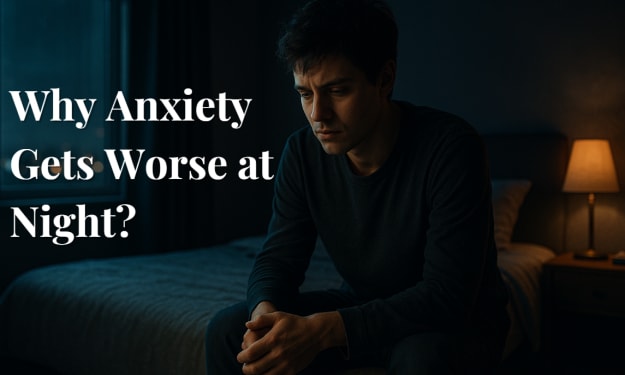
Why Your Anxiety Gets Worse at Night & What Helps
If you’ve ever felt perfectly fine during the day but somehow become overwhelmed the moment everything gets quiet at night, you’re not alone. Many people experience this uncomfortable shift — where worries feel louder, the mind refuses to slow down, and small things suddenly seem much bigger than they are.
By Liam Osuos11 months ago in Psyche
Not Everyone is Counting Down
Every year, starting December 1st, the countdown begins. Advent calendars are opened. Holiday movies play on repeat. Conversations fill with excitement about traditions, plans, and everything people can’t wait for. And every year, I watch that countdown from the outside.
By Annie Edwards 11 months ago in Psyche
The Emotional Echo: How Micro-Rejections Shape Our Inner World. AI-Generated.
Most people understand the sting of major rejection. A breakup, a job denial, a falling-out with a friend—these events leave marks that are easy to recognize. But psychology has begun paying increasing attention to something far quieter: micro-rejections. These are small, often fleeting moments of social dismissal that many of us overlook or brush aside. A text left unanswered, a slightly cold tone from someone we care about, a subtle exclusion from a group conversation, a joke that doesn’t land the way we hoped—it’s easy to dismiss these experiences as trivial. Yet they leave emotional echoes that can meaningfully influence our behavior, self-perception, and overall psychological health.
By Kyle Butler12 months ago in Psyche
Mental Health & Anxiety: Legal Ways to Seek Help and Treatment Options. AI-Generated.
In today's fast-paced world, mental health issues like anxiety are becoming increasingly common. The World Health Organization(WHO) states that one in four people in the world will be affected by mental or neurological disorders at some point in their lives. Therefore, it's crucial to understand the various legal ways to seek help and explore potential treatment options.
By Dwayne Lindsay12 months ago in Psyche
The Hidden Costs of Hustling. Top Story - December 2025.
People do not need to be reminded of the murky, colourless and dull picture of what burnout resembles, of either 'taking on too much' or 'hustling too hard.' I truly get it. Burnout is real for both entrepreneurs and employees alike; and when we push our bodies to the brink - aches and pains, and perhaps a few viral infections and mental exhaustion (only to name) come knocking on your domain. And these pesky guests do not give two hoots as to whether or not they are invited to the party - let alone into your own personal space. Life is expensive, and it is only becoming more commonplace and familiar. It is important to put in the effort, yet that effort needs to be inspired. It does not matter what line of work you engage in, provided you are in the flow. The healing starts with you in getting to the bottom of your trauma and inner child. Doing the inner work.
By Justine Crowley12 months ago in Psyche
The Quiet Power of Liminal Spaces: How Threshold Moments Shape the Psyche. AI-Generated.
Liminal spaces—moments, states, or environments where we stand between what was and what will be—have long fascinated psychologists, anthropologists, and storytellers alike. They occupy the hazy middle ground between known and unknown, certainty and ambiguity, identity and transformation. In the realm of psychology, liminality falls under the broader category of existential and developmental psychology, but it is a striking subcategory in its own right, touching on identity formation, emotional resilience, and the way we process change throughout our lives.
By Kyle Butler12 months ago in Psyche
How Do I Know If I Should See A Psychiatrist In Charleston, SC?
Life in Charleston, South Carolina, can be very beautiful with its vast beaches, rich history, and vibrant culture. But even in such a lively city, people sometimes struggle with their mental health. Life can feel overwhelming when stress and worry do not go away. If you often feel sad, anxious, or unable to cope with daily life, you are not alone.
By Ankita Dey12 months ago in Psyche
The Art of Becoming Unshakeable
Life rarely announces when it’s about to test you. One moment you’re moving forward confidently, and the next, something hits you from an angle you never expected. People tend to believe strength comes from being naturally tough, but the truth works in a quieter and far more interesting way: strength is built in layers, through choices you make every day, and through the tiny battles no one sees. Becoming unshakeable is not a personality trait — it’s a psychological skill set. The world constantly pushes, pulls, distracts, and demands. Most people react. A few people respond. And the rare ones — the unshakeable — adapt deliberately, hold their course, and rise stronger. They don’t avoid storms; they learn to sail better. This article is about that kind of inner engineering. 1. Your Mind is a System — Not a Mystery Modern psychology treats the mind less like a fragile glass object and more like a dynamic system. Systems can be shaped, tuned, upgraded, and redesigned. When you understand you’re not a fixed personality but a living architecture of neural pathways, habits, memories, and interpretations, you stop feeling trapped by who you were yesterday. A resilient mind has one foundational belief: “I can change how I operate.” Your thoughts stop being dictators and become data. Your emotions stop feeling like explosions and start feeling like signals. This shift alone makes you harder to break. 2. Resilience Starts With Friction, Not Comfort People chase comfort, yet comfort is the enemy of psychological evolution. Muscles grow through resistance; character grows through emotional weight-lifting. Every difficult moment in life acts like a mini-upgrade request. When you feel challenged — mentally, financially, emotionally, socially — your brain fires neural spikes that can either break you or build you, depending on how you interpret the moment. The unshakeable ask, “What is this teaching me?” Everyone else says, “Why is this happening to me?” The question you choose decides the path you follow. 3. Control Is the First Pillar of Mental Power You control less of the world than you think, and far more of your inner world than you realize. Pressure becomes unbearable only when you fight battles that weren’t yours in the first place. Unshakeable people have a simple formula: If I can control it, I act. If I can’t, I adapt. If it doesn’t serve my direction, I release it. This mindset frees enormous psychological energy — energy that most people waste on obsession, fear, comparison, and regret. Once you master this distinction, chaos feels smaller. 4. Build Emotional Endurance the Same Way You Build Physical Endurance Emotional resilience isn’t about being cold; it’s about being trained. Every time you handle a tough conversation instead of avoiding it… Every time you stay calm when your brain wants to panic… Every time you choose patience over explosion… …you strengthen your emotional “recovery time.” The unshakeable aren’t emotionless. They simply return to balance faster. 5. Identity: The Core of Becoming Unbreakable Your identity is the psychological engine behind your behavior. If you see yourself as weak, you will act weak, even when you’re capable of more. If you see yourself as someone who adapts, solves, or endures — your actions naturally follow. Changing your identity begins with small, consistent confirmations: • “I finish what I start.” • “I’m the type of person who handles pressure.” • “I can evolve faster than my problems.” Repeat these as truths, then prove them through small victories. Identity isn’t declared — it’s built. 6. Let Hardship Turn Into Direction, Not Damage Life will hit you. That’s non-negotiable. What is negotiable is what the hit becomes. For some, hardship becomes trauma cement. For others, it becomes psychological steel. What decides the difference? Interpretation. The unshakeable don’t romanticize pain, but they extract meaning from it. They turn setbacks into data points. They use heartbreak to refine standards, failure to improve strategy, and rejection to strengthen focus. Pain is inevitable. Damage is optional.
By The Insight Ledger 12 months ago in Psyche