addiction
The realities of addition; the truth about living under, above and beyond the influence of drugs and alcohol.
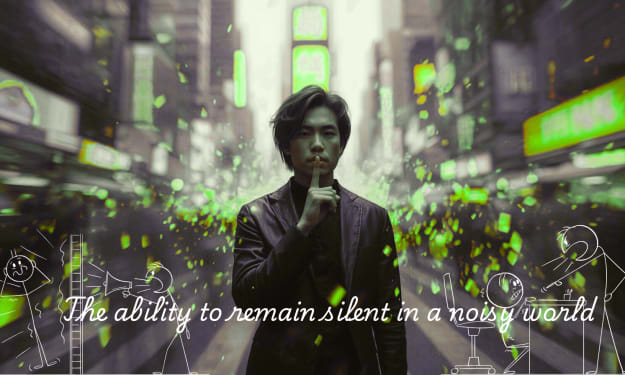
The ability to remain silent in a noisy world
Today's world seems full of noise—people talking, cars moving, screens buzzing, thoughts swirling. Everywhere there's a rush, competition, comparison, and the pressure of expectations. But amidst all this, there's a skill that few people learn: the skill of remaining silent. This skill isn't simple; it comes from within—from understanding, calmness, and patience.
By Sohail Ahmad11 months ago in Psyche
13 Tips For Sound Sleep
Summary The article talks about the importance of sleep and how lifestyle changes may aid in achieving sound sleep. However, aside from making lifestyle adjustments, people who suffer from sleeping disorders should also seek the advice of medical practitioners regarding the use of safe sleep medications.
By KASHIF karim12 months ago in Psyche
The Loud Minority and the Manufactured Narrative
When President Trump appeared at the Washington Commanders versus Detroit Lions game, the media wasted no time turning it into a national spectacle. Headlines shouted that America had booed its own president, declaring it proof that the country was ashamed of its leader. Clips of jeering crowds were shared endlessly, accompanied by commentary claiming that even America’s favorite sport had rejected him.
By Peter Thwing - Host of the FST Podcast12 months ago in Psyche
The Empty Side of the Bed
The Empty Side of the Bed It’s been one hundred and thirty-seven nights since you left, Amir. I know because I’ve written to you every single one. I still can’t stop counting—days, nights, breaths—everything feels like a measurement of the time I’ve spent learning to exist without you. Tonight, I’m writing from your side of the bed. It feels wrong, somehow, to sit here. The pillow still carries that faint trace of your cologne—cedar and soap, the scent that clung to you after your late-night showers. I used to tease you for being obsessed with smelling “fresh,” even before sleep. You’d laugh and say, “A man should go to bed like he’s meeting his dreams in person.” I never realized how many small pieces of you filled this room until you weren’t here to make them ordinary anymore. --- The first week after the funeral, I slept in the living room. Calling it “sleep” might be generous—it was more like waiting for exhaustion to win the argument. The bed upstairs felt like a museum exhibit: perfectly arranged, painfully untouched. Every time I saw the folded blanket on your side, it looked like a cruel joke about order after chaos. Our son, Bilal, asked if he could sleep next to me. I said no. Not because I didn’t want him there, but because I didn’t want him to remember his father’s place as a void to fill. I wanted him to remember you alive—standing at the doorway with that half-smile you reserved for our boy, the one that said “you’re my reason.” --- By the second month, people had stopped visiting. The tea sets were clean again, the condolences turned into silence. Grief, I’ve learned, is a guest who overstays but still makes you feel rude for asking it to leave. So I started writing these letters. Not to “heal,” not to “move on”—those words feel too neat for what this is. I write to keep the language of us alive. I write because if I stop, you’ll fade twice—once in body, once in memory. --- Last night I dreamt you came home. Not dramatically, not like a miracle—just quietly. You kicked off your shoes, sat on the edge of the bed, and said, “You’re sleeping on my side again.” I woke up laughing and crying at the same time. You would’ve found that funny—my messy contradictions. I think the hardest part isn’t the loneliness. It’s the habit of reaching for you and finding only the hollow weight of air. My hand remembers the shape of your shoulder better than my mind remembers the sound of your voice. Sometimes I record myself saying your name, just to hear it in the room again. It feels less like madness than silence does. --- Do you remember how you used to tease me for always sleeping on the left? You’d say, “Even in dreams you need control of the nightstand.” Maybe you were right. That side was safety, routine, predictability. Now I can’t stand it. The left side feels like an echo chamber of what was. The right side—the side you claimed—is where I’ve started sitting every evening, writing to you. At first, it was a rebellion against your absence. But now, it feels like an act of surrender. Sitting here reminds me that grief isn’t about holding on to pain—it’s about learning to live beside it. --- Bilal asked about you again yesterday. He’s only seven, but he asks questions like an old man. He wanted to know where people “go” after they stop breathing. I told him you’re still here, just invisible in the air between us. He seemed satisfied with that. Children accept what adults overcomplicate. He also asked if I still talk to you. I told him yes, every night. “Does Baba answer?” he said. “Sometimes,” I told him. “Not with words, but with memories.” He smiled and said, “Then I’ll write to him too.” Maybe grief runs in the family, but maybe love does too. --- It’s strange how the world keeps spinning like nothing happened. The neighbor’s dog still barks at the mailman. The same stray cat still naps on our porch. The seasons keep changing without permission. I’ve gone back to work. The first day was brutal—everyone trying not to say your name, tiptoeing around the truth like it was glass. I wanted to tell them not to worry; saying your name doesn’t break me. Not saying it does. After work, I sometimes make your favorite lentil soup. I don’t eat it—it’s too much food for one person—but I like the smell. It fills the house with something that feels like “before.” --- Tonight feels different, though. Maybe it’s the rain tapping the windows, or maybe it’s the calm that finally doesn’t feel like denial. I changed the bedsheets today—first time since you passed. White ones, fresh and crisp. It felt like betrayal at first, but then I realized grief had started to smell like old laundry. I’m learning that moving forward doesn’t mean moving away. You’re stitched into the fabric of my days, but not like a wound anymore—more like a scar that’s become part of the skin. I even moved my pillow back to my original side tonight. The left one. The familiar, the ordinary. It doesn’t feel as empty as I feared. Maybe because I’ve accepted that emptiness isn’t the enemy—it’s the space where love used to live, and where memory now sleeps. --- Before I close this letter, I want to tell you something I never could when you were alive: I was always afraid you’d leave first. You’d laugh and call me dramatic, but it wasn’t drama—it was intuition. I think some part of me always knew our story would be shorter than I wanted. But if love is measured in time, we had enough. If it’s measured in depth, we had infinity. --- So, my love, tonight I will sleep on my side again—not because I’ve stopped missing you, but because I’ve learned to share this bed with your absence. The empty side isn’t a reminder of what’s gone anymore. It’s proof of what remains.
By Abdul Muhammad 12 months ago in Psyche
The potentials of yoga in helping you get better sleep
The potentials of yoga in helping you get better sleep Many people believe that yoga is all about experiencing pure ecstasy through the union of the mind, the soul, and the body. But most yoga practitioners and teachers would agree that apart from providing relaxation and peace, yoga is about the seemingly limitless capability of a person to be in control and unite with him or her inner self. With this in mind, more and more people—especially those who are having trouble to get better sleep—is using this activity.
By KASHIF karim12 months ago in Psyche
A Small But Insanely Important Aspect Of Identity That Most People Get Wrong. Top Story - November 2025.
Who Are You? This is perhaps one of the most important, yet completely misunderstood, questions of all time. The goal of the question is to understand our identity...
By H.E. Dr. Cody Dakota Wooten, COIE, DFM, DHM12 months ago in Psyche
Inattentional Blindness
Kristen was an eight-year-old child. He was sitting on a park bench, sad. There was worry, fear and depression on his face. It was evening walk time. The park was full of people. People used to come near him, look at him and quietly move on. A couple also passed by. The couple saw that there were posters about the child in the park. The woman passed near the child. She looked at him carefully. She went ahead and stopped near the poster stuck on the tree. The poster had written in bold letters that this child is missing. Below it, the child's age, height, weight, facial color and name were written and also a photo. The woman read the poster carefully. She came to the child again. She also looked at him carefully and when she was sure that it was the same child, she shrugged her shoulders and moved on. She also did not try to contact the phone number written on the poster. The child sat on the bench for two hours but no one paid attention to him or called the number written on the poster. Did the park even become deserted?
By shahkar jalal12 months ago in Psyche