addiction
The realities of addition; the truth about living under, above and beyond the influence of drugs and alcohol.
How to Choose the Best PHP Program Near You in North Carolina. AI-Generated.
Finding the right level of care is an important step when seeking help for mental health or substance use challenges. While some individuals benefit from traditional outpatient therapy, others may need more structured support without committing to full residential treatment. This is where Partial Hospitalization Programs (PHP) can play an important role in recovery.
By Jordan Blake8 months ago in Psyche
The Quiet People Are Always Observing
The Quiet People Are Always Observing People often misunderstand quiet people. They assume silence means emptiness. They think a person who speaks less must have fewer thoughts, fewer opinions, or less confidence. In loud rooms, the quiet ones are easy to overlook. They sit slightly back from the center of the conversation, listening while others fill the air with stories, arguments, and laughter. But what most people don’t realize is that quiet does not mean unaware. Quiet often means observing. I used to think there was something wrong with me because I wasn’t the loudest person in the room. In school, the confident students were the ones who raised their hands first, spoke quickly, and seemed comfortable sharing every thought that crossed their minds. Teachers praised participation. Friends admired charisma. Meanwhile, I often found myself listening more than speaking. At first, it felt like a weakness. I wondered why my mind worked differently. While others talked freely, I was usually watching the details — the small pauses in conversation, the slight change in someone’s tone, the way a smile didn’t quite reach someone’s eyes. Over time, I began to realize something strange. The quieter I was, the more I noticed. People reveal a lot when they believe no one is paying attention. The friend who laughs loudly at every joke but becomes silent when the conversation shifts to their own life. The coworker who speaks confidently in meetings but nervously taps their fingers when someone questions them. The person who says “I’m fine” while their voice carries a quiet heaviness. These details rarely appear in loud conversations. They appear in the spaces between them. Quiet people tend to live in those spaces. While others focus on what they want to say next, observers focus on what is actually happening. They notice patterns in behavior. They sense tension before anyone mentions it. They understand emotions that people try to hide behind casual words. It’s not a special power. It’s simply what happens when someone spends more time listening than speaking. At some point, I began to understand that silence had given me something valuable. Perspective. When you are not constantly trying to control a conversation, you begin to see it more clearly. You notice who interrupts others. You notice who encourages people to speak. You notice who listens, and who only waits for their turn to talk. You begin to understand people in a different way. Loud personalities often dominate attention, but quiet observation reveals character. Some of the most revealing moments in life are incredibly subtle. A quick glance between two people. A long pause before answering a simple question. A nervous laugh that hides discomfort. These small signals say more than long speeches ever could. Of course, being observant has its challenges too. Sometimes you see things others miss — tensions in relationships, hidden insecurities, or unspoken conflicts. You may notice when someone’s confidence is fragile even though everyone else believes they are strong. And once you see these things, you can’t easily ignore them. Observation creates understanding, but it can also create loneliness. When you understand people deeply, you sometimes realize how rarely people understand each other. But there is also something quietly beautiful about it. Observant people often become the ones others trust most. Because when they finally speak, their words carry weight. They are not speaking simply to fill silence; they are speaking because they have truly considered what they want to say. And people can feel that difference. Quiet people may not lead every conversation, but they often understand the room better than anyone else. They know when someone is uncomfortable. They notice when someone feels excluded. They recognize when someone is pretending to be okay. Because they have been watching. In a world that celebrates constant noise and endless opinions, silence can seem invisible. But silence is not empty. Silence is where awareness grows. Some of the most thoughtful people in the world are not the ones who speak the most — they are the ones who observe carefully, think deeply, and choose their words with intention. The truth is, quiet people are rarely disengaged from what is happening around them. If anything, they are often the most present people in the room. They see the things others miss. They hear the meaning hidden behind casual words. And while the world may overlook them at first, the quiet observers often understand far more than anyone expects. So the next time you notice someone sitting quietly during a conversation, don’t assume they have nothing to say. They may simply be watching the story unfold. And chances are, they understand it better than anyone else.
By Faizan Malik8 months ago in Psyche
How Inpatient Dual Diagnosis Treatment Can Transform Your Life. AI-Generated.
Living with both a mental health disorder and a substance use disorder can feel overwhelming and isolating. When these conditions occur together often referred to as dual diagnosis they can create complex challenges that make recovery more difficult without specialized care. Many individuals find that traditional treatment methods do not fully address both issues at the same time.
By Jordan Blake8 months ago in Psyche
Effective Ways to Break the Cycle of Addiction and Start Healing . AI-Generated.
Addiction can feel like a repeating cycle that is difficult to escape. Many individuals struggling with substance use experience patterns of cravings, temporary relief, and relapse that can make recovery seem overwhelming. However, breaking the cycle of addiction is possible with the right support, treatment strategies, and long-term commitment to healing.
By Jordan Blake8 months ago in Psyche
The Girl at Seat 4B: What I Learned by Ignoring My Phone for a Month
The blue light was my morning prayer. Before my feet hit the floor, before the coffee breathed its first steam, I was scrolling. I fed on a diet of outrage, filtered perfection, and the relentless "ping" of notifications that made me feel important while I was actually becoming invisible.
By imtiazalam8 months ago in Psyche
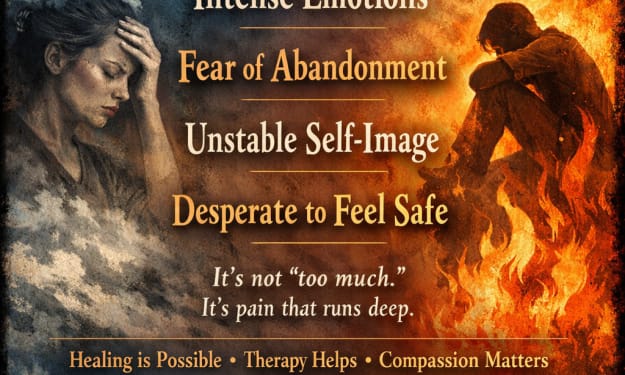
BPD: When the Nervous System Lives at the Edge
A compassionate reflection on Borderline Personality Disorder that explores emotional intensity, unstable self-image, fear of abandonment, and the possibility of healing through understanding, support, and treatment.
By Flower InBloom8 months ago in Psyche
Before You Knock on My Door, Look Inside Yourself
A story about a psychologist who helps his patients reclaim their dignity. This Might Be the Truth You’ve Been Avoiding What if the problem you’ve been blaming on the world… was never really the world? What if the reason relationships fail, confidence collapses, and life feels unfair isn’t always because people betrayed you, ignored you, or misunderstood you? What if the uncomfortable truth is this: Sometimes the door you keep knocking on isn’t locked… you’re just afraid to look inside yourself first. That realization is painful. Because blaming others is easy. Looking inward requires courage. But one psychologist made it his mission to help people do exactly that. Not by fixing their lives for them. But by helping them rediscover something many had forgotten: Their dignity. --- Chapter 1: The Door with a Strange Sign In a quiet street stood a small therapy clinic. Nothing about it looked extraordinary. Except for one thing. On the door of Dr. Adrian Malik’s office was a small sign that confused almost everyone who saw it. It read: “Before you knock on my door, look inside yourself.” Some patients smiled at it. Others frowned. A few even felt offended. “What does that even mean?” they would mutter. But once they stepped inside the office, they slowly began to understand. Because Dr. Malik wasn’t like other therapists. He didn’t simply listen and nod. He challenged people to confront the truths they had been avoiding. --- Chapter 2: The First Patient One afternoon, a young man named Karim walked into the office. His shoulders were tense. His eyes looked tired. The moment he sat down, frustration poured out of him. “My life is full of unfair people,” he said. “My boss disrespects me. My friends take advantage of me. And every relationship I’ve had ends the same way.” Dr. Malik listened quietly. He didn’t interrupt. When Karim finished speaking, he asked a simple question. “Tell me something,” the doctor said gently. “Why do you keep allowing people to treat you this way?” Karim looked confused. “I don’t allow it,” he replied defensively. “It just happens.” Dr. Malik leaned forward slightly. “No,” he said calmly. “It continues because somewhere, you believe you deserve it.” Silence filled the room. It was the first time anyone had suggested that Karim’s lack of boundaries might be part of the problem. --- Chapter 3: The Hidden Enemy of Dignity Many people believe dignity is something others give us. Respect from colleagues. Love from partners. Recognition from society. But Dr. Malik taught something different. Dignity begins with self-respect. If someone does not value themselves internally, they often tolerate treatment they should never accept. They apologize too often. They remain silent when they should speak. They accept behavior that slowly erodes their confidence. Karim realized something painful during that session. He had spent years trying to please everyone around him. But he had never protected his own dignity. --- Chapter 4: Why People Lose Their Sense of Worth Dr. Malik explained that many people lose their sense of dignity gradually. Not through one dramatic moment. But through repeated small experiences. Criticism during childhood. Toxic relationships. Fear of rejection. Constant comparison with others. Over time, these experiences create an invisible belief: “I am not enough.” And once that belief takes root, people begin making decisions that reinforce it. They accept disrespect. They avoid confrontation. They shrink themselves to make others comfortable. But Dr. Malik’s goal was simple: Help people challenge that belief. --- Chapter 5: The Mirror Exercise One day Dr. Malik gave Karim an unusual assignment. “I want you to stand in front of a mirror every morning,” he said. Karim laughed awkwardly. “That sounds strange.” “Maybe,” the doctor replied. “But tell me—when was the last time you truly looked at yourself?” The exercise was simple. Every morning Karim had to ask himself three questions: 1. Did I respect myself yesterday? 2. Did I allow anyone to cross my boundaries? 3. What can I do today to protect my dignity? At first the exercise felt uncomfortable. But after a few weeks, something began to change. Karim started noticing his patterns. And awareness is always the first step toward transformation. --- Chapter 6: The Power of Boundaries One of the most important lessons Dr. Malik taught his patients was about boundaries. Many people fear boundaries because they worry about losing relationships. But the doctor explained something powerful: The relationships that disappear when you set boundaries are the ones that were harming you. Healthy people respect limits. Toxic people resist them. Karim slowly began applying this lesson. He started speaking up at work. He stopped overcommitting to people who drained his energy. For the first time, he felt something unfamiliar. Control. --- Chapter 7: Another Patient’s Story One evening a woman named Laila entered the clinic. Her voice trembled as she spoke. “I feel invisible,” she said. “My partner never listens to me. My family dismisses my opinions. I feel like I don’t matter.” Dr. Malik asked her a question that surprised her. “When was the last time you listened to yourself?” Laila hesitated. “I don’t understand.” The doctor explained: “If you constantly ignore your own needs to satisfy others, people learn that your voice is optional.” It was a difficult realization. But an important one. Respect from others often begins with self-respect. --- Chapter 8: Reclaiming Personal Dignity Dr. Malik’s approach focused on rebuilding dignity through simple but powerful actions. Here are some of the principles he taught. Speak honestly Silence often protects conflict but damages self-respect. Expressing your thoughts respectfully strengthens your identity. Protect your time Time is a reflection of priorities. When you constantly sacrifice your time for others, you unintentionally signal that your needs are less important. Stop seeking approval Approval feels good. But depending on it makes you vulnerable to manipulation. Confidence grows when you make decisions aligned with your values. Accept imperfection Many people lose dignity because they fear mistakes. But mistakes are not proof of failure. They are proof of growth. --- Chapter 9: The Transformation Months passed. Karim returned to the clinic with a different energy. His posture was straighter. His voice calmer. “My life isn’t perfect,” he said. “But something feels different.” “What changed?” Dr. Malik asked. Karim smiled slightly. “I stopped blaming everyone else… and started taking responsibility for how I allow people to treat me.” The doctor nodded. That was the lesson he hoped every patient would discover. Not guilt. Not self-blame. But awareness. --- Chapter 10: The Meaning Behind the Sign One evening, as Karim prepared to leave the clinic for the last time, he looked again at the sign on the door. “Before you knock on my door, look inside yourself.” This time the words felt different. They weren’t a warning. They were an invitation. An invitation to self-reflection. Because real change doesn’t begin with advice from others. It begins with honest conversations with yourself. --- Final Reflection Many people spend years knocking on doors hoping someone else will fix their lives. A partner. A friend. A therapist. But the most important door you will ever open is the one within yourself. Inside it lives something powerful: Your self-respect. Your dignity. Your ability to choose how the world treats you. And once you reconnect with that inner strength, something incredible happens. You stop begging for respect. And you start living in a way that commands it naturally. --- If this story made you pause and reflect, you’re not alone. ❤️ If you found something meaningful here, leaving a like helps this message reach others who might need it. 💬 I’m curious — what do you think is the most important step in reclaiming personal dignity? Share your thoughts in the comments. 🔔 And if you enjoy thoughtful stories that explore psychology, relationships, and personal growth, follow along. Because sometimes a single idea can open a door inside us we didn’t even realize was locked.
By Ahmed aldeabella8 months ago in Psyche