
Why the U.S. Can’t Fully Open the Strait of Hormuz: Inside Iran’s Growing Maritime Dominance
From drone threats to selective ship access, Iran’s strategy is turning a global trade route into a powerful geopolitical weapon.

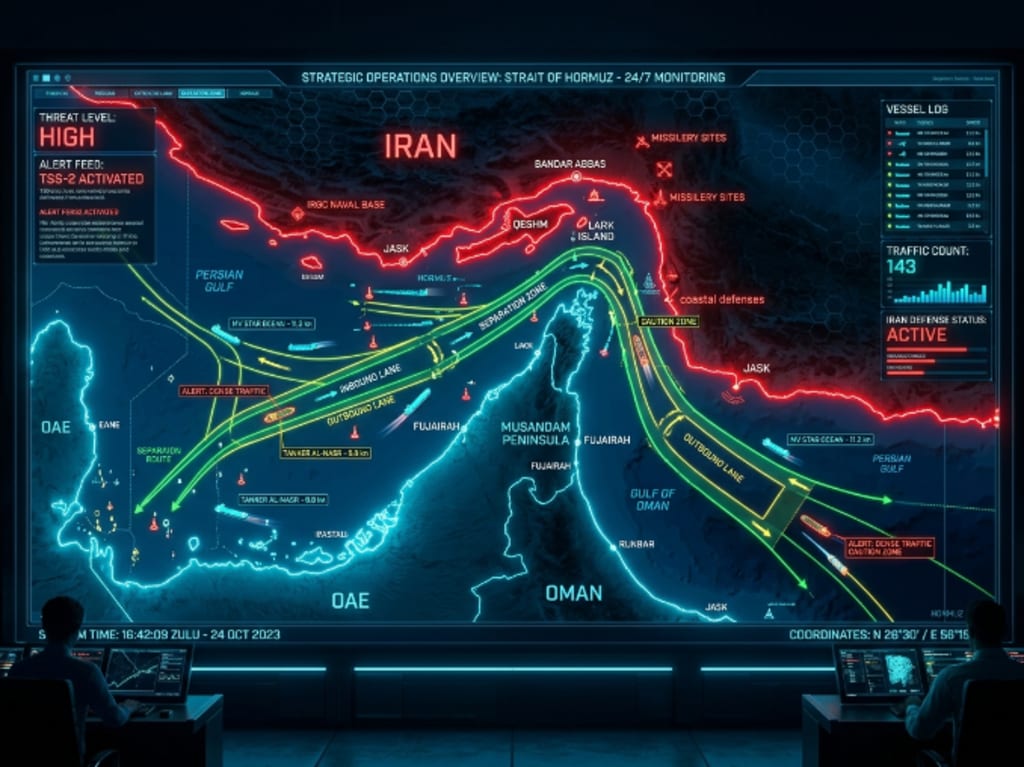
1. The Chokepoint That Controls the World
The Strait of Hormuz is not just a narrow waterway—it is the beating heart of the global energy system. Nearly one-fifth of the world’s oil supply passes through this tight corridor every day, making it one of the most strategically important locations on Earth. When this route is disrupted, the entire world feels the shock—from rising fuel prices to economic instability. Today, that chokepoint has become a battlefield of power, where control matters more than sheer military strength.
2. Iran’s Silent Grip Over the Strait
Iran has not officially declared a full closure of the Strait, yet it has effectively controlled it. Instead of a traditional blockade, Tehran has implemented a system of selective access—allowing some ships to pass while restricting others. This creates a powerful psychological and economic pressure on global shipping. In reality, the Strait is not “closed”—it is controlled, and that difference is exactly what gives Iran leverage over global trade.
3. Geography: Iran’s Greatest Weapon
Unlike distant powers, Iran sits directly along the northern coast of the Strait of Hormuz. This geographic advantage gives it unmatched surveillance and rapid-response capability. From coastal missile systems to naval patrols, Iran can monitor and influence nearly every ship that enters the region. Geography is not just a factor—it is the foundation of Iran’s dominance, allowing it to exert control without needing to overpower the U.S. Navy directly.
4. The Rise of Asymmetric Warfare
Iran does not rely on conventional naval battles to assert control. Instead, it uses asymmetric tactics—drones, fast attack boats, sea mines, and missile threats—to create uncertainty and fear. These low-cost, high-impact strategies force even the most advanced navies to operate cautiously. The U.S. may have superior firepower, but Iran’s unpredictable tactics make any attempt to “force open” the Strait extremely risky.
5. The Cost of Keeping the Strait ‘Open’
Keeping the Strait fully open is not as simple as sending warships. True openness means safe passage, low insurance costs, and no threats to crews or vessels. Today, that reality does not exist. Shipping companies face soaring insurance premiums and constant security risks, making them hesitant to operate freely in the region. Even when ships move, they do so under fear—proving that control is not about closure, but about risk.
6. America’s Strategic Dilemma
The United States faces a difficult choice: escalate or accept limited control. A full military operation to secure the Strait would require massive resources, continuous patrols, and the risk of direct conflict with Iran. Yet doing nothing allows Iran to maintain its grip. This has created a strategic stalemate where neither side can fully dominate, but Iran continues to shape the reality on the ground—or rather, on the water.
7. Turning Trade Into a Weapon
Iran has transformed the Strait into more than just a shipping route—it has turned it into a geopolitical weapon. Reports indicate that Iran has even explored systems where ships must coordinate or pay for safe passage, effectively monetizing control over global trade. This shift marks a new kind of power: not just blocking trade, but controlling who benefits from it.
8. Global Oil Markets Under Pressure
The impact of this situation extends far beyond the Middle East. Oil tankers have been delayed, rerouted, or completely halted, disrupting global supply chains. Dozens of large oil carriers remain stuck or operating under severe restrictions, pushing oil prices higher and increasing economic uncertainty worldwide. What happens in the Strait of Hormuz no longer stays there—it echoes across every economy on Earth.
9. A War of Endurance, Not Strength
This conflict is not being decided by who has the strongest military—it is being decided by who can endure longer. Iran’s strategy is built on patience and pressure, slowly increasing costs for the United States and its allies. Meanwhile, the U.S. must balance military action with political and economic consequences. The result is a prolonged standoff where time itself becomes a weapon.
10. The Future of Global Maritime Power
The situation in the Strait of Hormuz may signal a broader shift in global power dynamics. It shows that control over critical chokepoints can outweigh traditional military superiority. Smaller or regional powers can challenge global superpowers by exploiting geography, strategy, and economic pressure. As this crisis continues, it raises a critical question: Is the era of uncontested global sea control coming to an end?
Final Thought: Control Without Closure
The Strait of Hormuz is not fully closed—but it is no longer truly open either. That gray zone is where Iran has found its strength. By controlling access without triggering full-scale war, it has created a new model of influence—one that challenges even the most powerful nations. And as long as this balance continues, the world’s most important waterway will remain not just a route for oil, but a symbol of shifting global power.
About the Creator
Muhammad Zeeshan
I’m Muhammad Zeeshan, a curious student who loves science, geology, and exploring how the Earth works. I write to share ideas, stories, and knowledge that inspire thinking and discovery.
Enjoyed the story? Support the Creator.
Subscribe for free to receive all their stories in your feed.
Comments
There are no comments for this story
Be the first to respond and start the conversation.