
Where Darkness Meets Grace: A Quiet Reverence for Byron’s “She Walks in Beauty”
A timeless reflection on beauty, purity, and the art of silent admiration.

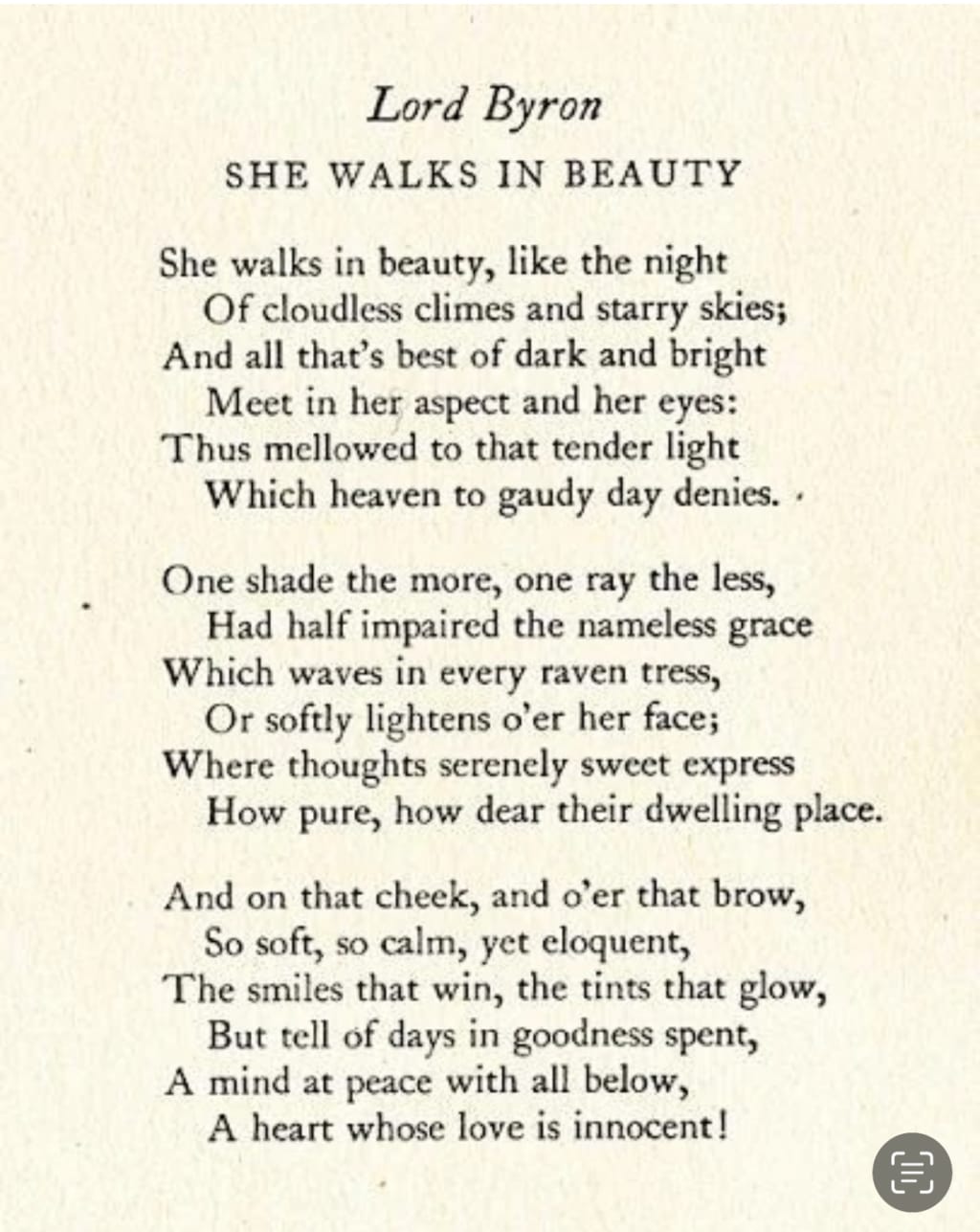
There are verses that ripple like water — and others that stand still, like a moment suspended between heartbeats.
Lord Byron’s “She Walks in Beauty” belongs to the latter.
Written in 1814, the poem was inspired not by a lover or mistress, but by a chance glimpse — Byron saw his cousin by marriage, Lady Wilmot Horton, dressed in black with spangles, the night after her husband’s funeral. What moved him wasn’t lust, but the stark harmony between sorrow and grace — between the darkness of her attire and the light of her beauty.
In just eighteen lines, Byron paints a portrait of a woman not through action, but through stillness.
She walks. That’s all. And yet the air seems to shift around her.
“She walks in beauty, like the night / Of cloudless climes and starry skies…”
— This is no ordinary compliment. Byron likens her not to day, but to night. A clear, starry night: infinite, mysterious, balanced. Not one extreme or the other — but the rare place where opposites meet.
Dark and bright. Shadow and light.
There’s an elegance in the way he brings them together, not as contrasts, but as parts of the same whole. She’s not flawless because she’s perfect — but because nothing in her disturbs the quiet harmony she carries.
By the second stanza, Byron deepens the reverence. He doesn’t describe her face with conventional beauty tropes — he speaks of grace, of a nameless quality that softens every shade and tames every ray. There’s an air of restraint, even awe, in his tone. This isn’t lustful admiration. It’s gentleness.
And in the final stanza, his focus shifts from her appearance to her essence:
“A mind at peace with all below,
A heart whose love is innocent!”
These closing lines are perhaps the most revealing. Her beauty is not simply external — it is born of peace. Of inner harmony. Of a soul untainted by restlessness or pretence. It’s the kind of beauty that doesn’t know it’s beautiful, and that’s why it remains untouched by vanity.
In an age that often reduces beauty to surface, Byron’s poem still reminds us of something truer:
That real beauty is the quiet glow of a life lived with sincerity. That grace doesn’t scream — it whispers.
Sometimes, the poems that say the least — leave the deepest echo.
About the Creator
Elisa Johnson
Reader 📖
Enjoyed the story? Support the Creator.
Subscribe for free to receive all their stories in your feed.
Comments
There are no comments for this story
Be the first to respond and start the conversation.